
Embarking on the journey to medical school is a significant undertaking, and for many, the prestigious doors of McGill University’s Faculty of Medicine beckon. Renowned for its rigorous academic standards, cutting-edge research, and commitment to global health, McGill consistently ranks among the world’s leading medical institutions, as evidenced by its strong performance in global university rankings like the QS World University Rankings. Situated in the vibrant, bilingual metropolis of Montreal, Quebec, Canada, McGill offers a unique educational environment that attracts aspiring physicians from across Canada and around the globe. Navigating the admissions process for such a distinguished program can feel daunting, particularly given its unique structure and the competitive nature of selecting future medical school students. This comprehensive guide is designed to demystify the McGill Medical School admissions process, providing aspiring physicians with the in-depth knowledge and strategic insights needed to build a compelling application and maximize their chances of application success. We will delve into the intricate details of applicant categories, academic prerequisites, the MCAT, crafting a standout application, special considerations for US students, and the rich experience of life as a McGill medical student.
This blog will cover:
- Understanding McGill’s Unique Admission Streams
- Essential Prerequisites for McGill Medical School (MDCM Program)
- The MCAT: Decoding What McGill Expects
- Language Proficiency: English and French Considerations for Success
- Crafting Your Competitive McGill Medical Application
- Special Considerations for US Applicants to McGill Medicine
- Life as a McGill Medical Student
- The Application Timeline and Key Dates
- Conclusion: Your Journey to McGill Medicine Starts Here
What This Guide Will Cover
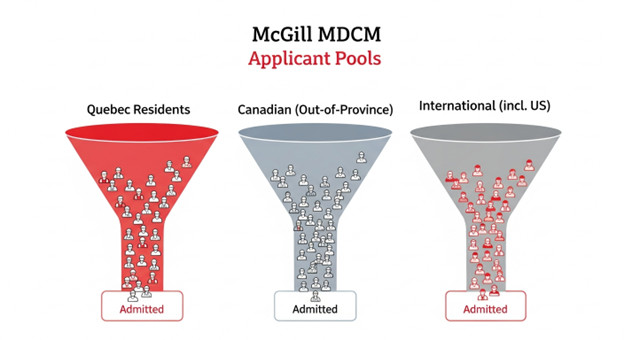
This guide aims to equip you with a thorough understanding of everything you need to know to pursue admission to McGill’s Faculty of Medicine. We will begin by dissecting McGill’s distinct admission streams, clarifying how applicant categories, including Quebec residents, Canadian out-of-province candidates, and international students (with a specific focus on US students), are managed through its unique quota system. Understanding these distinctions is paramount, as competition varies significantly between these pools. We will then meticulously detail the essential prerequisites for the MDCM (Doctor of Medicine, Master of Surgery) program, covering crucial academic requirements such as specific prerequisite courses and the pivotal MCAT exam, alongside language proficiency considerations. The heart of your application lies in presenting a compelling case; therefore, we will explore strategies for crafting a competitive application, emphasizing academic excellence beyond GPA, the importance of well-rounded extracurricular activities, writing impactful personal statements and autobiographical sketches, and selecting effective letters of recommendation. The unique interview process, a critical gatekeeper, will also be thoroughly examined. For applicants hailing from the United States, we will dedicate a section to special considerations, including eligibility for US citizens and green card holders, and the landscape of financial aid and funding, contrasting the McGill experience with that of US medical schools. We will offer a glimpse into life as a McGill medical student, detailing the innovative MDCM curriculum, research and global health opportunities, and the vibrant student life in Montreal, as well as strategies for well-being. Finally, we will provide a clear roadmap of the application timeline and key dates, what to expect after submission, and advice for those considering reapplying. By the end of this guide, you will possess a clear, actionable strategy for navigating your path to becoming a McGill physician.
Understanding McGill’s Unique Admission Streams
McGill University’s Faculty of Medicine operates with a carefully structured admissions system designed to balance provincial, national, and international representation. Understanding these streams and the competition within each is fundamental to developing a realistic and effective application strategy. The university meticulously allocates spots based on clearly defined applicant categories, each with its own set of criteria and competitive landscape.
Applicant Categories: Quebec, Canadian Out-of-Province, and International Applicants (Including US students)
McGill Medical School categorizes applicants into three primary groups, each subject to different admission quotas and selection processes:
- Quebec Residents: These applicants represent the largest proportion of the incoming class. Eligibility is typically based on having resided in Quebec for a specified period and being a permanent resident or citizen of Canada studying in Quebec. This stream often benefits from a dedicated quota, reflecting McGill’s role as a leading medical institution within the province.
- Canadian Out-of-Province Applicants: This category includes Canadian citizens and permanent residents who are residents of provinces other than Quebec. Competition within this stream is generally high, as the number of available seats is limited, and candidates are drawn from across the entire country.
- International Applicants: This broad category encompasses all applicants who are not Canadian citizens or permanent residents. This includes candidates from the United States, Europe, Asia, and all other countries. Within this group, US students form a significant segment. International applicants must meet all academic and personal requirements, and they face a highly competitive selection process due to a limited number of seats designated for them.
The Quota System: How Competition Differs for Each Stream
The quota system is a cornerstone of McGill’s admissions policy, directly influencing the competitive intensity for each applicant category. This system allocates a specific number or percentage of seats to residents of Quebec, out-of-province Canadians, and international students.
For Quebec residents, the dedicated quota generally translates into a more accessible pathway compared to other streams, provided they meet the academic and qualitative standards. This reflects an agreement between McGill and the Quebec government to ensure a supply of physicians for the province.
Canadian out-of-province applicants contend with a smaller set of available seats. The competition here is robust, as candidates from across Canada vie for these limited spots. Their applications are evaluated on merit, with a strong emphasis on academic achievement and extracurricular depth, similar to Quebec applicants but within a more constrained allocation.
International applicants, including US students, face the most intense competition due to the smallest quota. While McGill seeks to maintain a diverse student body, the number of international spots is very limited. This means that successful international applicants often need to demonstrate an exceptional profile that clearly distinguishes them from an already highly qualified applicant pool. For US students specifically, while there are no explicit US citizenship quotas, they fall under the general international category, meaning they compete for these same limited seats.
Key Differences from U.S. Medical School Admissions
Aspiring physicians from the United States applying to McGill will encounter several key differences compared to the admissions process at US medical schools. Understanding these distinctions is crucial for a successful application.
Firstly, the application service differs. In the US, the primary application portal is the American Medical College Application Service (AMCAS). McGill, along with most Canadian medical schools, uses the Ontario Medical School Application Service (OMSAS) for out-of-province and international applicants, or a direct McGill application portal for Quebec residents. These services have different formatting, requirements, and submission timelines, necessitating careful attention to detail.
Secondly, while both systems value academic excellence, the emphasis and specific requirements can vary. GPA expectations are high across the board, but the specific prerequisite courses may differ. The MCAT is a common requirement for both US and Canadian schools, but the score ranges considered competitive can vary, and some Canadian schools, including McGill, may place different weights on specific sections of the exam.
Thirdly, the role and format of interviews can differ. While US medical schools often conduct traditional interviews, McGill utilizes the Multiple Mini Interview (MMI) format for most applicants. The MMI assesses candidates through a series of short, independent stations, each presenting a different scenario (ethical, personal, or academic) that the applicant must respond to. This format tests critical thinking, communication skills, and ethical reasoning under pressure in a way that differs from a single, longer interview.
Finally, financial considerations are distinct. US students attending McGill, while eligible for federal Stafford loans, will pay international tuition fees. This is a significant difference from attending a US public or private institution, where tuition structures are different. Scholarship and bursary opportunities, while available at McGill, may also have different eligibility criteria for international students compared to domestic ones.
Essential Prerequisites for McGill Medical School (MDCM Program)
McGill University’s MDCM program seeks to enroll students who possess a strong academic foundation, a keen intellect, and the potential for a career in medicine. Meeting the prerequisite requirements is the first, non-negotiable step in this rigorous selection process. These requirements are designed to ensure that applicants have the foundational knowledge and analytical skills necessary to succeed in a demanding medical curriculum.
Academic Requirements: Core Prerequisite Courses
McGill mandates a specific set of undergraduate courses that applicants must have successfully completed prior to enrollment. While a strong GPA is paramount, demonstrating proficiency in these core subjects is essential. The typical prerequisites include:
- Biological Sciences: At least one full academic year (equivalent to two semesters or three quarters) of introductory biology, including content such as cell biology, genetics, and physiology. Advanced courses in areas like molecular biology or biochemistry are highly recommended.
- Chemistry: At least one full academic year of general chemistry and one full academic year of organic chemistry. Biochemistry is also a critical component, often integrated into organic chemistry or offered as a separate course.
- Physics: At least one full academic year of introductory physics, covering fundamental principles.
- English/Humanities/Social Sciences: At least one full academic year of courses in English (literature or composition) or other humanities or social science disciplines. This requirement underscores the importance of strong communication skills and a broad understanding of human behavior and societal contexts, vital for patient care.
It is crucial for applicants to verify the most current prerequisite course list on the official McGill Faculty of Medicine admissions website, as these requirements can be updated. While these are the minimums, many successful applicants have completed more extensive coursework, particularly in STEM fields, which often provides a robust academic grounding. Many successful medical school students enter with degrees in disciplines such as biology, biochemistry, biomedical sciences, or psychology, though students from diverse undergraduate programs with the requisite prerequisites are also welcome.
The MCAT: Decoding What McGill Expects
The Medical College Admission Test (MCAT) is a standardized, multiple-choice examination required by McGill for all applicants. It assesses a candidate’s knowledge of scientific concepts and principles prerequisite to the study of medicine, as well as their ability to apply these concepts in problem-solving and critical thinking.
McGill, like most medical schools, places significant emphasis on MCAT scores. While there isn’t a strict cutoff score, applicants are expected to achieve scores that are competitive within the context of the overall applicant pool. This generally means scores well above the national average for all test-takers. The exam comprises four sections: Chemical and Physical Foundations of Biological Systems; Critical Analysis and Reasoning Skills (CARS); Biological and Biochemical Foundations of Living Systems; and Psychological, Social, and Sociological Foundations of Behavior. McGill evaluates performance across all sections, with the CARS section often being a particular point of focus, given its assessment of reading comprehension and critical analysis skills.
Applicants are typically advised to take the MCAT in the spring or summer preceding the application year to ensure scores are available by the application deadline. Preparation for the MCAT is a significant undertaking; dedicated study plans, practice tests, and potentially review courses are often employed to achieve the best possible outcome. A strong MCAT score, when coupled with a high GPA, forms the bedrock of a competitive academic profile.
Language Proficiency: English and French Considerations for Success
As an institution of higher learning in Montreal, Quebec, Canada, McGill operates primarily in English. Therefore, strong English language proficiency is a mandatory requirement for all applicants. This is assessed through academic transcripts (demonstrating coursework completed in English) and, for some international applicants whose native language is not English, through standardized tests like TOEFL or IELTS.
While French is not a mandatory prerequisite for admission to the MDCM program, proficiency in French can be a significant asset, particularly for medical school students aiming to practice in Quebec. Montreal is a vibrant, bilingual city, and many patients within the Quebec healthcare system communicate primarily in French. While applicants are not penalized for not speaking French, demonstrating an awareness of or commitment to developing French language skills can be viewed positively. Some applicants may choose to highlight any French language coursework or experience in their application materials. This demonstrates an understanding of the linguistic landscape of Quebec and a proactive approach to serving a diverse patient population.
Crafting Your Competitive McGill Medical Application
Beyond meeting the baseline academic prerequisites, crafting a truly competitive application for McGill Medical School requires a holistic approach that showcases your unique strengths, experiences, and potential. McGill, like many top-tier medical institutions, employs a holistic review process, meaning they evaluate applicants across a wide spectrum of criteria, not solely based on GPA and MCAT scores. This approach aims to identify individuals who not only possess intellectual aptitude but also demonstrate the maturity, resilience, empathy, and drive necessary for a successful career in medicine.
Academic Excellence and GPA: Going Beyond the Numbers
While a strong Grade Point Average (GPA) is undoubtedly a critical component of your application, McGill looks for more than just a high numerical value. They seek evidence of intellectual curiosity, sustained academic rigor, and the ability to excel in challenging STEM coursework. This means that a high GPA achieved in demanding science courses is often viewed more favorably than a slightly higher GPA obtained in less rigorous programs.
If your GPA has dips or inconsistencies, it is important to be prepared to address them thoughtfully in your application. This might involve explaining extenuating circumstances, such as a challenging period of adjustment to university life, significant personal challenges, or a particularly demanding course load. However, the focus should always remain on demonstrating upward academic trajectory and a sustained commitment to academic achievement. Furthermore, engaging in research, particularly in STEM fields, can significantly enhance your application. Participation in research projects, whether through dedicated summer programs like a Summer Academy, or as part of your undergraduate studies, demonstrates a scientific aptitude and a commitment to advancing medical knowledge – qualities that align with the legacy of McGill, an institution that has fostered numerous Nobel Prize laureates and Rhodes Scholars. Building a robust academic profile is akin to designing a secure and efficient system; much like developers write clean and functional JavaScript code to create dynamic web applications, applicants must ensure their academic record is a testament to their intellectual capabilities and diligent work ethic.
Extracurricular Activities and Experience: Building a Holistic Profile
Your extracurricular activities and experiences are your opportunity to demonstrate the breadth of your interests, your commitment to service, and the development of essential soft skills. McGill values depth of experience and genuine commitment over a superficial list of accomplishments. They seek individuals who have actively engaged with their communities and pursued passions outside of academics.
Key areas to focus on include:
- Clinical Experience: Direct exposure to healthcare settings is crucial. This can include shadowing physicians, volunteering in hospitals or clinics, working as an EMT or nursing assistant, or participating in patient care roles. The goal is to gain an understanding of the realities of patient care and the medical profession.
- Research Experience: As mentioned earlier, research involvement, particularly in scientific or medical fields, is highly valued. This demonstrates analytical skills, scientific inquiry, and a potential for contribution to medical advancement.
- Volunteer and Community Service: Demonstrating a commitment to serving others, especially vulnerable populations, is a core tenet of medical ethics. Long-term, meaningful volunteer work showcases empathy, compassion, and a dedication to improving the lives of others.
- Leadership Roles: Holding leadership positions in clubs, organizations, or projects highlights your ability to motivate others, manage responsibilities, and work collaboratively.
- Work Experience: Paid employment can also be valuable, particularly if it involves responsibility, client interaction, or problem-solving skills.
When describing these experiences, focus on your specific contributions, the impact you made, and what you learned. Reflect on how each experience has shaped your understanding of medicine and your desire to pursue this career. A well-rounded profile demonstrates that you are a capable individual with diverse interests and a strong sense of purpose.
The Personal Statement and Autobiographical Sketch: Telling Your Story
The personal statement (or equivalent essay, often called an Autobiographical Sketch at McGill) is your chance to speak directly to the admissions committee and present yourself as more than just a collection of grades and scores. This is where you weave together your experiences, motivations, and aspirations into a compelling narrative.
Your essay should be authentic, reflective, and tailored to McGill. Clearly articulate why you want to study medicine and, more specifically, why McGill is the right place for you. Connect your experiences and values to McGill’s mission and its commitment to excellence in education, research, and patient care.
Key elements of a strong personal statement include:
- Authenticity: Speak in your own voice and share genuine experiences and reflections.
- Narrative Flow: Structure your essay logically, creating a story that draws the reader in.
- Show, Don’t Tell: Instead of stating you are compassionate, describe an experience that demonstrates your compassion.
- Reflection: Go beyond simply listing accomplishments; reflect on what you learned, how you grew, and how these experiences have prepared you for medical school.
- McGill Connection: Research McGill’s specific programs, research areas, or community initiatives that resonate with you and explain how you see yourself contributing to the McGill community.
Crafting this essay requires significant introspection and revision. It is the narrative that binds together the individual components of your application, providing context and personality.
Letters of Recommendation: Choosing Your Advocates
Letters of recommendation (LORs) provide the admissions committee with external perspectives on your character, academic abilities, and potential as a future physician. Choosing the right recommenders and providing them with adequate information is crucial for securing strong, supportive letters.
Ideally, you should select recommenders who know you well in an academic or professional capacity and can speak to specific examples of your skills, work ethic, and personal qualities. This typically includes:
- Professors: Particularly those who taught you in science courses or supervised you in research. They can attest to your academic performance, critical thinking abilities, and scientific aptitude.
- Supervisors: From clinical settings, volunteer organizations, or research labs. They can speak to your work ethic, professionalism, interpersonal skills, and ability to handle responsibility.
When requesting a letter, provide your recommender with:
- A clear deadline for submission.
- A copy of your CV or resume.
- A draft of your personal statement or autobiographical sketch.
- A brief summary of your experiences and why you are applying to McGill.
- Any specific qualities or experiences you would like them to highlight.
Most Canadian medical schools use the OMSAS LOR system, where recommenders upload their letters directly. Ensure your recommenders understand the submission process and are comfortable writing a comprehensive and positive letter on your behalf. Strong, detailed letters that provide specific anecdotes are far more impactful than generic ones.
The Interview Process: Preparing for Success
For successful applicants, the interview stage is the final hurdle before an offer of admission. McGill utilizes the Multiple Mini Interview (MMI) format. This dynamic process consists of a circuit of approximately 8-10 independent stations, each lasting about 8-10 minutes, followed by a brief break. At each station, you will encounter a unique scenario or question designed to assess different competencies.
Common themes and competencies assessed include:
- Ethical Dilemmas: Scenarios involving difficult ethical choices in medical or personal contexts.
- Communication Skills: Situations requiring you to explain complex ideas, engage in active listening, or de-escalate conflict.
- Problem-Solving and Critical Thinking: Analyzing information and proposing solutions to presented problems.
- Teamwork and Collaboration: Scenarios highlighting your ability to work effectively with others.
- Self-Awareness: Questions prompting reflection on your strengths, weaknesses, and motivations.
- Understanding of the Medical Profession: Demonstrating knowledge of the challenges and rewards of being a physician.
Preparation is key. Practice articulating your thoughts clearly and concisely under pressure. Engage in mock interviews, focusing on developing thoughtful responses that demonstrate your reasoning process and ethical framework. Reflect on your experiences and be ready to draw upon them to illustrate your skills. Practicing with peers or mentors can help you gain confidence and refine your approach to each station. The MMI is designed to simulate real-world scenarios, so approaching each station with authenticity and a genuine desire to engage with the prompt is essential.
Special Considerations for US Applicants to McGill Medicine
For US students aspiring to join the ranks of McGill’s medical school students, understanding the specific pathways, requirements, and financial implications is paramount. While McGill is an international institution, its admissions process for US applicants, though sharing similarities with other international candidates, has distinct aspects to consider.
Eligibility and Application Process for US Citizens and Green Card Holders
US citizens and individuals holding a US green card are eligible to apply to McGill’s MDCM program, falling under the international applicant category. This means they will compete for a limited number of seats allocated to non-Canadian citizens and permanent residents. The application process generally follows the same steps as other international applicants, but it’s crucial to be aware of specific documentation and requirements.
Applicants must have completed or be on track to complete the necessary prerequisite courses at an accredited university. A strong academic record, evidenced by a high GPA and competitive MCAT scores, is essential. As previously mentioned, US applicants will typically use the OMSAS application service or McGill’s direct application portal, depending on the specific admissions cycle and applicant stream. Detailed information regarding the submission of transcripts, standardized test scores, personal essays, and letters of recommendation will be available on the McGill Faculty of Medicine’s admissions website.
While US citizens do not require a study permit to study in Canada for short durations, for programs exceeding six months, they will need to apply for a study permit. This process is generally straightforward for US citizens. However, it is vital to consult official government sources for the most up-to-date information on immigration requirements. The university’s international student services office can also provide guidance. Understanding these logistical aspects early on is part of building a secure foundation for your application, much like adhering to stringent network security rules is vital for protecting sensitive data.
Financial Aid and Funding for International Students
One of the most significant considerations for US students applying to McGill is the financial aspect. As international students, they are subject to higher tuition fees than Quebec residents or Canadian out-of-province students. While McGill offers some scholarships and bursaries for international students, these are highly competitive and often do not cover the full cost of attendance.
A primary source of funding for US students attending medical school abroad is federal student loans. US citizens are eligible for federal Stafford loans, which can be used to cover tuition, living expenses, and other educational costs. McGill is an eligible institution for these federal loans. However, it is imperative for applicants to thoroughly research the loan amounts, interest rates, repayment terms, and the process for securing these funds well in advance.
Beyond Stafford loans, students should explore any available McGill-specific scholarships or bursaries for international students. These may be merit-based or need-based and are typically awarded based on the strength of the application. International students might also consider external scholarships from their home country or private organizations. A comprehensive financial plan is crucial, as the cost of medical education at an international institution can be substantial. Understanding the funding landscape and planning accordingly is a critical step in ensuring a smooth transition and academic journey.
Comparing the McGill Experience to U.S. Medical Schools
The McGill medical education experience offers a unique blend of academic rigor, research opportunities, and cultural immersion, which may differ from what US medical schools typically provide.
The MDCM curriculum at McGill is known for its innovative structure, often incorporating early clinical exposure and problem-based learning, encouraging students to actively engage with medical concepts. While US medical schools also employ various pedagogical approaches, McGill’s specific curriculum design might appeal to students seeking a particular learning style. The faculty comprises world-renowned researchers and clinicians, many of whom have made significant contributions to medicine. This environment is conducive to fostering future leaders, researchers, and practitioners, reflecting the calibre of institutions that nurture Rhodes Scholars and Nobel Prize laureates.
Furthermore, studying in Montreal offers an unparalleled cultural experience. The city’s vibrant arts scene, diverse culinary landscape, and bilingual environment provide a rich backdrop to academic pursuits. This contrasts with the experience of studying in many US cities and offers a unique opportunity for personal growth and exposure to different cultures. While both McGill and top US medical schools provide excellent training, the specific environment, curriculum structure, and the international perspective gained at McGill offer a distinct pathway to becoming a physician.
Life as a McGill Medical Student
The journey through medical school is demanding, but at McGill, it is also an enriching and transformative experience. Beyond the rigorous academics, students are immersed in a vibrant community, offered unparalleled research opportunities, and situated in one of Canada’s most dynamic cities. Life as a McGill medical student is characterized by intellectual stimulation, personal growth, and the development of a deep commitment to patient care and medical advancement.
The MDCM Curriculum: A Glimpse into Your Medical Education
McGill’s MDCM program is renowned for its innovative and comprehensive curriculum, designed to equip students with the foundational knowledge, clinical skills, and critical thinking abilities necessary for a successful career in medicine. The curriculum typically emphasizes a strong integration of basic sciences with clinical medicine, often starting with early patient contact. Students engage in lectures, laboratory sessions, small group discussions, and problem-based learning activities.
The program’s structure often encourages a balance between core scientific learning and the development of professional competencies. Students are encouraged to explore their interests through electives and research opportunities. The curriculum is continuously reviewed and updated to reflect the latest advancements in medical science and healthcare delivery. The faculty comprises leading experts in their fields, offering students direct access to cutting-edge knowledge and mentorship. The focus on developing resilient, adaptable, and compassionate physicians is a hallmark of the McGill MDCM program.
Research and Global Health Opportunities
McGill’s Faculty of Medicine is a powerhouse of research and innovation. Students have abundant opportunities to engage in research across a wide spectrum of disciplines, from fundamental biomedical sciences to clinical trials and public health initiatives. This engagement can range from participating in summer research programs to undertaking research projects as part of their academic program. Such involvement provides invaluable experience in scientific inquiry, data analysis, and scholarly communication, preparing students for careers that may involve significant contributions to medical knowledge. The university’s legacy, marked by associations with Nobel Prize laureates and Rhodes Scholars, underscores the caliber of research and academic excellence fostered within its walls.
Furthermore, McGill has a strong commitment to global health. Students have the opportunity to participate in international health electives and projects, gaining exposure to healthcare challenges and practices in diverse global settings. These experiences not only broaden a student’s understanding of health disparities but also foster cultural competence and a commitment to addressing health inequities worldwide. Such global engagement is an integral part of the McGill experience, shaping well-rounded physicians with a broad perspective on health.
Student Life in Montreal: Beyond Academics
Life as a McGill medical student extends far beyond the lecture halls and laboratories. Montreal offers a rich and vibrant urban environment that provides students with ample opportunities for personal growth, cultural exploration, and recreation. The city is known for its lively arts scene, diverse culinary offerings, historic Old Montreal, and numerous festivals. Students can enjoy the city’s many parks, explore its distinct neighborhoods, and experience its unique bilingual culture.
The university itself fosters a strong sense of community among its medical students. Various student-run organizations, clubs, and social events provide avenues for connection, networking, and pursuing interests outside of academics. Balancing academic demands with social engagement and personal well-being is a key aspect of thriving as a medical student, and Montreal provides an ideal setting for this. The cost of living in Montreal, while varying, is generally considered more affordable than many major North American cities, making it an attractive place to live and study.
Supporting Your Well-being: Navigating the Demands of Medical School
The rigorous demands of medical school can take a toll on students’ mental and physical well-being. McGill recognizes this and offers a range of support services to help students navigate the challenges of their academic journey. These services often include academic advising, mental health counseling, wellness programs, and peer support networks.
Students are encouraged to proactively seek out these resources and develop healthy coping mechanisms. This includes prioritizing sleep, maintaining a balanced diet, engaging in regular physical activity, and cultivating social support systems. Mindfulness practices, stress management techniques, and time management skills are invaluable tools for success. The strong sense of community among medical students also provides a crucial support network, where peers can share experiences and offer encouragement. By actively managing their well-being, medical school students can not only succeed academically but also foster resilience and a sustainable approach to their demanding careers.
The Application Timeline and Key Dates
Navigating the application process for McGill Medical School requires meticulous planning and adherence to specific deadlines. Understanding the timeline is crucial for ensuring that all components of your application are submitted correctly and on time. The application cycle typically opens in the late summer or early fall and continues through the following spring, with offers of admission generally extended in the spring.
Important Deadlines for Each Applicant Stream
The deadlines for McGill’s MDCM program vary depending on your applicant stream: Quebec residents, Canadian out-of-province, and international applicants.
- Quebec Residents: Typically apply directly through McGill, with deadlines usually in the fall or early winter.
- Canadian Out-of-Province and International Applicants: These applicants generally use the OMSAS application service. The OMSAS application usually opens in the late summer/early fall, with a primary deadline in the fall. Supporting documents, such as letters of recommendation, often have slightly later deadlines.
It is imperative to consult the official McGill Faculty of Medicine Admissions website for the most accurate and up-to-date deadlines for the specific application year you are applying. Missing a deadline for any part of the application can result in your application not being considered.
What to Expect After Submitting Your Application
Once you have submitted your application and all supporting documents by the respective deadlines, the admissions committee begins its comprehensive review. This process is multi-staged:
- Initial Screening: Applications are reviewed to ensure all minimum requirements have been met.
- Academic Review: Your GPA and MCAT scores are carefully evaluated.
- Holistic Review: A more in-depth assessment of your extracurricular activities, personal statement, autobiographical sketch, and letters of recommendation takes place. This stage often involves faculty members and sometimes current medical students.
- Interview Invitations: Based on the holistic review, a select group of applicants will be invited for an interview. For McGill, this is typically the Multiple Mini Interview (MMI).
- Interview Assessment: Following the interview, candidates are further evaluated based on their performance.
- Final Decisions: Offers of admission are extended to successful candidates, usually in the spring. A waitlist may also be established.
The entire process can take several months, from application submission to the final decision. Patience and preparedness are key.
Advice for Reapplicants
If your initial application to McGill was unsuccessful, do not be discouraged. Many successful applicants have reapplied after a period of strengthening their profile. McGill often provides feedback to reapplicants upon request, which can be invaluable.
To improve your application for a subsequent cycle:
- Identify Weaknesses: Honestly assess which aspects of your previous application may have been less competitive. Was it academic performance, MCAT scores, extracurricular depth, or interview performance?
- Gain More Experience: Seek out experiences that address your identified weaknesses. This might mean pursuing further clinical exposure, engaging in research, or taking on more leadership roles.
- Retake the MCAT: If your MCAT score was below your expectations or below the competitive range for your applicant stream, consider retaking the exam after dedicated preparation.
- Refine Your Narrative: Use your personal statement and autobiographical sketch to clearly articulate your growth and renewed commitment to medicine and McGill.
- Seek Feedback: If possible, request feedback from the admissions committee or mentors.
Reapplying demonstrates resilience and a continued dedication to your goal. A thoughtfully revised and strengthened application can significantly improve your chances of success in future cycles.
Conclusion: Your Journey to McGill Medicine Starts Here
Pursuing admission to McGill University’s Faculty of Medicine is an ambitious yet achievable goal for dedicated and well-prepared individuals. This guide has illuminated the multifaceted aspects of the admissions process, from understanding the unique applicant streams and quota systems to mastering the academic prerequisites and crafting a compelling, holistic application. We have explored the nuances of the MCAT, the importance of diverse extracurricular experiences, the art of storytelling through essays, and the strategic selection of recommenders. For US students, we’ve addressed specific considerations regarding eligibility, financial aid, and the comparative experience to American medical schools. Life as a McGill medical student, characterized by an innovative curriculum, extensive research and global health opportunities, and the vibrant backdrop of Montreal, offers a truly unique and rewarding path.
The journey to becoming a McGill physician is one that demands intellectual rigor, unwavering commitment, and a deep-seated passion for serving others. By meticulously preparing your academic foundation, thoughtfully curating your experiences, and articulating your aspirations with clarity and authenticity, you can position yourself as a strong candidate. Remember that McGill seeks not only academic prowess but also individuals who embody compassion, resilience, and a commitment to lifelong learning. Embrace the challenge, leverage the resources available to you, and present the most authentic and compelling version of yourself. Your comprehensive understanding of this process, coupled with strategic execution, is the foundation for achieving application success. The path to McGill Medicine is rigorous, but with diligent effort and a clear vision, your journey can indeed begin here.
Frequently Asked Questions About McGill Medical School
1. What GPA do you need to get into McGill University Faculty of Medicine and Health Sciences?
McGill does not publish a minimum GPA cutoff, but competitive applicants typically hold a cumulative GPA of 3.80 or higher on a 4.0 scale. The average GPA among applicants invited to interview is approximately 3.89 for Quebec residents and 3.95 for non-Quebec Canadian residents and international applicants. McGill uses a weighted GPA calculation that may discount lower-performing years, so an upward academic trend can strengthen your file. A GPA below 3.75 makes admission highly unlikely.
2. What MCAT score do you need for McGill University Faculty of Medicine and Health Sciences?
McGill University Faculty of Medicine and Health Sciences does not require the MCAT for its MDCM program. This sets McGill apart from virtually all US medical schools and most Canadian programs. Applicants are evaluated on GPA, CASPer scores, personal experiences, and the interview. If you are applying from the United States, note that your MCAT score will not factor into the McGill admissions decision.
3. What is the acceptance rate at McGill University Faculty of Medicine and Health Sciences?
McGill Faculty of Medicine and Health Sciences has an overall acceptance rate of approximately 6–7%, making it one of the most selective medical programs in Canada. The competition is especially intense for non-Quebec applicants, who compete for a limited number of reserved seats. Quebec residents benefit from a preferential admissions process given the provincial funding model for medical education. Only a small fraction of the thousands of annual applicants ultimately receive an offer of admission.
4. How many people apply to McGill University Faculty of Medicine and Health Sciences each year?
McGill receives thousands of applications each cycle across its Quebec resident, non-Quebec Canadian, and international streams. The program admits approximately 175–185 students per entering class into the MDCM degree program. Competition is especially fierce because McGill is one of only a handful of top-ranked Canadian medical schools open to a limited number of non-Quebec and international applicants. Applicant numbers fluctuate each cycle but consistently far exceed available seats.
5. Does McGill University Faculty of Medicine and Health Sciences accept out-of-province or international applicants?
Yes, McGill accepts applications from non-Quebec Canadian residents, US citizens, and international applicants, but seats are strictly limited for non-Quebec students. Quebec residents receive priority because the Quebec government subsidizes their medical education. Non-Quebec Canadians and international students face higher tuition rates and a more competitive admissions pool. US and international applicants must apply as international students and should review McGill’s specific eligibility criteria for their stream.
6. What is the interview format at McGill University Faculty of Medicine and Health Sciences?
McGill uses the Multiple Mini Interview (MMI) format, which consists of a series of short, timed stations rather than a single panel interview. Stations are task-oriented, scenario-based, or discussion-based, assessing communication, ethical reasoning, and interpersonal skills. Interviews last approximately half a day and, once scheduled, cannot be rescheduled. Invitations are competitive and extended only to applicants who meet the pre-interview academic and CASPer thresholds.
7. What are the secondary essay prompts at McGill University Faculty of Medicine and Health Sciences?
McGill does not use a traditional secondary essay application in the way US MD programs (via AMCAS) do. Instead, applicants submit a curriculum vitae (CV), autobiographical letter, and supporting documentation through McGill’s own online admissions portal — not through OMSAS or AMCAS. The autobiographical letter is a key narrative component where applicants describe their background, motivations, experiences, and suitability for medicine. There is no secondary application fee separate from the standard university application fee.
8. How much does McGill University Faculty of Medicine and Health Sciences cost?
Tuition at McGill differs substantially by residency status. Quebec residents pay heavily subsidized tuition of roughly CAD $4,000–$6,000 per year, while non-Quebec Canadian students pay significantly more, and international/US students pay the full international rate, which can exceed CAD $25,000–$30,000 per year. A student financing all four years through loans — including tuition, fees, and cost of living in Montreal — can expect to graduate with total debt of approximately CAD $238,000. Tuition has increased by approximately 2–3% annually in recent cycles.
9. Is CASPer required to apply to McGill University Faculty of Medicine and Health Sciences?
Yes, CASPer (Computer-Based Assessment for Sampling Personal characteristics) is required for admission to McGill’s MDCM program. CASPer accounts for 20% of the pre-interview selection formula, making it a significant component of your application. The test consists of 11 scenarios spread across two sections — 4 video-response scenarios and 7 typed-response scenarios — each requiring answers to 2 questions. Applicants must register, verify their identity, and reserve a test date aligned with McGill’s application cycle deadlines.
10. What degree does McGill award and what makes its medical program historically distinctive?
McGill awards the MDCM (Medicinae Doctorem et Chirurgiae Magistrum — Doctor of Medicine and Master of Surgery), not the MD degree granted by US schools or most other Canadian programs. Founded in 1829, McGill’s Faculty of Medicine and Health Sciences was the first faculty established at the university and the first medical school in Canada, giving it nearly 200 years of history and institutional prestige. The program is housed within a research-intensive university consistently ranked among the top medical schools in the world. Clinical training is supported by a network of world-class Montreal teaching hospitals including the McGill University Health Centre (MUHC).
11. Does McGill University Faculty of Medicine operate in English or French, and what is its bilingual environment like?
McGill’s MDCM program is taught primarily in English, which is notable given that Montreal and the province of Quebec are predominantly francophone. However, students train in a bilingual clinical environment and will regularly interact with French-speaking patients during their clinical rotations throughout Montreal and Quebec. Functional French is a significant practical asset, though it is not formally required for admission. Through the Distributed Medical Education (DME) program, students also rotate through community and regional sites across Quebec, further immersing them in a bilingual healthcare environment.