
Your Journey to MSU College of Human Medicine
Embarking on the journey to become a physician is a profound commitment, and selecting the right medical school is a critical first step. For aspiring doctors drawn to a mission-driven institution with a deep connection to its communities, Michigan State University College of Human Medicine (MSU CHM) stands as a distinguished choice. This guide is meticulously crafted to provide prospective applicants with a comprehensive understanding of the admission process at MSU CHM. We will navigate the unique aspects of this esteemed medical school, from its distinctive curriculum and community-focused approach to the specific requirements and application steps. Whether you are beginning your exploration or refining your strategy, this resource aims to equip you with the knowledge and insights necessary to present your strongest candidacy. Understanding the nuances of medical school admissions at a top-tier institution like MSU CHM is paramount, and this guide serves as your essential roadmap.
This blog will cover:
- Your Journey to MSU College of Human Medicine
- Why MSU College of Human Medicine? Understanding Its Unique Identity and Mission
- Essential Admissions Requirements: Building a Strong Foundation
- The MSU CHM Application Process: A Step-by-Step Guide
- Beyond the Numbers: MSU CHM’s Holistic Review Process
- Special Considerations for Applicants to MSU CHM
- Financial Aid and Post-Acceptance Information
- Conclusion
Welcome to Michigan State University College of Human Medicine (MSUCHM)
Michigan State University College of Human Medicine is renowned for its innovative approach to medical education, prioritizing patient-centered care, community engagement, and a strong foundation in scientific inquiry. Situated within the vibrant academic environment of Michigan State University, CHM is dedicated to training compassionate, competent, and community-oriented physicians who are prepared to meet the evolving healthcare needs of Michigan and beyond. The college’s commitment to excellence is reflected in its pioneering curriculum, its extensive network of community campuses, and its dedication to fostering a diverse and inclusive learning environment.
Why This Guide Is Essential for Aspiring Medical Students
Navigating the complex world of medical school admissions can be daunting. This guide serves as a vital resource, offering clarity and strategic advice tailored specifically to MSU College of Human Medicine. We aim to demystify the application process, highlight MSU CHM’s unique attributes, and help you understand what the admissions committee truly looks for in an applicant. By providing a detailed breakdown of requirements, application stages, and the holistic evaluation process, this guide empowers you to approach your application with confidence and precision, ultimately increasing your chances of success.
Differentiating MSU CHM (MD) from MSU College of Osteopathic Medicine (DO)
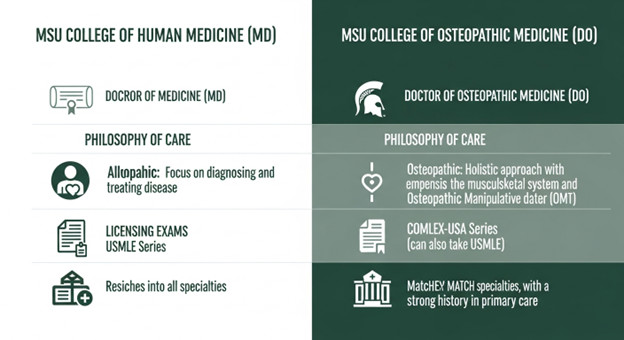
A common point of inquiry for prospective students interested in Michigan State University‘s medical programs is the distinction between the College of Human Medicine (CHM) and the College of Osteopathic Medicine (COM). While both are highly respected medical schools within MSU, they offer different pathways to medical licensure and practice. MSU CHM awards a Doctor of Medicine (MD) degree, preparing graduates for residency programs and practice across all specialties, following the traditional medical model. Conversely, MSU COM awards a Doctor of Osteopathic Medicine (DO) degree. DO physicians receive all the same training as MD physicians but also receive additional training in osteopathic manipulative treatment (OMT), a hands-on approach to diagnosing and treating patients. Applicants must carefully consider which degree and training philosophy aligns best with their personal and professional aspirations. This guide focuses exclusively on the admission process for MSU CHM (MD).
Why MSU College of Human Medicine? Understanding Its Unique Identity and Mission
MSU College of Human Medicine distinguishes itself through a steadfast commitment to its core mission: to educate compassionate physicians who will serve the people of Michigan and address critical health needs, particularly in underserved areas. This mission permeates every aspect of the college, from its groundbreaking curriculum to its deep integration with communities across the state. The institution fosters an environment where scientific rigor meets humanistic care, preparing graduates who are not only skilled clinicians but also thoughtful leaders and advocates for public health.
The Shared Discovery Curriculum: A Patient-Centered, Integrated Approach
The cornerstone of the MSU CHM experience is the Shared Discovery Curriculum. This innovative program moves away from traditional compartmentalized learning, instead emphasizing an integrated, patient-centered approach from day one. Students engage with clinical cases and real patient experiences early in their medical education, fostering a deeper understanding of the human experience of illness and the practical application of scientific knowledge. The curriculum is designed to promote critical thinking, problem-solving, and lifelong learning, ensuring graduates are well-equipped for the complexities of modern healthcare. This integrated approach allows students to “discover” knowledge alongside faculty and peers, fostering a dynamic and engaging learning environment.
The Community-Campus Network: Learning Across Michigan
A defining feature of MSU CHM is its expansive Community-Campus Network, a model that distributes medical education across seven regional campuses throughout Michigan. This unique structure allows students to immerse themselves in diverse communities, gaining invaluable clinical experience in a variety of settings. From urban centers to rural areas, students work closely with experienced physicians and healthcare teams, experiencing firsthand the healthcare challenges and opportunities unique to each region. This distributed model not only enriches the educational experience but also reinforces the college’s commitment to serving the entire state. Learning occurs in Grand Rapids, Lansing, Flint, Midland, Traverse City, Southeast Michigan (Detroit), and the Upper Peninsula (Marquette), providing a broad spectrum of clinical exposure.
Research & Discovery with Student Engagement
MSU College of Human Medicine actively encourages and supports student involvement in Research and Discovery. The college recognizes that scientific inquiry is fundamental to advancing medical knowledge and improving patient care. Students have numerous opportunities to participate in research projects alongside faculty mentors, contributing to the college’s robust research enterprise. Whether pursuing basic science, clinical, or translational research, students can explore their intellectual curiosity, develop critical research skills, and contribute to new discoveries. These experiences not only enhance their understanding of medicine but also prepare them for careers in academic medicine or research-intensive practices.
What MSU CHM Seeks: Core Values and Ideal Applicant Profile
MSU College of Human Medicine seeks applicants who embody its core values and are aligned with its mission. Beyond strong academic credentials, the admissions committee looks for individuals who demonstrate a deep commitment to service, a passion for lifelong learning, resilience, empathy, and the potential for leadership. The ideal applicant will have a proven track record of meaningful experiences that reflect these values, such as community service, clinical exposure, research involvement, and personal growth. They should articulate a clear understanding of why MSU CHM’s unique mission and educational model are a good fit for their aspirations to become a physician dedicated to serving diverse populations, particularly within Michigan.
Essential Admissions Requirements: Building a Strong Foundation
A successful admission application to MSU CHM is built upon a solid academic foundation and demonstrated understanding of the medical field. Meeting the prerequisite requirements is crucial, but the evaluation process extends far beyond mere academic metrics.
Academic Prerequisites: The Coursework You Need
MSU College of Human Medicine requires a baccalaureate degree from an accredited institution prior to matriculation. While a specific major is not mandated, applicants must complete a set of rigorous science and humanities courses. Key prerequisites typically include:
- Biology: One year with laboratory (e.g., general biology, cell biology, genetics).
- General Chemistry: One year with laboratory.
- Organic Chemistry: One year with laboratory.
- Physics: One year with laboratory.
- English Composition/Writing: One semester or equivalent.
- Mathematics: One year of college-level mathematics (calculus or statistics strongly recommended).
- Behavioral Sciences: One year of coursework in subjects such as psychology, sociology, or anthropology.
It is essential to consult the official MSU CHM Admissions website for the most current and detailed course requirements, as these can be subject to change. MSU CHM often considers applicants who have demonstrated strong performance in these foundational subjects, reflecting their readiness for the demanding scientific coursework of medical school.
The MCAT: What Scores Mean for MSU CHM Admissions
The Medical College Admission Test (MCAT) is a standardized examination that assesses a student’s knowledge of scientific concepts and principles prerequisite to the study of medicine, as well as their problem-solving, critical thinking, and writing skills. For MSU CHM admission, a strong MCAT score is a significant factor in the evaluation of an applicant. While MSU CHM employs a holistic review process, competitive MCAT scores are essential.
Historically, MSU CHM has looked for applicants to score at or above the 500 mark on the MCAT. For the 2024-25 entering class, the median MCAT score for matriculants at U.S. MD-granting medical schools was 512 AAMC, 2025. While there isn’t a strict cutoff score published by MSU CHM, applicants are generally expected to perform competitively. A minimum MCAT score of 495 is often cited as a benchmark, with scores of 500+ being desirable, and 125+ in each section being ideal. The MCAT should typically have been taken within the last three years prior to matriculation. Applicants should focus on achieving their best possible scores across all sections of the MCAT, as each contributes to the overall assessment.
Situational Judgment Tests: AAMC PREview and CASPer
In addition to academic performance and the MCAT, MSU College of Human Medicine, like many other medical schools, utilizes Situational Judgment Tests to further assess applicants. These tests are designed to gauge an applicant’s understanding of ethical and professional behavior in various medical scenarios. MSU CHM may require or recommend the AAMC PREview Professional Readiness Exam or CASPer (Computer-Adaptive Testing).
The AAMC PREview exam assesses competencies such as ethical responsibility, social responsibility, and working effectively with others, qualities that are paramount for future physicians. CASPer is an online, unproctored assessment that evaluates interpersonal competencies, professionalism, and motivation. These situational judgment tests provide admissions committees with additional insight into an applicant’s character, judgment, and suitability for the medical profession, complementing traditional academic measures. Applicants should carefully review MSU CHM’s specific requirements regarding these assessments well in advance of application deadlines.
The MSU CHM Application Process: A Step-by-Step Guide
Applying to MSU College of Human Medicine involves a multi-stage process managed through the American Medical College Application Service (AMCAS) and MSU CHM’s own supplemental application. Understanding each step is critical for a successful admission journey.
Step 1: The Primary Application – AMCAS Submission
The initial step in the admission process for MSU CHM is to complete and submit your primary AMCAS application. The American Medical College Application Service (AMCAS) is the centralized application system used by most MD-granting medical schools in the United States. This comprehensive application includes your biographical information, academic history (transcripts from all undergraduate and graduate institutions), a detailed list of your experiences (e.g., volunteer work, shadowing, employment, research, leadership), and your Personal Statement.
Your Personal Statement is a crucial essay where you articulate your motivations for pursuing medicine, your relevant experiences, and your suitability for a medical career. It is your opportunity to tell your unique story and convey your passion. Completing the AMCAS application thoroughly and thoughtfully is essential, as it serves as the foundation for your application review. It is advisable to begin working on your AMCAS application early in the application cycle, as verification can take several weeks. The total number of medical school applicants has seen fluctuations, with a 1.2% decline for the 2024-25 academic year AAMC, 2025.
Step 2: The Secondary Application – Showcasing Your Fit with MSU CHM
Following the initial review of your AMCAS application by MSU CHM, eligible applicants will receive an invitation to complete the secondary application. This supplemental application is your opportunity to specifically demonstrate why you are a good fit for MSU College of Human Medicine and its unique mission. The secondary application typically includes a series of essays or short answer questions that prompt you to reflect on your experiences, your understanding of MSU CHM’s values, and your commitment to serving the Michigan community.
These essays require careful thought and preparation. Prompts often relate to your motivation for attending MSU CHM, your understanding of community health, your experiences with diversity, and your future career goals. It is vital to tailor your responses to MSU CHM’s specific mission and values, drawing upon concrete examples from your background. Thoroughly answering each prompt and showcasing your alignment with the college’s patient-centered, community-focused approach is key to making a strong impression.
Step 3: Letters of Evaluation (Letters of Recommendation)
Strong letters of evaluation, often referred to as letters of recommendation, are a critical component of your MSU CHM admission application. These letters provide the admissions committee with external perspectives on your academic abilities, personal character, and potential as a future physician. MSU CHM typically requires a specific number of letters, often including at least one from a science faculty member who can attest to your performance in your science courses, and another from an individual who has supervised you in a significant capacity, such as a mentor in a research project, a supervisor from a volunteer experience, or a pre-health advisor.
The quality of your letters is paramount. It is advisable to waive your right to view these letters, as this often signals greater confidence in the recommender and the authenticity of their assessment. Cultivate relationships with individuals who know you well and can speak to your strengths, work ethic, and personal attributes in detail. A strong letter of evaluation can significantly bolster your application by offering insights that may not be apparent elsewhere in your AMCAS application or secondary application.
Step 4: The Interview – Making Your Best Impression
For applicants who successfully pass the initial review of their AMCAS application, secondary application, and letters of evaluation, the next crucial stage is the interview. The interview is a vital opportunity for the admissions committee to gain a deeper understanding of you as an individual and to assess your suitability for MSU CHM beyond your academic record. MSU CHM typically employs a semi-structured or structured interview format, often conducted by faculty members, admissions committee members, or current medical students.
Preparation is key to making your best impression. Research MSU CHM’s mission, curriculum, and community campus network thoroughly. Be prepared to discuss your motivations for pursuing medicine, your experiences (including research and clinical work), your understanding of healthcare challenges, and why you are specifically interested in MSU CHM. Practice articulating your thoughts clearly and concisely. The interview is a two-way street; it is also your chance to ask insightful questions about the college and to determine if it is the right fit for you. Demonstrating genuine enthusiasm, thoughtful reflection, and a clear understanding of your commitment to medicine and MSU CHM’s values will significantly contribute to a positive interview experience.
Beyond the Numbers: MSU CHM’s Holistic Review Process
MSU College of Human Medicine is committed to a holistic evaluation process, recognizing that an applicant’s potential extends far beyond numerical indicators like GPA and MCAT scores. This comprehensive approach ensures that the college admits a diverse class of students who possess the broad range of attributes necessary to excel in medicine and serve their communities effectively.
How MSU CHM Evaluates the Whole Applicant
The holistic review at MSU CHM considers all aspects of an applicant’s background, experiences, and personal qualities. This includes:
- Academic Achievements: While GPA and MCAT scores are important, they are considered within the context of the applicant’s overall academic record, including course rigor and any mitigating circumstances.
- Personal Qualities and Attributes: The admissions committee assesses traits such as maturity, empathy, resilience, integrity, leadership potential, communication skills, and commitment to service. These are often gauged through essays, letters of evaluation, and the interview.
- Experiences: Significant weight is given to diverse experiences, including clinical exposure (shadowing, volunteering, patient care roles), research, leadership positions, community service, and any experiences that demonstrate an understanding of and commitment to serving diverse populations, particularly within Michigan.
- Understanding of the Medical Profession: Applicants are expected to demonstrate a realistic understanding of the demands and rewards of a career in medicine.
- Alignment with MSU CHM Mission: A critical component of the evaluation is how well an applicant’s values, experiences, and aspirations align with MSU CHM’s mission to educate physicians who serve the people of Michigan and address health disparities.
This comprehensive evaluation allows MSU CHM to build a class comprised of individuals with varied backgrounds, perspectives, and talents, all united by a shared passion for medicine and service.
Student Body Profile: What Kind of Medical Students Thrive at MSU CHM
The students who thrive at MSU College of Human Medicine are typically those who are intellectually curious, driven, and possess a strong sense of purpose. They are individuals who are passionate about science and patient care, and who are eager to contribute to their communities. MSU CHM attracts students who are comfortable with integrated learning and who are proactive in seeking out clinical and research opportunities.
The college values diversity in all its forms, including academic background, life experiences, geographic origin, and personal attributes. Successful matriculants often demonstrate leadership qualities, a capacity for teamwork, and a commitment to lifelong learning. They are individuals who are not afraid to ask questions, challenge themselves, and grow both personally and professionally. The emphasis on community-based learning means that students who are adaptable, communicative, and eager to engage with diverse patient populations tend to excel. The medical school admissions process at MSU CHM seeks individuals who not only meet academic benchmarks but also embody the compassionate, community-focused spirit of the institution.
Special Considerations for Applicants to MSU CHM
MSU College of Human Medicine recognizes that applicants come from diverse backgrounds and may have unique circumstances. The admissions committee considers these factors through a holistic lens.
Michigan Residents: Understanding In-State Preference
MSU College of Human Medicine has a strong commitment to serving the citizens of Michigan. As such, there is a significant preference given to Michigan residents during the admission process. While out-of-state applicants are considered, the majority of the entering class is typically comprised of residents from Michigan. This in-state preference reflects the college’s mission to train physicians who will address the healthcare needs of the state. Michigan residents applying to MSU CHM should clearly articulate their connection to and commitment to serving the Michigan community in their applications.
Reapplicants: Strategies for Success
For applicants who have previously applied to MSU CHM but were not successful, reapplying is a common path. MSU CHM welcomes reapplication, provided that applicants can demonstrate significant growth and improvement since their previous application. Simply reapplying with the same credentials is unlikely to lead to a different outcome.
Successful reapplicants typically address specific areas of weakness identified in their previous application. This might involve:
- Gaining Additional Clinical Experience: Expanding exposure to patient care settings.
- Pursuing Further Research: Engaging in more research projects or contributing to publications.
- Strengthening Academic Performance: Improving grades, perhaps through additional coursework or a post-baccalaureate program.
- Achieving Higher MCAT Scores: Retaking the MCAT if scores were not competitive.
- Developing New Skills or Experiences: Taking on new leadership roles or engaging in unique volunteer activities.
- Refining Personal Statement and Secondary Essays: Providing a clearer, more compelling narrative that demonstrates growth and a deeper understanding of medicine and MSU CHM’s mission.
It is crucial for reapplicants to reflect honestly on their previous applications and to actively pursue experiences that showcase their development and increased readiness for medical school.
MD/PhD Program and Other Specialized Tracks
MSU College of Human Medicine offers a variety of specialized tracks and programs designed to cater to diverse interests and career aspirations within medicine. For applicants interested in a career that combines clinical practice with significant research, the MD/PhD program is an excellent option. This rigorous, fully funded program is designed to train physician-scientists.
In addition to the MD/PhD, MSU CHM offers other specialized tracks, such as:
- Leadership in Rural Medicine (LIRm): This track focuses on preparing physicians to serve rural communities, addressing critical healthcare needs in underserved areas. Given that 92% of rural counties in the U.S. were designated as primary care Health Professional Shortage Areas in 2023 Commonwealth Fund, 2025, this track is highly relevant. The rural family physician workforce has notably shrunk by 11% from 2017 to 2023 Annals of Family Medicine, 2025.
- Medical Partners in Public Health (MD-PH): This program emphasizes the intersection of medicine and public health, preparing physicians to address population health challenges and health disparities.
- Leadership in Medicine for the Underserved (LMU): This track is dedicated to training physicians who will work with and advocate for underserved populations, addressing critical societal health needs. Projections indicate a shortage of 70,610 primary care physicians by 2038 HRSA, 2025.
These specialized tracks require specific essays within the secondary application, and applicants must demonstrate a clear commitment and aptitude for the chosen specialization.
Financial Aid and Post-Acceptance Information
Understanding the financial implications of medical school and the steps following acceptance is essential for applicants. MSU College of Human Medicine is committed to helping students navigate these aspects.
Understanding Medical School Costs: Expenses Per Academic Year
The cost of medical education is a significant consideration for all aspiring physicians. For the 2024-25 academic year, tuition and fees at U.S. MD-granting medical schools can vary considerably. While specific figures for MSU CHM should be obtained directly from their financial aid office, prospective students should be aware of the national trends. The median education debt for graduating medical students in 2023 was $200,000 AAMC, 2023. This figure underscores the importance of diligent financial planning and seeking out all available aid opportunities. Expenses typically include tuition, fees, living expenses, books, and supplies.
Navigating Financial Aid: Scholarships, Grants, and Loans
MSU College of Human Medicine offers a range of financial aid options to help students manage the costs of medical school. This includes federal student loans, institutional scholarships, and grants. The primary application for federal financial aid is the Free Application for Federal Student Aid (FAFSA). The medical school admissions process often runs concurrently with financial aid application processes.
Prospective students are encouraged to thoroughly explore all available financial aid resources. Merit-based scholarships and need-based grants are often awarded based on academic achievement, financial need, and specific criteria. Understanding the terms and conditions of loans, including interest rates and repayment options, is also crucial. The MSU CHM financial aid office provides comprehensive guidance and support to help students secure the necessary funding for their education.
What Happens After Acceptance: Orientation & Matriculation
Upon receiving an offer of admission from MSU College of Human Medicine, applicants embark on the final stages of their journey: orientation and matriculation. After accepting the offer, students will receive detailed information regarding orientation programs. These programs are designed to welcome new students, provide essential information about the curriculum, student support services, and campus life, and introduce them to their cohort and faculty.
Matriculation marks the official enrollment of students into the college. This involves completing all necessary paperwork, including financial aid documents and enrollment forms. The transition into medical school is a significant milestone, and MSU CHM provides a supportive environment to ensure a smooth and successful start to your medical education. With a successful interview and acceptance, you will be on your way to joining the ranks of physicians trained at this distinguished institution.
Conclusion
The journey to becoming a physician at Michigan State University College of Human Medicine is a rigorous yet immensely rewarding one. This guide has illuminated the path, from understanding the college’s distinctive mission and patient-centered curriculum to navigating the essential requirements of academic excellence, standardized testing, and a comprehensive application process. We’ve detailed the importance of the AMCAS application, the strategic approach to the secondary application, the impact of strong letters of evaluation, and the critical nature of the interview.
MSU CHM’s holistic evaluation process seeks applicants who not only possess strong academic foundations, including competitive MCAT scores, but also embody its core values of service, compassion, and community engagement. Whether you are a Michigan resident or an out-of-state applicant, understanding the nuances of your application, from prerequisites to specialized tracks, is paramount. For reapplicants, demonstrating significant growth is key to renewed success.
As you prepare your application, remember that MSU CHM seeks individuals who are eager to learn, dedicated to serving others, and aligned with its commitment to addressing healthcare needs across Michigan. By carefully preparing each component of your application and showcasing your unique strengths and motivations, you can present a compelling case for admission to this esteemed institution. The pursuit of a medical education is a significant undertaking, and with thorough preparation and a clear understanding of what MSU CHM values, you can confidently embark on this transformative journey.
Frequently Asked Questions About Michigan State University College of Human Medicine
1. What GPA do you need to get into Michigan State University College of Human Medicine?
The average GPA of matriculating students at MSU College of Human Medicine is approximately 3.9. While there is no published minimum, competitive applicants typically hold a cumulative and science GPA at or above 3.7. MSU CHM takes a holistic review approach, so strong research, clinical experience, and community service can strengthen a lower-than-average GPA application.
2. What MCAT score is needed for Michigan State University College of Human Medicine?
The average MCAT score for enrolled students at MSU CHM is 509 for the 2025–2026 cycle. Competitive applicants typically score between 507 and 515. The college does not publish a strict minimum score, but scores below 505 significantly reduce the likelihood of an interview invitation.
3. What is the acceptance rate at Michigan State University College of Human Medicine?
The acceptance rate at MSU College of Human Medicine is approximately 2.33% for the 2025–2026 application cycle. Out of roughly 8,296 applicants, 193 students matriculated into the first-year class. This makes MSU CHM a highly selective institution despite its mission-driven, community-focused admissions philosophy.
4. How many people apply to Michigan State University College of Human Medicine each year?
Approximately 8,296 applicants submitted applications to MSU College of Human Medicine for the 2025–2026 cycle. The entering class size is around 193 students, making the school competitive but attainable for well-prepared applicants. Total enrollment across all four years of the MD program is approximately 822 students.
5. Does Michigan State University College of Human Medicine accept out-of-state applicants?
Yes, MSU College of Human Medicine does accept out-of-state applicants, though Michigan residents receive preference in admissions. Out-of-state tuition is significantly higher at $61,576 per year compared to the in-state rate of $33,752 per year (2025–2026 figures). Out-of-state applicants with strong ties to Michigan, interest in primary care, or a commitment to underserved communities may strengthen their application.
6. What is the interview format at Michigan State University College of Human Medicine?
MSU CHM uses a combination interview format consisting of a 30-minute structured one-on-one interview with a current medical student and a four-station Multiple Mini Interview (MMI). Interviews are conducted virtually. Applicants are also required to complete either the CASPer situational judgment test (Altus Suite) or the AAMC PREview Exam as part of their application.
7. What are the secondary essay prompts for Michigan State University College of Human Medicine?
For the 2025–2026 application cycle, MSU CHM secondary essays include a prompt asking applicants to address systemic injustices and inequities (400 words or fewer) and a prompt asking what the applicant wants the admissions committee to know about them (400 words or fewer). The secondary application deadline is November 15, 2025, and the secondary fee is $100, with fee assistance waivers available.
8. How much does it cost to attend Michigan State University College of Human Medicine?
For the 2025–2026 academic year, tuition and fees at MSU College of Human Medicine are $33,752 per year for Michigan residents and $61,576 per year for non-residents. Total cost of attendance, including living expenses, books, and health insurance, is higher. MSU CHM participates in federal financial aid programs, and scholarships and loan assistance are available through the school.
9. What is the distributed community campus model at Michigan State University College of Human Medicine?
MSU College of Human Medicine was among the first U.S. medical schools to adopt a community-based, distributed education model when it was founded in 1964. Students complete their clerkships and clinical training at one of eight community campuses spread across Michigan, including sites in Grand Rapids, Flint, Lansing, and several rural regions. This model is designed to train physicians comfortable practicing in diverse settings, including underserved urban and rural communities.
10. What is MSU College of Human Medicine’s focus on underserved and primary care medicine?
MSU CHM has a strong institutional emphasis on primary care, health equity, and serving medically underserved populations. The college extended this mission in 2026 by launching the Primary Care Research Collaborative, which builds research capacity within community-based residency programs across Michigan. Approximately 50% of the college’s NIH funding is directed toward public health research addressing social determinants of health and health disparities.