
Your Path to Becoming a VCU Physician
The journey toward a career in medicine is a profound undertaking, demanding dedication, resilience, and a clear understanding of the path ahead. For aspiring physicians drawn to Virginia Commonwealth University (VCU) School of Medicine, this guide serves as your comprehensive roadmap. VCU School of Medicine, a beacon of medical education and innovation in Richmond, Virginia, offers a distinctive environment for shaping future leaders in healthcare. This article will demystify the VCU admissions process, offering strategic insights into building a competitive application, navigating each stage of the application, and understanding what makes an applicant truly stand out. We will delve into VCU’s unique mission and values, explore the holistic review process, and provide actionable advice for every component of your application, from the initial AMCAS submission to the crucial interview.
This blog will cover:
- Your Path to Becoming a VCU Physician
- Understanding the VCU School of Medicine: Mission, Values, and Environment
- The Ideal VCU Applicant: A Holistic Review Perspective
- Pre-Application Strategy: Building a Competitive Profile for VCU
- The AMCAS Application: Your Primary Introduction to VCU
- The VCU Secondary Application: Deepening Your “Why VCU” Narrative
- The VCU Interview Blueprint: Mastering the Modified Multiple Mini Interview (MMI)
- After the Interview: Navigating the Admissions Cycle
- Conclusion: Your Future as a VCU Physician
Welcome to VCU School of Medicine
Virginia Commonwealth University School of Medicine is a leading institution dedicated to transforming health through innovative education, pioneering research, and compassionate patient care. Located in the vibrant capital city of Richmond, VCU Health is a prominent academic medical center that provides a rich learning environment for its students. The School of Medicine is committed to fostering physicians who are not only clinically excellent but also dedicated to serving diverse communities and advancing medical knowledge. Prospective students will find a dynamic and supportive ecosystem designed to nurture their growth as compassionate healers and critical thinkers.
What This Guide Covers: A Strategic Approach to Admission
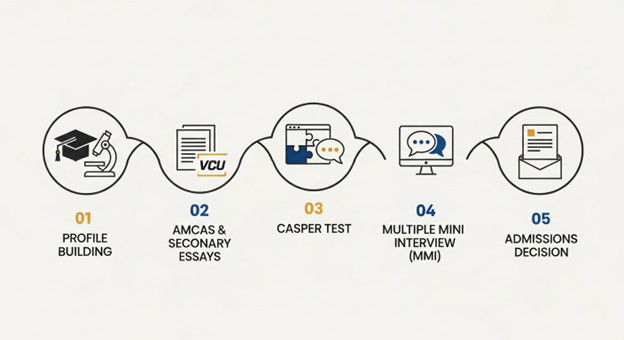
This guide is meticulously crafted to provide a strategic and detailed overview of the VCU School of Medicine admissions process. We aim to equip you with the knowledge and confidence needed to present your strongest application. You will find in-depth information covering: an exploration of VCU’s mission, values, and unique institutional environment; an explanation of their holistic review process and the attributes of an ideal VCU applicant; a comprehensive strategy for pre-application profile building, including academic achievements and meaningful experiences; a step-by-step breakdown of the AMCAS application, secondary essays, and the CASPer test; a detailed blueprint for preparing for VCU’s modified Multiple Mini Interview (MMI); insights into the post-interview stages and decision-making process; and an overview of the VCU medical student experience and curriculum. Our goal is to empower you with a clear, actionable understanding of how to navigate your journey to becoming a VCU physician.
Understanding the VCU School of Medicine: Mission, Values, and Environment
To successfully navigate the VCU School of Medicine admissions process, a deep understanding of the institution’s ethos is paramount. VCU is more than just a place to earn a medical degree; it is a community driven by a distinctive mission and a set of core values that shape its educational philosophy, research endeavors, and commitment to patient care. Understanding these fundamental aspects will allow you to articulate your alignment with the school and demonstrate why you are a strong fit for its culture.
Why VCU? Unpacking Its Unique Identity
VCU School of Medicine distinguishes itself through its commitment to innovation, its robust clinical training opportunities within a major academic medical center, and its dedication to serving the diverse populations of Virginia and beyond. It is a place where groundbreaking research directly informs patient care, creating a synergistic environment for learning. The School of Medicine is renowned for its patient-centered approach, emphasizing not just the science of medicine, but also the art of healing. Its location in Richmond, Virginia, offers unique advantages, including exposure to a wide spectrum of medical cases and community health challenges. This urban setting provides a dynamic backdrop for Virginia Commonwealth University’s dedication to improving health outcomes through education, research, and service.
VCU’s Mission and Values: What Drives the Institution
The mission of VCU School of Medicine is to improve the lives of patients and communities through excellence in education, research, and health care. This mission is underpinned by core values that guide its operations and expectations for its students. These include a commitment to diversity and inclusion, fostering an environment where all individuals feel valued and respected. They also emphasize innovation in medical education and practice, encouraging critical thinking and the pursuit of novel solutions to health challenges. Furthermore, VCU champions collaboration, recognizing that the best outcomes are achieved through teamwork. Integrity, accountability, and a deep-seated sense of service are also central to the VCU ethos, shaping the kind of physicians they aim to cultivate. Understanding and reflecting these values in your application is crucial.
Student Body Profile and Diversity
VCU School of Medicine actively seeks to build a diverse and dynamic student body, recognizing that varied perspectives enrich the learning environment and prepare future physicians for a diverse patient population. The institution is committed to principles of equity, diversity, and inclusion, which are woven into its curriculum and campus culture. In the 2022-2023 academic year, first-generation students, those whose parents have not completed college, constituted 15% of the U.S. medical school matriculant pool AAMC, 2024. VCU strives to attract students from a broad range of backgrounds, experiences, and identities, believing that this diversity is essential for fostering empathy, cultural competence, and a comprehensive understanding of health disparities. This commitment translates into a supportive atmosphere where students from all walks of life can thrive and contribute to the medical community.
The Ideal VCU Applicant: A Holistic Review Perspective
VCU School of Medicine employs a holistic review process in its admissions decisions, moving beyond mere numerical metrics to gain a comprehensive understanding of each applicant. This approach acknowledges that becoming an exceptional physician requires a diverse set of skills, experiences, and personal qualities. Therefore, the ideal VCU applicant is not defined by a single characteristic but by a constellation of attributes that demonstrate their potential for success in medicine and their alignment with the VCU School of Medicine’s mission.
Beyond the Numbers: VCU’s Holistic Review Process
VCU’s holistic review process is designed to identify candidates who possess the academic prowess, interpersonal skills, and commitment to service that are essential for a career in medicine. This means that while MCAT Scores and GPA are important indicators of academic preparedness, they are considered alongside a wide array of other factors. The admissions committee evaluates the depth and breadth of an applicant’s experiences, their personal qualities as demonstrated in essays and interviews, and their letters of recommendation. They seek to understand not just what an applicant has accomplished, but also their motivations, resilience, maturity, and potential to contribute to the VCU community and the broader medical field. This comprehensive assessment ensures that VCU admits individuals who will not only succeed academically but will also become compassionate, skilled, and dedicated physicians.
Desired Experiences: Research, Clinical, and Community Involvement
The VCU School of Medicine highly values experiences that demonstrate an applicant’s commitment to medicine, their intellectual curiosity, and their capacity for empathy and service. Research is particularly encouraged, as it fosters critical thinking and an understanding of scientific inquiry. This can range from bench science to clinical research, with opportunities to engage in longitudinal projects or summer research programs. Clinical exposure, through shadowing physicians or volunteering in healthcare settings, provides invaluable insights into the day-to-day realities of patient care. In 2022-2023, medical school matriculants in the U.S. collectively performed over 16.4 million community service hours, averaging 709 hours per student AAMC, 2025, underscoring the significant commitment to service expected of aspiring physicians. Beyond clinical settings, robust community involvement and leadership roles showcase an applicant’s ability to connect with diverse populations and contribute meaningfully to society. These experiences, when thoughtfully presented, paint a picture of a well-rounded individual prepared for the rigors of medical school and the demands of patient care.
Pre-Application Strategy: Building a Competitive Profile for VCU
Before embarking on the formal application process, a strategic approach to building your profile is essential for gaining admission to VCU School of Medicine. This phase involves cultivating academic excellence, excelling on standardized tests, and accumulating experiences that align with VCU’s values and mission. A well-prepared applicant demonstrates not only academic aptitude but also a genuine passion for medicine and a clear understanding of their commitment to serving others.
Academic Excellence: Coursework and GPA
A strong academic record is the foundation of any successful medical school application. VCU School of Medicine expects applicants to demonstrate a mastery of foundational scientific concepts, typically through rigorous undergraduate coursework in biology, chemistry, physics, and mathematics. While there are no strict cut-offs, the average GPA for accepted MD medical school students was 3.75 for the 2023-2024 application cycle EduAvenues, 2025. This statistic highlights the competitive academic landscape. Maintaining a high GPA, particularly in science courses, reflects discipline, intellectual curiosity, and the ability to handle complex material. If your GPA is not as high as you would like, consider excelling in advanced science courses, pursuing a post-baccalaureate program, or demonstrating significant improvement over time. Focusing on a deep understanding of basic science principles will serve you well not only in your application but also in your future curriculum at VCU.
Mastering the Medical College Admission Test (MCAT)
The Medical College Admission Test (MCAT) is a critical component of the application to medical schools, including VCU. It assesses a broad range of knowledge and skills essential for success in medical school and the practice of medicine. VCU School of Medicine, like other competitive institutions, considers MCAT Scores as a significant metric. The average MCAT score for matriculants at VCU is typically around 512 [AAMC, 2023 data often cited]. Preparing for the MCAT requires a comprehensive study plan, dedicated time, and potentially a review course or tutor. It is crucial to understand the test’s structure, content areas, and scoring system. Beyond achieving a competitive score, demonstrating consistent performance across all sections—Chemical and Physical Foundations of Biological Systems, Critical Analysis and Reasoning Skills (CARS), Biological and Biochemical Foundations of Living Systems, and Psychological, Social, and Biological Foundations of Behavior—is important. Remember that the MCAT is not solely about memorization; it tests your ability to apply knowledge and critical thinking skills, which are central to the VCU curriculum.
Gaining Meaningful Experiences
Beyond academics and standardized tests, your experiences are what truly differentiate you and demonstrate your commitment to medicine. VCU School of Medicine looks for depth, reflection, and impact in your extracurricular activities. Research is highly valued, offering opportunities to engage with scientific inquiry and contribute to medical knowledge. Many successful applicants have participated in longitudinal research projects, presenting their findings or contributing to publications. Clinical exposure is equally vital. This includes shadowing physicians to understand their daily roles, volunteering in healthcare settings to directly assist patients, or gaining work experience in a medical field. Such experiences allow you to develop empathy, communication skills, and a realistic perspective on the profession. Furthermore, extensive community involvement showcases your dedication to service. The AAMC reports that medical school matriculants in the U.S. performed over 16.4 million community service hours in the 2022-2023 academic year AAMC, 2025, highlighting the significant role of volunteerism. Leadership roles, whether in student organizations, volunteer groups, or your community, demonstrate your ability to take initiative and inspire others. Each experience should be approached with a mindset of learning and contribution, and later articulated with reflection in your application.
The AMCAS Application: Your Primary Introduction to VCU
The American Medical Colleges Application Service (AMCAS) is the centralized application system used by nearly all U.S. medical schools, including VCU. This primary application is your first formal introduction to the admissions committee, serving as the bedrock upon which your candidacy is built. Meticulous attention to detail, authenticity, and a clear narrative are crucial at this stage.
Navigating the American Medical Colleges Application Service (AMCAS)
Completing the AMCAS application requires careful planning and execution. The service collects extensive information about your academic history, work experiences, extracurricular activities, volunteer endeavors, and personal background. You will need to enter details about every college and university attended, including courses taken, grades received, and degrees earned. The “Work and Activities” section is where you detail your most impactful experiences, including research, clinical work, volunteer service, and leadership roles. For each entry, you are provided a limited character count to describe your involvement and reflect on its significance. This section is a prime opportunity to showcase your alignment with VCU’s values by highlighting experiences that demonstrate your commitment to service, intellectual curiosity, and understanding of medicine. Be precise, honest, and reflective in your descriptions.
Official Transcripts and MCAT Scores Submission
Accuracy and timeliness are paramount when submitting official documents for your AMCAS application. You will be required to have official transcripts from all post-secondary institutions you have attended sent directly to AMCAS. These transcripts provide an official record of your academic performance, validating the GPA and coursework information you provide in your application. Similarly, your MCAT Scores will be automatically released to AMCAS once you designate them. It is important to ensure that you have taken the MCAT well in advance of the application deadlines to allow sufficient time for scores to be processed and verified. VCU School of Medicine, like other medical schools, will review these official records as part of their holistic assessment. The Virginia Commonwealth University School of Medicine emphasizes the importance of academic rigor, and your transcripts and MCAT Scores are key indicators of this.
Choosing Your Reference Writers: The Power of Letters of Recommendation
Letters of Recommendation (LORs) provide crucial third-party validation of your character, skills, and potential for medicine. For your AMCAS application, you will typically request a committee letter from your undergraduate institution if available, or individual letters from faculty members, research mentors, or supervisors who know you well. When selecting your reference writers for VCU School of Medicine, prioritize individuals who can speak to your strengths most effectively and specifically. Ideally, these individuals should have observed you in academic or professional settings and can comment on your intellectual abilities, work ethic, interpersonal skills, leadership potential, and commitment to service. For VCU, it is beneficial if they can also speak to your understanding of basic science and your aptitude for clinical practice. It is vital to ask your recommenders well in advance of the deadline, provide them with your CV, personal statement draft, and any specific information about VCU or the application prompts to help them craft a tailored letter. A strong letter of recommendation can significantly bolster your application to VCU.
The VCU Secondary Application: Deepening Your “Why VCU” Narrative
Once your primary AMCAS application has been submitted and VCU School of Medicine receives it, you may be invited to complete a secondary application. This supplemental phase is your opportunity to provide more specific information about your interest in VCU and to further elaborate on aspects of your profile that may not have been fully captured in the primary application. It’s a crucial step to demonstrate your genuine interest and “fit” with the VCU School of Medicine.
Understanding the VCU Supplemental Application
The VCU supplemental application typically consists of several short essays or prompts designed to assess your alignment with the institution’s mission and values. These prompts are carefully crafted to elicit responses that reveal your motivations, experiences, and your understanding of VCU’s unique contributions to medicine and healthcare in Virginia. Common themes often include why you are interested in VCU School of Medicine specifically, how your experiences have prepared you for medical school, your thoughts on health disparities or diversity in medicine, and how you envision contributing to the VCU community. Be prepared to discuss your understanding of their curriculum, research opportunities, or clinical training environment. The prompts require thoughtful, authentic, and concise responses. It’s essential to tailor each answer directly to VCU, rather than using generic statements. For instance, instead of saying you want to be a doctor, explain why you want to be a VCU physician, referencing specific programs or faculty that resonate with you.
The CASPer Situational Judgement Test: Preparation and Strategy
VCU School of Medicine, like an increasing number of medical schools, requires applicants to complete the CASPer (Computer-based Assessment for Sampling Personal Characteristics) test. CASPer is a standardized, online situational judgment test designed to evaluate non-cognitive skills and traits such as empathy, ethics, communication, and critical thinking. The test consists of a series of video-based scenarios followed by typed responses to questions about how you would act or what you would consider in those situations. It’s not a knowledge test; rather, it assesses your judgment and decision-making abilities in real-world contexts relevant to medicine. To prepare for CASPer, familiarize yourself with the test format and common types of scenarios. Practice articulating your thoughts clearly and concisely under time constraints. Focus on demonstrating your ethical reasoning, your ability to consider multiple perspectives, and your commitment to patient-centered care. Your responses should reflect maturity, self-awareness, and an understanding of professional conduct expected of future physicians. This test is an integral part of VCU’s holistic review, offering insights beyond traditional academic metrics.
The VCU Interview Blueprint: Mastering the Modified Multiple Mini Interview (MMI)
The interview is often the final and most personal stage of the VCU School of Medicine admissions process. VCU employs a Modified Multiple Mini Interview (MMI) format, which is designed to assess a broad range of competencies in a standardized yet dynamic way. This approach moves beyond traditional interview formats to provide a more comprehensive evaluation of an applicant’s suitability for medicine and for the VCU community.
Understanding the VCU Interview Process
VCU’s Modified Multiple Mini Interview (MMI) typically involves a series of independent stations, each presenting a unique scenario or question. These stations are designed to evaluate various attributes, such as communication skills, ethical reasoning, problem-solving abilities, diversity awareness, teamwork, and self-reflection. Unlike a traditional one-on-one interview, the MMI exposes candidates to multiple interviewers and a variety of situations, providing a more robust assessment. The “modified” aspect may involve specific VCU-centric questions or a particular emphasis on certain competencies aligned with the school’s mission. The goal is to assess how you think on your feet, your emotional intelligence, and your alignment with the values of Virginia Commonwealth University School of Medicine. Success in the MMI hinges on your ability to think critically, communicate clearly and empathetically, and demonstrate a genuine understanding of the ethical and professional responsibilities inherent in the practice of medicine.
Preparing for Your VCU MMI: Beyond General Advice
Thorough preparation is key to excelling in VCU’s Modified MMI. While general MMI preparation is helpful, it’s crucial to tailor your approach to VCU’s specific context. Begin by thoroughly understanding the school’s mission, values, and any specific programs or initiatives that appeal to you. Reflect on how your own experiences, particularly in research, clinical settings, or community service, have shaped your perspectives and prepared you for the challenges of medicine. Practice articulating your thoughts on ethical dilemmas, difficult situations, and your own strengths and weaknesses. Engage in mock interviews, ideally with individuals familiar with the MMI format. Consider common MMI station types: ethical scenarios, interpersonal interactions, role-playing, or questions about your motivation for applying to VCU School of Medicine. Focus on active listening, clear and concise communication, and demonstrating empathy. Be authentic; the interviewers are looking for the real you, not a rehearsed persona. Your responses should reflect critical thinking and a genuine desire to contribute to the VCU community and the field of medicine.
Post-Interview Etiquette and Follow-Up
After completing your VCU interview, maintaining professional etiquette is essential. While VCU School of Medicine, like most institutions, does not require a formal thank-you letter after an MMI, a brief, sincere email to your primary contact person (often an admissions coordinator) can be appropriate. This email should be concise and reiterate your continued strong interest in VCU. Avoid sending thank-you notes to each individual interviewer, as this can be logistically challenging and may not be the preferred method of communication. Focus on presenting yourself professionally throughout the entire admissions cycle. The most important follow-up actions involve patiently awaiting a decision and ensuring that all required application materials have been submitted correctly and on time. Remember that the interview is a two-way street; it’s also your opportunity to ask thoughtful questions that demonstrate your engagement and curiosity about the School of Medicine.
After the Interview: Navigating the Admissions Cycle
The period following your interview at VCU School of Medicine can be a time of anticipation and reflection. Understanding how the admissions committee operates and the potential outcomes can help manage expectations and provide clarity during this crucial phase of the application process. Your journey through medical schools is a marathon, and this stage requires patience and continued engagement with your aspirations.
Understanding VCU’s Admissions Committee Review Process
After your interview, your application package, including your AMCAS entry, secondary essays, MCAT Scores, Letters of Recommendation, and your interview performance, is meticulously reviewed by VCU’s Admissions Committee. This committee is composed of faculty members from various departments, administrators, and sometimes even current medical students. They conduct a comprehensive, holistic review, weighing all aspects of your candidacy to determine your suitability for the VCU School of Medicine and the medical profession. The committee aims to identify individuals who not only possess the academic foundation but also demonstrate the personal qualities, maturity, and commitment to service that align with VCU’s mission. This rigorous evaluation process ensures that those accepted will thrive within the curriculum and contribute positively to the medical community.
Potential Outcomes: Acceptance, Waitlist, or Rejection
Upon completion of the committee’s review, you will receive one of several possible outcomes. The most desired is an acceptance, offering you a place in the incoming class. Another possibility is being placed on the waitlist. A waitlist status indicates that you are a competitive candidate, but the school is unable to offer you a place at that moment due to class size limitations or the need to evaluate other candidates. If placed on the waitlist, it is important to understand VCU’s policies regarding waitlist movement and to continue to express your interest if appropriate. The least favorable outcome is a rejection. While disappointing, it is essential to remember that medical school admissions are highly competitive, and many highly qualified applicants do not receive an offer. The United States is projected to face a physician shortage of up to 86,000 physicians by 2036 AAMC, 2024, emphasizing the continued need for dedicated individuals entering the field, even if the path involves setbacks.
The Admissions Offer and Matriculation Deposit
Receiving an admissions offer from VCU School of Medicine is a significant achievement, marking a critical milestone in your journey toward becoming a physician. Upon acceptance, you will typically be provided with a timeline and instructions regarding the next steps. This usually involves submitting a matriculation deposit to secure your place in the incoming class. This deposit signifies your intent to enroll at VCU and is applied toward your tuition fees. It is crucial to adhere to the deadlines associated with the offer and deposit. Once you have submitted your deposit, your active pursuit of admission at other medical schools may cease, or you may need to manage your commitments carefully if considering other options. This offer represents the culmination of your hard work and dedication throughout the application process, and it is a testament to your potential as a future VCU physician.
Conclusion: Your Future as a VCU Physician
The path to VCU School of Medicine admissions is demanding yet incredibly rewarding. By understanding VCU’s distinctive mission, embracing its holistic review process, and strategically building your profile, you can present a compelling case for your candidacy. From excelling academically and mastering the MCAT to curating meaningful experiences in research, clinical settings, and community service, every step contributes to showcasing your potential as a future physician. Navigating the AMCAS application, crafting authentic secondary essays, and preparing thoroughly for the CASPer test and the Modified MMI are critical phases that allow you to articulate your motivations and demonstrate your alignment with VCU’s values. Remember that VCU School of Medicine seeks individuals who are not only academically capable but also compassionate, resilient, and committed to serving others and advancing medicine. The Virginia Commonwealth University School of Medicine offers a rich environment in Richmond for you to grow into the physician you aspire to be. With diligent preparation, authenticity, and a clear vision, you can navigate this complex process and take a significant step towards your goal of becoming a VCU physician, contributing to the vital healthcare needs of Virginia and beyond. The journey requires perseverance, but the prospect of shaping the future of medicine at VCU makes it an endeavor well worth undertaking.
Frequently Asked Questions About VCU School of Medicine
1. What GPA do you need to get into Virginia Commonwealth University School of Medicine?
Competitive applicants to VCU School of Medicine typically have a GPA of 3.5 or higher, with the average enrolled student carrying a 3.88 overall GPA. The minimum GPA considered is around 3.3. Both science (BCPM) and cumulative GPAs are evaluated, and an upward trend in grades can help offset a lower early GPA.
2. What MCAT score do you need for Virginia Commonwealth University School of Medicine?
The average MCAT score for students enrolled at VCU School of Medicine is 513, and the school-reported average for accepted applicants is 512. VCU sets a minimum MCAT threshold of 503. Scoring at or above 512 places you within the competitive range for serious consideration.
3. What is the acceptance rate at Virginia Commonwealth University School of Medicine?
VCU School of Medicine has an acceptance rate of approximately 2.80% for the 2025 entering class, making it a highly selective program. With 184 students matriculating into a class, competition is intense. Strong academic preparation, relevant clinical experience, and a clear alignment with VCU’s mission are all essential.
4. How many people apply to Virginia Commonwealth University School of Medicine each year?
VCU School of Medicine receives several thousand applications each cycle through AMCAS, with only a small fraction advancing to secondary review and an even smaller number ultimately receiving offers. The 2025 entering class totaled 184 matriculants out of a highly competitive applicant pool. Applicants who receive secondaries should submit promptly, as VCU reviews on a rolling basis.
5. Does Virginia Commonwealth University School of Medicine accept out-of-state applicants?
Yes, VCU School of Medicine does accept out-of-state applicants, though like most public medical schools in Virginia it gives preference to Virginia residents. Out-of-state tuition is approximately $61,224 per year compared to $40,913 for Virginia residents. Out-of-state applicants should demonstrate compelling reasons for choosing VCU and a genuine connection to its mission of serving diverse urban communities.
6. What is the interview format at Virginia Commonwealth University School of Medicine?
VCU School of Medicine uses a Multiple Mini Interview (MMI) format, typically consisting of 6–8 timed stations. Interviewees also complete two traditional one-on-one interviews — often with a faculty member and a community member or current medical student — and a timed written essay component. The MMI is designed to assess communication, ethical reasoning, and interpersonal skills rather than factual medical knowledge.
7. What are the secondary essay prompts at Virginia Commonwealth University School of Medicine?
For the 2025–2026 cycle, VCU’s secondary application includes an essay asking how your personal mission and values align with VCU School of Medicine (2,000 characters), a prompt describing a time you took on a responsibility that wasn’t yours because it needed to be done (2,000 characters), an explanation of any lapses in your path to medicine not covered elsewhere (2,000 characters), and an optional explanation of any low GPAs or poor grades (2,000 characters). The secondary application fee is $80, with a fee assistance waiver available, and the secondary deadline is January 30, 2026. Submit your secondary promptly after receiving the invitation, as VCU reviews applications on a rolling basis.
8. How much does Virginia Commonwealth University School of Medicine cost?
Annual tuition at VCU School of Medicine is $40,913 for Virginia residents and $61,224 for out-of-state students (2025 figures). Over four years, total program costs are approximately $151,316 for in-state students and $204,376 for non-residents, not including living expenses. Prospective students should explore VCU’s financial aid office, merit scholarships, and federal loan programs early in the application process.
9. What is the Medical College of Virginia (MCV) and why does it matter for VCU medical students?
VCU School of Medicine is housed on the historic Medical College of Virginia (MCV) Campus in downtown Richmond, one of the oldest and most storied medical campuses in the United States, founded in 1838. The MCV Campus is home to the VCU Medical Center, a major Level I trauma center and the largest academic health system in Virginia, giving students access to a high-volume, diverse patient population from day one. This immersive urban academic medical center environment means students train alongside specialists in a full range of clinical disciplines throughout all four years.
10. What research opportunities and programs does VCU School of Medicine offer?
VCU School of Medicine is a research powerhouse, accounting for nearly half of VCU’s total sponsored research awards and 87% of the university’s NIH funding. The school has a $300 million-plus research strategic plan aimed at expanding scientific infrastructure and discovery culture. Medical students can participate in dedicated research programs including the I2CRP (International/Inner City/Rural Preceptorship), which prepares future physicians to serve underserved urban, rural, and international communities — a hallmark of VCU’s mission to improve health through innovation and equitable care.