
Charting Your Path to the Donald and Barbara Zucker School of Medicine
Embarking on the journey to medical school is a significant undertaking, filled with rigorous academic preparation, strategic planning, and a deep commitment to service. For aspiring physicians drawn to a unique educational model that seamlessly blends academic excellence with unparalleled clinical experience, the Donald and Barbara Zucker School of Medicine at Hofstra/Northwell stands as a beacon of innovation. This esteemed institution offers a distinctive path to a career in medicine, shaped by its foundational partnership between Hofstra University and Northwell Health. Navigating the admissions process for such a competitive program requires a comprehensive understanding of its values, curriculum, and application requirements. This guide serves as your strategic blueprint, designed to demystify the Zucker School of Medicine admissions process and equip you with the knowledge and insights needed to present your strongest candidacy. We will delve into what makes Zucker distinct, explore the academic profile of successful applicants, outline the essential application components, and provide actionable advice for every stage of your application journey.
This blog will cover:
- Charting Your Path to the Donald and Barbara Zucker School of Medicine
- Why Zucker? Unpacking the Hofstra Northwell Advantage
- Demystifying the Zucker School of Medicine Class Profile and Selection Criteria
- Core Application Requirements: Your Pre-Flight Checklist
- The Zucker Secondary Application: Demonstrating Specific Fit
- Early Decision Program (EDP) Considerations
- Mastering the Interview Day
- Financial Considerations and Scholarships
- Conclusion
Welcome to Zucker: A Distinctive Medical Education Journey
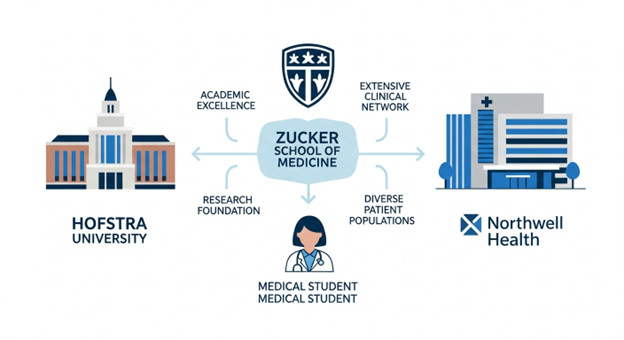
The Donald and Barbara Zucker School of Medicine at Hofstra/Northwell is more than just another medical school; it is a pioneering institution built on the principle of integrated education, clinical practice, and community engagement. Established with a visionary commitment to train the next generation of physician-leaders, Zucker distinguishes itself through its deep affiliation with Northwell Health, New York State’s largest healthcare system. This partnership ensures that students are immersed in a rich and diverse clinical environment from the outset of their studies. The school’s philosophy centers on fostering a collaborative learning atmosphere, emphasizing critical thinking, and instilling a profound sense of empathy and dedication to patient care. Choosing Zucker means opting for a medical education that is forward-thinking, evidence-based, and deeply rooted in the realities of modern healthcare delivery, preparing graduates not only for the challenges of residency but for lifelong contributions to the field of medicine.
What This Guide Will Cover: Your Strategic Blueprint for Admission
This comprehensive guide is meticulously crafted to provide prospective applicants with a clear, actionable roadmap to the Donald and Barbara Zucker School of Medicine admissions process. We will unpack the distinct advantages of the Hofstra/Northwell partnership, exploring the innovative curriculum, extensive clinical opportunities, and robust research environment that define the Zucker experience. You will gain a clear understanding of the academic profile and selection criteria employed by the admissions committee, including insights into GPA, MCAT scores, and the holistic review process. Furthermore, we will meticulously detail all core application requirements, from academic prerequisites and standardized testing to letters of recommendation, offering strategic advice on preparing each component. The guide will also demystify the application timeline, secondary application nuances, and interview day expectations. Finally, we will touch upon important financial considerations, including scholarship opportunities, ensuring you are well-equipped for every facet of your application journey. Our aim is to empower you with the knowledge necessary to present a compelling and authentic application that highlights your unique strengths and aligns with Zucker’s mission.
Why Zucker? Unpacking the Hofstra/Northwell Advantage
The decision to pursue a medical degree is profound, and selecting the right institution is paramount. The Donald and Barbara Zucker School of Medicine at Hofstra/Northwell offers a compelling proposition for aspiring physicians, rooted in a unique and powerful partnership between a leading academic university and the largest healthcare system in New York State. This synergy is not merely a structural affiliation; it is the engine that drives Zucker’s innovative educational model, providing students with unparalleled opportunities for learning, research, and clinical experience. Understanding this advantage is crucial for any applicant seeking to thrive in an environment that prioritizes comprehensive physician training.
Integrated & Innovative Curriculum: Learning for the Future of Medicine
Zucker’s curriculum is designed to move beyond traditional medical education, fostering a deep understanding of medicine through an integrated and innovative approach. The program is structured to ensure that students develop a robust scientific foundation while simultaneously gaining exposure to clinical practice and patient care from the very beginning of their studies. This forward-thinking design aims to produce physicians who are not only knowledgeable but also adaptable, compassionate, and prepared for the evolving landscape of healthcare.
Curriculum 2.0: Early Clinical Exposure and Case-Based Learning
A cornerstone of the Zucker experience is its “Curriculum 2.0,” which prioritizes early and continuous clinical exposure. Unlike many traditional medical programs where patient contact is largely deferred to later years, Zucker students engage with real-world medical scenarios and patient interactions early on. This hands-on approach is complemented by a strong emphasis on case-based learning. Students are presented with complex clinical cases, encouraging them to think critically, apply their growing knowledge base, and develop problem-solving skills collaboratively. This pedagogical method ensures that theoretical concepts are immediately contextualized within practical applications, solidifying learning and fostering clinical reasoning from day one. This approach is vital in preparing students for the demanding realities of medical practice, where quick and accurate decision-making is essential.
Simulation and Experiential Training: Beyond the Classroom
To further bridge the gap between theoretical knowledge and practical application, the Zucker School of Medicine invests heavily in simulation and experiential training. Students have access to state-of-the-art simulation centers that replicate various clinical environments and patient scenarios. These high-fidelity simulations allow trainees to practice procedures, hone diagnostic skills, and refine their communication with “patients” in a safe, controlled setting. Experiential learning extends beyond simulation labs, encompassing hands-on workshops, interprofessional team exercises, and opportunities to learn from standardized patients who portray diverse medical conditions. This multifaceted approach ensures that graduates are not only academically prepared but also confident and proficient in their practical skills.
The Power of the Northwell Health Partnership: Unparalleled Clinical Access
The affiliation with Northwell Health is arguably the most significant differentiator for the Donald and Barbara Zucker School of Medicine. Northwell Health is an expansive and diverse integrated health system, comprising 21 hospitals and more than 800 outpatient facilities across the New York metropolitan area. This vast network provides Zucker students with an extraordinary breadth and depth of clinical experiences that are difficult to match elsewhere. The partnership ensures that students are exposed to a wide array of medical specialties, patient demographics, and healthcare settings, fostering a comprehensive understanding of healthcare delivery systems and patient needs.
Extensive Hospital Sites and Diverse Patient Populations
Within the Northwell Health system, Zucker students rotate through a multitude of hospital sites, each offering unique learning opportunities. From large academic medical centers to community hospitals, students encounter patients from all socioeconomic backgrounds, ethnicities, and age groups, and with a vast spectrum of acute and chronic conditions. This exposure to diverse patient populations is crucial for developing cultural competence, empathy, and a well-rounded perspective on health and disease. The sheer scale of Northwell Health means students are consistently presented with new challenges and learning experiences, ensuring continuous growth throughout their medical education. This comprehensive clinical immersion is fundamental to the Zucker philosophy of training physicians who are prepared to serve any community.
Research and Innovation: The Feinstein Institutes for Medical Research and Beyond
The Zucker School of Medicine is deeply committed to advancing medical knowledge through research and innovation. Students have direct access to the Feinstein Institutes for Medical Research, a leading biomedical research facility affiliated with Northwell Health. The Feinstein Institutes are at the forefront of discoveries in areas such as immunology and inflammation, neuroscience, cancer biology, bioelectronic medicine, and health services research. This proximity to cutting-edge research allows Zucker students to participate in groundbreaking studies, collaborate with leading investigators, and gain valuable experience in scientific inquiry. Involvement in research not only enhances a student’s understanding of the scientific underpinnings of medicine but also cultivates critical thinking skills and an appreciation for evidence-based practice, preparing them for careers that may involve research or incorporate the latest scientific advancements.
A Culture of Collaboration and Support: Team-Based Approach to Medical Education
Zucker fosters a distinctive culture of collaboration and mutual support, mirroring the team-based approach prevalent in modern healthcare. The curriculum is designed to encourage teamwork among students, faculty, and clinical staff. Group projects, case discussions, and interdisciplinary learning experiences are integral to the educational process. This collaborative environment helps students develop essential interpersonal skills, learn to communicate effectively with colleagues from various professional backgrounds, and understand the dynamics of a healthcare team. Faculty and staff are dedicated to providing robust academic and personal support, creating a nurturing atmosphere where students feel empowered to ask questions, seek help, and grow both personally and professionally. This emphasis on collaboration prepares graduates to be effective members and leaders of healthcare teams.
Commitment to Community Health and Diversity
A core tenet of the Donald and Barbara Zucker School of Medicine’s mission is its commitment to community health and the promotion of diversity within its student body and the medical profession. The school actively engages with the diverse communities it serves, implementing outreach programs and initiatives aimed at addressing health disparities and promoting wellness. This dedication to community health is woven into the curriculum and clinical experiences, encouraging students to understand the social determinants of health and their role in addressing them. Furthermore, Zucker places a high value on diversity in all its forms – including race, ethnicity, gender, socioeconomic background, and life experiences. By fostering an inclusive environment, the school aims to prepare physicians who are sensitive to the needs of diverse patient populations and who can contribute to a more equitable healthcare system.
Demystifying the Zucker School of Medicine Class Profile and Selection Criteria
Understanding the profile of admitted students and the selection criteria employed by the Donald and Barbara Zucker School of Medicine at Hofstra/Northwell is crucial for any applicant aiming to align their application with the institution’s expectations. While academic metrics are important, Zucker emphasizes a holistic review process, seeking individuals who not only excel academically but also demonstrate the personal qualities, experiences, and commitment necessary to become exceptional physicians.
Understanding the Academic Profile of Admitted Students
The academic profile of successful applicants to Zucker reflects a high level of preparedness and achievement. While specific statistics are updated annually, the school consistently attracts students with strong academic records. This typically includes a robust undergraduate GPA and competitive scores on the MCAT. Prospective applicants should aim for metrics that are at or above the average of recently admitted classes to ensure their academic qualifications are competitive. However, it is vital to remember that these numbers represent just one facet of the admissions evaluation.
Average GPA and MCAT Scores: Setting Realistic Expectations
While specific averages fluctuate yearly, the average MCAT score for matriculants to U.S. MD-granting medical schools in 2023-2024 was 511.7 AAMC, 2023. Applicants to the Zucker School of Medicine generally fall within or exceed this range. Similarly, applicants typically present a strong undergraduate GPA, often above 3.7. Prospective students should consult the most recent class profile published by the Zucker School of Medicine for precise figures. These statistics serve as important benchmarks, but the admissions committee views them within the broader context of an applicant’s overall profile.
The Acceptance Rate: A Competitive Landscape
The Donald and Barbara Zucker School of Medicine is a highly sought-after institution, reflected in its competitive acceptance rate. For the 2024-25 academic year, the total number of medical school applicants nationwide declined by 1.2%, marking the lowest figures since 2017-18 AAMC, 2025. Despite this trend, the overall application volume to top medical schools remains significant. Zucker’s own statistics typically indicate a substantial number of applications received, with a limited number of spots available in its MD program, underscoring the competitive nature of the admissions process. Successful applicants must present a well-rounded profile that goes beyond strong academic performance.
Beyond the Numbers: Zucker’s Holistic Review Philosophy
Zucker employs a holistic review process, meaning that every aspect of an applicant’s submission is carefully considered. This philosophy acknowledges that academic metrics alone do not fully capture an individual’s potential to succeed in medical school and as a physician. The admissions committee seeks to understand the applicant’s unique background, experiences, motivations, and personal qualities. This comprehensive approach allows Zucker to build a diverse class of students who bring a variety of perspectives and talents, enriching the learning environment for everyone.
Emphasis on Extracurricular Activities, Clinical Experiences, and Community Engagement
Beyond academic achievements, Zucker places significant emphasis on an applicant’s extracurricular involvement, clinical exposure, and commitment to community engagement. Meaningful clinical experiences are particularly vital, as nearly three-quarters of medical schools recommend or require them, with over 80% indicating applicants without them may be at a disadvantage OnlineMedEd, 2025. Demonstrating sustained involvement in activities that reflect leadership, teamwork, altruism, and a genuine understanding of the medical profession is paramount. Volunteer work, shadowing physicians, research participation, and leadership roles in organizations all contribute to a compelling application.
Demonstrating Leadership, Teamwork, and a Commitment to Patient Care
The admissions committee looks for evidence of leadership potential, the ability to work effectively in teams, and a deep-seated commitment to patient care. This can be demonstrated through various experiences, such as leading a student organization, participating in a team sport, or engaging in volunteer roles where empathy and service are central. Applicants should reflect on experiences that showcase their ability to communicate, collaborate, problem-solve, and demonstrate resilience. These qualities are fundamental to succeeding in Zucker’s collaborative learning environment and in the demanding field of medicine.
Technical Standards for Admission
The Donald and Barbara Zucker School of Medicine maintains specific technical standards for admission and progression. These standards outline the essential abilities and qualities required of students to complete the medical curriculum and participate in clinical activities safely and effectively. They encompass cognitive abilities, sensory and motor functions, communication skills, and emotional maturity. Prospective applicants are encouraged to review these technical standards thoroughly on the Zucker School of Medicine’s official website to ensure they can meet these requirements throughout their medical education. These standards are designed to ensure that all students can achieve the required competencies essential for the practice of medicine.
Core Application Requirements: Your Pre-Flight Checklist
Successfully navigating the application process to the Donald and Barbara Zucker School of Medicine at Hofstra/Northwell begins with understanding and meticulously fulfilling all core requirements. This stage demands careful attention to detail, strategic planning, and timely submission of all necessary documentation. A well-prepared application demonstrates your seriousness and organizational skills, essential traits for a future physician.
Academic Prerequisites: Coursework and Bachelor’s Degree
A foundational requirement for admission to the Zucker School of Medicine is the completion of a bachelor’s degree from an accredited college or university. While the specific major is not prescribed, applicants must demonstrate a strong academic record, particularly in the sciences. Successful candidates typically present a robust undergraduate GPA, reflecting consistent academic achievement. The admissions committee evaluates your academic performance holistically, considering the rigor of your coursework and the context of your academic institution.
Required Science Courses: Biology, Chemistry, Physics, and More
Specific coursework is essential to ensure applicants possess the necessary scientific foundation for medical school. While requirements can be updated, typically, applicants must have completed courses in:
- Biology: General biology with laboratory (typically one year)
- Chemistry: General chemistry with laboratory (typically one year), organic chemistry with laboratory (typically one year), and biochemistry (one semester)
- Physics: General physics with laboratory (typically one year)
- Mathematics: Calculus (one semester) and introductory statistics (one semester)
- English: Composition and writing (one year)
It is imperative to verify the most current list of required courses on the Zucker School of Medicine’s official admissions website, as these may be subject to change. Ensuring all prerequisite coursework is completed with satisfactory grades is a critical first step.
Recommended Coursework: Expanding Your Scientific Foundation
While the aforementioned courses are typically required, Zucker often recommends additional coursework that can further strengthen an applicant’s foundation and demonstrate a broader scientific curiosity. Courses in genetics, cell biology, advanced mathematics, psychology, sociology, and even humanities can provide valuable context and enhance an applicant’s understanding of the multifaceted nature of medicine. Engaging with subjects that explore human behavior, societal influences on health, and advanced scientific principles can make your application more competitive and better prepare you for the rigors of medical school.
Standardized Testing: MCAT and CASPer™ Scores
Standardized testing plays a significant role in the admissions process at the Zucker School of Medicine. Both the Medical College Admission Test (MCAT) and the CASPer™ (Computer-Based Assessment for Sampling Personal Characteristics) test are integral components of the application review. These assessments provide the admissions committee with objective measures of your academic aptitude and your non-cognitive skills, respectively.
MCAT Score: Strategies for Preparation and Success
The MCAT is a comprehensive examination designed to assess your knowledge of physical sciences, biological and biochemical foundations of living systems, psychological, social, and biological foundations of behavior, and critical analysis and reasoning skills. The average MCAT score for matriculants to U.S. MD-granting medical schools in 2023-2024 was 511.7 AAMC, 2023. To be a competitive applicant to the Zucker School of Medicine, you should aim for an MCAT score that aligns with or exceeds the average scores of previously admitted classes. Effective preparation involves rigorous study, strategic test-taking techniques, and ample practice exams. Consider utilizing reputable MCAT preparation resources and study plans tailored to your learning style.
The CASPer™ Test: Understanding This Unique Assessment and How to Prepare
The CASPer™ test is a crucial component of the Zucker application. It is an online, open-response situational judgment test designed to evaluate attributes such as ethics, professionalism, empathy, and communication skills. CASPer™ presents applicants with a series of hypothetical scenarios and asks them to respond to questions related to their intended actions and reasoning. Preparation for CASPer™ involves understanding its format, practicing responses to common scenario types, and reflecting on your own values and decision-making processes. While it assesses non-cognitive abilities, practicing articulating your thoughts clearly and concisely under timed conditions is essential for success.
Letters of Recommendation: Securing Impactful Endorsements
Letters of recommendation provide the admissions committee with valuable insights into your character, abilities, and potential from individuals who know you well. The Zucker School of Medicine requires letters of recommendation to be submitted as part of your application. These should come from individuals who can speak authentically to your academic capabilities, work ethic, interpersonal skills, and personal qualities relevant to medicine.
The Premedical Committee Letter: Why It Matters
If your undergraduate institution has a premedical advising committee, a committee letter is often the preferred method of submitting recommendations. This letter synthesizes feedback from multiple faculty members who have observed your performance in various academic and extracurricular capacities, offering a comprehensive overview. If a committee letter is not available or applicable, you will typically need to submit a specified number of individual letters from professors or supervisors who can provide detailed and specific anecdotes about your strengths and potential in a medical context. Ensure you provide recommenders with ample time and relevant materials, such as your CV, personal statement draft, and information about Zucker’s mission, to assist them in writing strong, personalized letters.
Having covered the foundational academic and testing requirements, this section delves into the remaining critical components of your application package for the Donald and Barbara Zucker School of Medicine at Hofstra/Northwell. Meticulous attention to these elements is essential for a complete and competitive submission.
The AMCAS Primary Application: Your Gateway to Zucker
The primary application for the Zucker School of Medicine is submitted through the American Medical College Application Service (AMCAS). AMCAS serves as a centralized system for most U.S. medical schools, streamlining the initial submission process. This application includes detailed sections for your biographical information, academic history, coursework, standardized test scores (MCAT), work and activities, and a personal statement. It is imperative to complete the AMCAS application accurately and thoroughly, as it forms the basis of your candidacy.
Crafting a Compelling Personal Statement
Your personal statement is a critical opportunity to showcase your motivations for pursuing a career in medicine and to highlight experiences that have shaped your journey. It should convey your passion, resilience, and unique perspective. For the Zucker School of Medicine, it is especially important to articulate why you are drawn to their specific program, referencing their innovative curriculum, the Hofstra/Northwell partnership, and their commitment to community health and diversity. Authenticity and introspection are key to crafting a statement that resonates with the admissions committee.
Submitting Official Transcripts
Official transcripts from all undergraduate and graduate institutions you have attended must be submitted directly to AMCAS. These transcripts provide an official record of your academic performance and are carefully reviewed by the admissions committee. Ensure that all courses, grades, and degree conferrals are accurately reflected. Any discrepancies or omissions can delay the review of your application.
The Zucker Secondary Application: Demonstrating Specific Fit
Once AMCAS verifies your primary application, you may be invited to complete the Zucker School of Medicine’s secondary application. This supplemental application is designed to gather more specific information about your fit with Zucker’s mission and values. It typically includes additional essay questions and demographic information.
Secondary Application Essays: Tailoring Your Narrative
The essays within the secondary application are your chance to provide specific details and elaborate on aspects of your profile that directly align with what Zucker seeks. Common prompts often focus on your interest in the Hofstra/Northwell affiliation, your understanding of their innovative curriculum, your experiences with diverse populations, and how you plan to contribute to the school community. Research the school thoroughly and use these essays to demonstrate that you have a clear understanding of Zucker’s unique offerings and that your goals and experiences are a strong match.
Addressing Specific Prompts and Demonstrating “Why Zucker”
When answering secondary essay questions, be specific and provide concrete examples. Avoid generic responses that could apply to any medical school. Instead, articulate precisely why the Donald and Barbara Zucker School of Medicine, with its specific strengths and values, is the ideal place for you to pursue your medical education. Mentioning aspects of their curriculum, research opportunities at the Feinstein Institutes, or specific community initiatives you are passionate about can powerfully convey your interest.
Secondary Application Fee
There is typically a fee associated with the secondary application. For the 2024-25 academic year, the fee was approximately $100 for domestic applicants [Source 9 – though specific year can vary]. Waivers may be available for applicants demonstrating financial need. Ensure you check the official admissions website for the most current fee information and details regarding fee waivers.
Early Decision Program (EDP) Considerations
The Donald and Barbara Zucker School of Medicine offers an Early Decision Program (EDP) for a limited number of highly qualified applicants who are certain that Zucker is their top choice for medical school. Applying through EDP has distinct advantages and responsibilities that applicants should carefully consider.
Is EDP Right for You? Strategic Considerations
Applying EDP signifies a commitment to matriculate at Zucker if accepted. This means you cannot apply to other medical schools through the regular decision process or accept offers from other institutions. EDP is suitable for applicants who have thoroughly researched Zucker, are confident in their fit with the institution’s mission and values, and have a strong academic record and experiences that align with the school’s competitive profile. The application deadline for EDP is August 1st for all materials [Source 6], significantly earlier than the regular decision timeline.
Application Materials for EDP
The application process for EDP follows a similar structure to regular decision but with an accelerated timeline. You will still need to submit your AMCAS primary application, MCAT scores, CASPer™ results, and letters of recommendation. The secondary application for EDP also needs to be completed and submitted by the August 1st deadline. Early preparation and organization are paramount for EDP applicants to ensure all components are submitted on time and meet the stringent requirements for early review. A successful EDP application demonstrates not only strong qualifications but also unwavering commitment to the Zucker School of Medicine.
Mastering the Interview Day
For many applicants, the interview day represents a pivotal stage in the admissions process for the Donald and Barbara Zucker School of Medicine. It is an opportunity for the admissions committee to gain a deeper understanding of your personality, critical thinking skills, communication abilities, and alignment with Zucker’s values beyond what can be gleaned from written materials. This stage requires thorough preparation and a genuine presentation of yourself.
What to Expect: Multiple Mini Interview (MMI) Format
The Zucker School of Medicine typically employs a Multiple Mini Interview (MMI) format. This structured interview process consists of a series of short, independent interview stations, each presenting a different scenario or prompt. These scenarios are designed to assess a range of competencies, including problem-solving, ethical reasoning, communication, critical thinking, teamwork, and self-awareness. Unlike traditional panel interviews, the MMI format allows for a more comprehensive evaluation of an applicant’s diverse skills.
Understanding the MMI: Assessing Communication, Ethics, Critical Thinking
Each MMI station is designed to evaluate specific attributes essential for a physician. For instance, one station might present an ethical dilemma, requiring you to articulate your thought process and justification for a course of action. Another might involve a simulated interaction, testing your communication and interpersonal skills. Other stations could focus on your ability to analyze information, think critically under pressure, and demonstrate empathy. Preparation should involve understanding the intent behind each type of scenario and practicing how to articulate your responses clearly and thoughtfully.
Preparation Strategies for Interview Success
Effective preparation for the MMI involves several key strategies. First, thoroughly understand Zucker’s mission, values, and the Hofstra/Northwell partnership. Reflect on your own experiences and identify specific examples that demonstrate the qualities the MMI assesses – leadership, teamwork, resilience, ethical decision-making, and a commitment to patient care. Practice articulating your thoughts aloud, focusing on clarity, conciseness, and logical reasoning. Familiarize yourself with common MMI question types and practice responding to them under timed conditions. Mock interviews, if possible, can be invaluable for building confidence and refining your approach.
Showcasing Authentic Self and Alignment with Zucker’s Values
The most crucial aspect of interview day is to be authentic. The admissions committee seeks to understand who you are as a person and how you would fit into the Zucker community. While preparation is key, avoid rehearsed or insincere responses. Instead, focus on presenting your genuine thoughts, values, and experiences. Demonstrate your enthusiasm for medicine, your understanding of the challenges and rewards of the profession, and your specific interest in the unique opportunities offered by the Donald and Barbara Zucker School of Medicine. By showcasing your authentic self and aligning your responses with Zucker’s core values, you can make a strong and memorable impression.
Financial Considerations and Scholarships
Pursuing a medical degree is a significant financial undertaking, and understanding the costs involved, along with available financial aid and scholarship opportunities, is an essential part of the application process for the Donald and Barbara Zucker School of Medicine. Planning for the financial aspects of medical school ensures that you can focus on your studies without undue burden.
Tuition & Fees
The cost of medical school is substantial. For the 2024-25 academic year, the average cost of medical school tuition and fees was $59,720 per year Education Data Initiative, 2025. These figures represent the direct educational expenses, and applicants should also budget for living expenses, books, supplies, and other associated costs. Prospective students are strongly advised to visit the official Zucker School of Medicine website for the most current and detailed information regarding tuition and fees for the MD program.
Scholarships and Financial Aid Opportunities
The Zucker School of Medicine is committed to making medical education accessible and offers various scholarships and financial aid opportunities to support its students. These can range from merit-based scholarships awarded for academic achievement and other accomplishments to need-based financial aid designed to assist students from diverse socioeconomic backgrounds. The school also participates in federal and state financial aid programs. Exploring these options early and applying for all applicable aid is crucial. Many scholarships are available through Hofstra University and Northwell Health, reflecting the collaborative nature of the institution.
Financial Support Application Process
Applying for financial aid and scholarships typically involves completing specific forms, such as the Free Application for Federal Student Aid (FAFSA), and potentially separate scholarship application processes managed by the school or affiliated organizations. Detailed information on the financial aid application timeline, required documentation, and available resources can be found on the Zucker School of Medicine’s financial aid section of their website. Proactive engagement with the financial aid office can help you understand your funding options and develop a realistic financial plan for your medical education.
Conclusion
The journey to becoming a physician at the Donald and Barbara Zucker School of Medicine at Hofstra/Northwell is a challenging yet profoundly rewarding path. This comprehensive guide has illuminated the distinct advantages of the Hofstra/Northwell partnership, from its integrated and innovative curriculum to the unparalleled clinical access provided by Northwell Health and the cutting-edge research opportunities at the Feinstein Institutes. We have dissected the competitive landscape, emphasizing Zucker’s holistic review philosophy that values academic rigor alongside personal qualities, diverse experiences, and a deep commitment to patient care.
By understanding the core application requirements, including academic prerequisites, standardized testing like the MCAT and CASPer™, and the strategic importance of compelling letters of recommendation, you are better equipped to build a robust application. We’ve also navigated the intricacies of the AMCAS primary and Zucker’s secondary application, stressing the importance of tailoring your essays to showcase your genuine fit with the school’s unique
mission. Early Decision Program considerations and mastering the MMI interview format have been addressed to prepare you for critical stages of the process. Finally, acknowledging the financial commitments, we’ve highlighted the importance of exploring scholarships and financial aid.
The future of medicine demands adaptable, compassionate, and highly skilled physicians. The Donald and Barbara Zucker School of Medicine is dedicated to cultivating these qualities through its distinctive educational model. As you embark on this journey, remember to approach each step with dedication, authenticity, and a clear understanding of what makes Zucker the ideal place for you to begin your career in medicine. Your next steps involve diligent preparation, strategic application, and an unwavering commitment to your dream of becoming a physician.
Frequently Asked Questions About Zucker School of Medicine
1. What GPA do you need to get into Zucker School of Medicine at Hofstra/Northwell?
The average GPA for matriculants at the Donald and Barbara Zucker School of Medicine at Hofstra/Northwell is 3.92, placing it among the more academically selective MD programs in the United States. Competitive applicants typically present strong science and cumulative GPAs, and an upward trend is viewed favorably if earlier coursework was weaker. Applicants below 3.7 should ensure other parts of their application — research, clinical experience, and personal statement — are exceptionally strong.
2. What MCAT score do you need for Zucker School of Medicine at Hofstra/Northwell?
The average MCAT score for admitted students at Zucker School of Medicine is 518, placing the typical matriculant in approximately the 97th percentile nationally. This score reflects the school’s highly competitive applicant pool. Applicants scoring below 515 may find admission challenging, though research involvement, leadership, and alignment with Northwell Health’s mission are considered holistically. The school does not publish a formal minimum MCAT cutoff.
3. What is the acceptance rate at Zucker School of Medicine at Hofstra/Northwell?
The acceptance rate at the Donald and Barbara Zucker School of Medicine is approximately 1.94%, making it one of the most selective medical schools in the country. In a recent admissions cycle, roughly 5,368 applicants competed for about 104 seats in the entering class. This low acceptance rate means that even well-qualified candidates face stiff competition, and early, complete applications are strongly recommended.
4. How many applicants does Zucker School of Medicine receive each year?
Zucker School of Medicine receives approximately 5,368 applications per admissions cycle for a class of roughly 104 students, meaning the school enrolls fewer than 2% of all applicants. The school draws interest from across the country, though it prioritizes candidates who align with Northwell Health’s mission of community-centered, innovative medicine. The total enrolled student body numbers more than 400 students across all four years.
5. Does Zucker School of Medicine at Hofstra/Northwell accept out-of-state applicants?
Yes — as a private medical school, the Donald and Barbara Zucker School of Medicine accepts out-of-state applicants on equal footing with New York residents, and there is no state-funded geographic preference built into admissions. That said, applicants with ties to the New York metropolitan area or a genuine interest in practicing in the region may resonate more naturally with the school’s mission, given its deep integration with Northwell Health across Long Island and New York City.
6. What is the interview format at Zucker School of Medicine at Hofstra/Northwell?
Interview invitations are offered on a rolling basis, with virtual interviews typically beginning in mid-August. The school uses a traditional interview format rather than Multiple Mini Interviews (MMI), giving applicants space to discuss their background, motivations, and fit with the school’s mission in a conversational setting. Notably, Zucker School of Medicine does not require CASPer or the AAMC PREview exam, simplifying the application process relative to some peer institutions.
7. What are the secondary essay prompts for Zucker School of Medicine at Hofstra/Northwell?
The secondary application includes two main essays of 250 words each. The first asks you to explain why Zucker School of Medicine is the right fit for your medical education journey. The second draws from the school’s mission statement — “dedicated to inspiring diverse, promising students to lead and transform medicine for the betterment of humanity” — and asks how you would contribute to those mission and values, and where you see this taking you in the future. There are also supplemental questions about family employment connections to Hofstra or Northwell Health, and whether you’d like your application considered alongside another applicant in the same cycle.
8. What does it cost to attend Zucker School of Medicine at Hofstra/Northwell?
Tuition at the Donald and Barbara Zucker School of Medicine for the 2025–2026 academic year is $61,875. When living expenses — housing, meals, books, transportation, and personal costs — are added, the total estimated annual cost of attendance rises to approximately $98,921. Over four years, students can expect a total investment exceeding $390,000 before scholarships or financial aid. The school offers both merit-based scholarships and need-based financial aid, and applicants are encouraged to explore all funding options early in the process.
9. How does Zucker School of Medicine integrate with Northwell Health?
The Donald and Barbara Zucker School of Medicine is co-founded by Hofstra University and Northwell Health, New York’s largest health system, giving students unparalleled clinical exposure across more than 20 hospitals and hundreds of outpatient facilities spanning Long Island and New York City. Students rotate through a diverse, high-volume patient population in urban, suburban, and community settings from early in their training. Northwell’s more than 4,000 faculty physicians serve as the school’s clinical faculty, ensuring that academic learning stays tightly aligned with real-world practice and the health needs of the communities Northwell serves.
10. What research opportunities are available at Zucker School of Medicine at Hofstra/Northwell?
Zucker School of Medicine offers outstanding research opportunities through Northwell Health, the Feinstein Institutes for Medical Research, and Cold Spring Harbor Laboratory — one of the world’s leading biomedical research centers. Students can pursue basic, translational, and clinical research projects, with structured options that include a summer research experience between first and second year and dedicated research elective blocks in fourth year. The school has been ranked among the best medical programs for research by U.S. News & World Report for ten consecutive years (2016–2025), reaching top-tier status in 2024–2025. Independent study tracks are also available for students seeking a deeper, sustained research experience.