
Embarking on the journey to become a physician is a profound calling, and for many, the path begins with selecting the right medical school. Drexel University College of Medicine, located in the vibrant heart of Philadelphia, stands as a distinguished institution known for its commitment to innovative medical education, cutting-edge research, and the development of compassionate, highly skilled physicians. The admissions process at Drexel Med is rigorous, reflective of its status and the caliber of students it seeks to nurture. This comprehensive guide is designed to demystify the admissions landscape, providing aspiring students with the insights, strategies, and detailed information necessary to craft a compelling application and navigate their way to acceptance. We will delve into Drexel’s unique identity, its holistic admissions philosophy, the intricate steps of the application journey, and the crucial elements that contribute to a successful candidacy. Whether you are just beginning to explore medical school options or are refining your application strategy, this guide aims to be your indispensable resource.
This blog will cover:
- Why Drexel? Understanding the College of Medicine’s Unique Identity
- Decoding Drexel’s Admissions Philosophy: The Holistic Review in Practice
- The Application Journey: Your Step-by-Step Strategic Roadmap
- The Interview Process: Showcasing Your Potential to Drexel
- Specialized Programs and Pathways at Drexel Med
- After Acceptance: Final Steps and Important Policies
- Resources and Insider Tips for Aspiring Drexel Med Students
- Conclusion: Your Future in Medicine Starts Here
Welcome to Drexel University College of Medicine
Drexel University College of Medicine is a leading academic medical center that educates the next generation of physicians, biomedical scientists, and health professionals. Situated in Philadelphia, a city rich in medical history and a hub for healthcare innovation, Drexel Med offers its students unparalleled opportunities for clinical exposure, research, and community engagement. The college is dedicated to fostering an environment where students can develop the knowledge, skills, and ethical grounding necessary to excel in the evolving field of medicine. Its strategic location provides access to a diverse patient population and a vast network of healthcare facilities, enriching the learning experience for every medical student.
Why This Guide Matters for Your Admissions Cycle
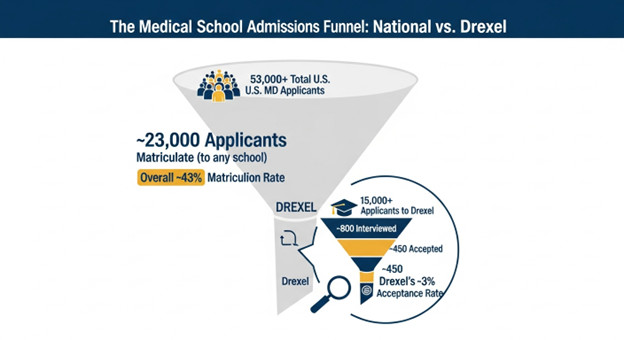
Navigating the medical school application process can feel complex and overwhelming. With numerous requirements, deadlines, and nuanced evaluation criteria, understanding where to focus your energy is paramount. This guide is crafted to provide clarity and strategic direction specifically for those targeting Drexel University College of Medicine. Unlike generic advice, this resource dives deep into Drexel’s unique mission, its specific admissions philosophy, and the practical steps required to build a standout application. By offering detailed insights into what Drexel seeks in its future medical students and how to best present your qualifications, this guide aims to empower you to approach your application with confidence and purpose, increasing your chances of success in a highly competitive admissions cycle. The average acceptance rate for MD schools in the U.S. was 44.58% in 2024, underscoring the necessity of a targeted and informed approach [MedSchoolCoach, 2025].
Why Drexel? Understanding the College of Medicine’s Unique Identity
Choosing a medical school is a significant decision that extends beyond academic rankings; it involves finding an institution whose ethos, educational approach, and values align with your own aspirations as a future physician. Drexel University College of Medicine offers a distinctive educational experience shaped by its foundational principles, innovative curriculum, and unwavering commitment to research and clinical excellence. Understanding these core elements is crucial for any applicant aiming to articulate their fit with the institution.
Drexel’s Mission and Values: Beyond the Traditional Curriculum
At its core, Drexel University College of Medicine is driven by a mission to educate physicians and scientists who are not only knowledgeable and skilled but also compassionate, ethical, and dedicated to serving diverse communities. The institution seeks individuals who embody “desire, intelligence, and integrity,” qualities that form the bedrock of excellent medical practice. Drexel fosters an environment that values a diverse student body, recognizing that varied perspectives enrich the learning community and better prepare students to care for a diverse patient population. This commitment is reflected in its admissions philosophy, which looks beyond mere academic metrics to identify candidates with the emotional maturity, empathy, and sound motivation necessary for a career in medicine, ultimately aiming to produce physicians who deliver compassionate patient care.
A Distinctive Medical Curriculum: Preparing Future Physicians
Drexel’s medical education is designed to be dynamic and forward-thinking, preparing students for the complexities of modern healthcare. The curriculum, often characterized by its emphasis on active learning and early clinical exposure, moves beyond traditional lecture-based formats. Students engage with material through problem-based learning, small group discussions, and hands-on experiences from the outset of their medical school journey. This pedagogical approach ensures that theoretical knowledge is continually integrated with practical application, fostering critical thinking and diagnostic skills. By immersing students in clinical settings early on, Drexel cultivates a strong understanding of patient care and the healthcare system, equipping them to adapt to evolving medical landscapes and to practice medicine with confidence and competence.
Research, Innovation, and Clinical Excellence
Drexel University College of Medicine is a powerhouse of research and innovation. The institution actively encourages students to participate in scholarly activities, providing ample opportunities to engage with faculty on groundbreaking research projects across a wide spectrum of disciplines. This emphasis on research not only deepens students’ scientific understanding but also cultivates a spirit of inquiry and lifelong learning essential for medical professionals. Furthermore, Drexel’s commitment to clinical excellence is evident in its robust network of affiliated hospitals and clinical sites. These partnerships offer students exposure to a wide array of patient conditions and healthcare settings, from large urban hospitals to specialized clinics, ensuring a comprehensive and well-rounded clinical education that prepares them for diverse practice environments.
Decoding Drexel’s Admissions Philosophy: The Holistic Review in Practice
Drexel University College of Medicine distinguishes itself through its comprehensive approach to evaluating applicants, prioritizing a holistic review process. This means that the admissions committee considers a wide range of factors beyond just academic achievements and standardized test scores. Understanding this philosophy is key to presenting a well-rounded and compelling application that showcases your unique potential as a future physician.
What “Holistic Review” Truly Means at Drexel Med
Holistic review at Drexel Med signifies a commitment to understanding the entirety of an applicant’s experiences, attributes, and potential. It acknowledges that exceptional physicians come from diverse backgrounds and possess a variety of strengths. Instead of focusing solely on GPA and MCAT scores, the committee carefully examines personal essays, letters of recommendation, extracurricular activities, leadership roles, community service, and life experiences. This process aims to identify candidates who demonstrate not only the intellectual capacity for medical training but also the emotional intelligence, resilience, ethical compass, and commitment to service that are vital for compassionate and effective patient care. Drexel actively seeks to build a class that reflects the diversity of the populations they will eventually serve, valuing unique perspectives and backgrounds.
Key Qualities and Experiences Drexel Seeks in Applicants
Drexel University College of Medicine looks for applicants who demonstrate a compelling blend of academic prowess and personal attributes. Central to their evaluation are the core qualities of desire, intelligence, and integrity. Beyond these, the committee seeks evidence of sound motivation for a career in medicine, demonstrating a genuine understanding of the profession’s challenges and rewards. Emotional maturity and resilience are critical, as medical school and the practice of medicine require navigating stressful situations with grace and perseverance.
A significant emphasis is placed on experiences that showcase a commitment to others. This includes meaningful community service, where applicants have actively contributed to the well-being of others, and robust clinical exposure. While traditional clinical shadowing is valuable, it’s important to note that 87% of medical school admissions officers accept an alternative activity instead of traditional clinical shadowing [AAMC, 2023 as cited by Texas Health Education Service]. This indicates that diverse forms of clinical experience that demonstrate patient interaction and understanding of healthcare delivery are highly regarded. Leadership roles, research involvement, and experiences that highlight overcoming adversity or significant personal growth are also viewed favorably, as they demonstrate initiative, problem-solving skills, and the ability to learn and adapt.
The Application Journey: Your Step-by-Step Strategic Roadmap
Successfully gaining admission to Drexel University College of Medicine requires a meticulous and strategic approach to each stage of the application process. From fulfilling academic prerequisites to crafting compelling essays and excelling in assessments, every step plays a vital role in presenting your candidacy. This section breaks down the application journey into actionable components, providing guidance on how to navigate each phase effectively.
Prerequisite Coursework and Academic Foundations
A strong academic foundation is paramount for any aspiring medical student. Drexel University College of Medicine, like most medical schools, requires applicants to have successfully completed a baccalaureate degree from an accredited institution prior to matriculation. While specific majors are not mandated, a rigorous science curriculum is essential. Core prerequisite courses typically include general biology, general chemistry, organic chemistry, physics, and mathematics (calculus and/or statistics). Many applicants also find courses in subjects such as biochemistry, genetics, and advanced biology beneficial for building a strong understanding of foundational scientific principles. Drexel acknowledges that applicants may have pursued diverse academic paths; the committee evaluates the rigor and context of all coursework, including science-heavy curricula from any undergraduate major, and understands that some applicants may have utilized advanced placement credits or completed prerequisite courses online or in non-traditional formats.
The AMCAS Application: Building Your Primary Profile
The American Medical College Application Service (AMCAS) serves as the centralized platform for your primary medical school application. This comprehensive document is your first opportunity to introduce yourself to the admissions committees of multiple institutions, including Drexel University College of Medicine. Key components of the AMCAS application include:
- Personal Statement: This essay is your chance to articulate your journey into medicine, your motivations, and your understanding of the profession. It should be a narrative that authentically reflects your experiences, insights, and why you are drawn to medicine and specifically to Drexel.
- Work/Activities Section: Here, you detail your significant experiences, categorizing them into areas like research, volunteer work, clinical experiences, extracurricular activities, and employment. For each entry, you will provide descriptions and reflect on what you learned, the impact you made, and the skills you developed. Demonstrating consistent involvement and meaningful contributions in areas such as community service and clinical exposure is crucial.
- Transcripts: Official transcripts from all undergraduate and graduate institutions attended must be submitted.
- Letters of Recommendation: Typically, three to five letters are required, often including a committee letter from your pre-health advising office, as well as individual letters from faculty members, research mentors, or supervisors who can speak to your academic abilities, character, and potential for success in medical school.
Crafting a compelling AMCAS application requires careful attention to detail, authenticity, and strategic self-representation.
The MCAT Exam: Strategic Preparation and Context
The Medical College Admission Test (MCAT) is a standardized, multiple-choice examination designed to assess your problem-solving, critical thinking, and scientific reasoning skills, as well as your knowledge of foundational concepts in biological, chemical, and physical sciences, and psychological, social, and biological foundations of behavior. For the Class of 2025–2026, Drexel University College of Medicine accepts MCAT scores from up to three years prior to the application year. This means scores from 2023 onwards are considered for the 2026 application cycle, and scores taken through December 2025 will be considered for that cycle. Drexel reviews all submitted MCAT scores, with a greater emphasis placed on more recent scores.
The competitive nature of medical school admissions means that MCAT scores are an important component of your application. While Drexel does not publish specific GPA cutoffs, understanding score distributions can be helpful. The median MCAT score for matriculants at Drexel University College of Medicine is typically around 512. This median score reflects the academic caliber of students who are successfully admitted. Strategic preparation for the MCAT is essential, involving comprehensive review of content areas, extensive practice tests, and understanding the exam’s unique structure. Given the importance of analytical reasoning, particular attention to the Critical Analysis and Reasoning Skills (CARS) section is often advised.
The CASPer Test: Assessing Your Non-Cognitive Skills
In addition to academic metrics and standardized tests, Drexel University College of Medicine utilizes the CASPer Test (Computer-based Assessment for Sampling Personal Characteristics) as part of its admissions process. CASPer is an online situational judgment test designed to evaluate non-cognitive skills and attributes such as ethics, empathy, resilience, and professionalism. It consists of a series of video scenarios and corresponding essay or video responses, prompting applicants to demonstrate how they would handle various situations common in medical education and practice. The CASPer Test provides the admissions committee with a standardized measure of personal characteristics that are difficult to assess through traditional application components, offering further insight into an applicant’s suitability for the demanding and interpersonal nature of medicine. Preparation for CASPer involves understanding its format and practicing thoughtful, well-reasoned responses that reflect ethical considerations and interpersonal awareness.
The Drexel Secondary Application: Demonstrating Your Unique Fit
Once your primary AMCAS application has been submitted and reviewed, Drexel University College of Medicine may invite eligible applicants to complete a secondary application. This application provides an opportunity to delve deeper into your qualifications and demonstrate your specific fit with Drexel. Secondary applications typically include additional essays or short answer questions that prompt you to:
- Elaborate on specific experiences that have prepared you for medical school.
- Explain your interest in Drexel University College of Medicine and why you believe it is the right place for your education.
- Address any unique aspects of your background, challenges you have overcome, or contributions you would make to the medical community.
- Provide further details on your community service, clinical experience, and research endeavors.
Tailoring your responses to Drexel’s mission, values, and curriculum is crucial here. Admissions committees look for authentic reflections that go beyond generic statements, showcasing genuine interest and a clear understanding of what makes Drexel unique. This is your chance to further illustrate the qualities and experiences that align with the holistic review process.
Application Screening and Committee Review
After you submit both your primary AMCAS application and the Drexel secondary application, your application undergoes a thorough screening and review process. Drexel University College of Medicine has stated that, beginning with the 2025–2026 AMCAS application cycle, artificial intelligence (AI) will be incorporated to assist in the initial screening of applications. This AI-assisted process helps manage the high volume of applications efficiently, identifying candidates who meet the fundamental criteria. However, it is crucial to understand that this is an assistive tool, and all completed applications are subsequently reviewed in their entirety by a member of the admissions committee.
The committee review is comprehensive, looking at all aspects of your application: your academic record (GPA, MCAT scores), the quality and depth of your extracurricular activities including community service and clinical exposure, your personal statement and secondary essays, and your letters of recommendation. Drexel is committed to fostering diversity in its student body, so they consider how your background, experiences, and perspectives contribute to this goal. They also look for evidence of resilience, leadership potential, and a strong ethical compass. This thorough evaluation ensures that each applicant is considered based on their individual merits and potential to succeed as a physician. Updates to your application, such as revised resumes or updated transcripts, are handled through the applicant portal according to specific school policies, typically with a limit on the number and type of updates accepted.
The Interview Process: Showcasing Your Potential to Drexel
The interview stage is a critical juncture in the admissions process for Drexel University College of Medicine. It represents a vital opportunity for the admissions committee to gain a deeper understanding of you as an individual beyond your written application, and for you to ascertain if Drexel is the right environment for your medical education. Successfully navigating this phase requires thoughtful preparation and an authentic presentation of your qualifications and aspirations.
Preparing for Your Drexel Interview
Drexel University College of Medicine typically conducts interviews virtually, a format that has become standard across many medical institutions. Following the application screening and review, selected candidates will receive an invitation to interview. The scheduling process is managed online, and applicants are usually provided with a competency grid or rubric that outlines the areas the interview will assess. Interviews are generally conducted over an extended period, often from September through April, allowing ample time for candidates to be evaluated. It is essential to approach interview preparation with the same diligence as you would any other aspect of your application, as no students may be accepted without an interview. Familiarize yourself with Drexel’s mission, values, curriculum, and research endeavors. Prepare to discuss your motivations for pursuing medicine, your experiences in clinical exposure and community service, and why you are specifically interested in Drexel.
What the Admissions Committee Seeks in Interviewees
During the interview, the Drexel admissions committee seeks to assess several key attributes that are indicative of a strong candidate and a future successful physician. They are evaluating your maturity, your ability to communicate effectively and articulately, and your emotional intelligence, including your capacity for empathy and understanding. Critical thinking skills will be gauged through your ability to analyze situations and respond thoughtfully. Interviewers are keen to understand your personal journey, your genuine passion for medicine, and your specific reasons for choosing Drexel University College of Medicine. Situational judgment and ethical reasoning are also important areas of assessment; you may be presented with scenarios to gauge your thought process and ethical framework. Your interview performance should aim to showcase not only your intellectual capabilities but also your personal character, your commitment to patient care, and how well you align with the values and goals of Drexel Med.
Specialized Programs and Pathways at Drexel Med
Drexel University College of Medicine offers a variety of specialized programs and pathways designed to cater to students with diverse interests and career aspirations within medicine. These programs provide unique opportunities for focused learning, accelerated training, or tailored educational experiences that can significantly enhance a student’s medical education journey and future career trajectory.
Dual Degree Opportunities for Focused Career Paths
For students seeking to integrate advanced training in areas such as business, public health, or bioethics alongside their medical education, Drexel offers several dual degree programs. These programs allow students to earn both an MD and another advanced degree, such as an MD/MBA (Master of Business Administration) or an MD/MPH (Master of Public Health). The MD/MBA program is ideal for students interested in leadership roles in healthcare management, administration, or entrepreneurship, equipping them with the business acumen to navigate the complex financial and operational aspects of healthcare. The MD/MPH program prepares physicians to address public health challenges, focusing on population health, epidemiology, and health policy. Pursuing a dual degree allows students to develop a unique skill set that positions them for leadership in an ever-evolving healthcare landscape.
Linkage and Pathway Programs for Diverse Applicants
Drexel also provides specific linkage and pathway programs designed to support students from diverse backgrounds or those who demonstrate exceptional promise early in their academic careers. The Drexel Pathway to Medical School (DPMS) is one such initiative, offering a structured route for highly motivated undergraduate students to gain admission to Drexel’s MD program. These programs often provide mentorship, early exposure to medical concepts, and clear guidance on meeting admissions requirements. Additionally, Drexel offers Accelerated and Early Assurance Linkage Programs designed for students from specific partner institutions or programs who are identified as strong candidates for medical school. These pathways can offer a streamlined application process or early notification of acceptance, reducing some of the uncertainty associated with the traditional application cycle and encouraging talented individuals to pursue careers in medicine.
Tuition and Financial Aid: Planning for Your Medical Education
The pursuit of a medical education is a significant financial undertaking, and understanding the costs involved, along with available financial aid options, is a critical part of the application and matriculation process. Drexel University College of Medicine is committed to helping students navigate these financial considerations to ensure that dedicated individuals can access the quality education they deserve.
Understanding the Cost of Attendance
The financial commitment to medical school is substantial. For the 2025-2026 academic year, the tuition and fees for the MD program at Drexel University College of Medicine are set at $76,245. This figure represents the direct cost of tuition and mandatory fees. However, prospective students should also factor in other essential living expenses, such as room and board, books, supplies, health insurance, transportation, and personal expenses. The total cost of attendance can vary significantly based on individual circumstances and lifestyle choices. It is advisable to consult the official Drexel University College of Medicine admissions and financial aid websites for the most up-to-date and comprehensive breakdown of estimated living costs and other associated expenses. It is also worth noting that the median education debt for indebted medical school graduates (including premedical debt) was $212,341 for the Class of 2024, highlighting the significant financial investment typically associated with this career path [AAMC, 2024].
Navigating Financial Assistance Options
Drexel University College of Medicine offers various avenues for financial assistance to help students manage the cost of their medical education. The primary source of funding for most medical students comes from federal student loans, including Direct Unsubsidized Loans and Grad PLUS Loans. To be considered for federal aid, all applicants must complete the Free Application for Federal Student Aid (FAFSA).
Beyond federal loans, Drexel provides institutional financial aid in the form of scholarships and grants. These awards are often merit-based, need-based, or designated for students who meet specific criteria, such as belonging to underrepresented groups in medicine or demonstrating exceptional academic achievement. The financial aid office at Drexel offers resources and counseling to guide students through the application process for these various aid types. Prospective students are encouraged to proactively research scholarship opportunities and deadlines, and to engage with the financial aid office early in their application process to understand their potential aid packages and develop a realistic financial plan for their medical education.
<h2id=”6″>After Acceptance: Final Steps and Important Policies
Receiving an acceptance to Drexel University College of Medicine is a monumental achievement, marking the culmination of a rigorous application process and the beginning of an exciting new chapter. However, several important steps and policy considerations follow an acceptance decision. Understanding these final protocols ensures a smooth transition into your medical education and adherence to the institution’s standards.
Compliance and Technical Standards
As a condition of admission and continued enrollment, all students at Drexel University College of Medicine must meet specific technical standards. These standards outline the essential abilities and characteristics required of students to successfully complete the medical curriculum and to participate fully in clinical training. They encompass cognitive abilities, communication skills, sensory and motor functions, and behavioral attributes. Applicants are required to attest that they meet these technical standards, with or without reasonable accommodation. Adherence to these standards is crucial for ensuring patient safety and the integrity of the medical education program. Further details on these standards are provided to admitted students and can be found on the university’s official website.
Student Support and Resources
Drexel University College of Medicine is deeply invested in the success and well-being of its students. A comprehensive network of support services and resources is available to help medical students navigate the academic and personal challenges of their journey. This includes academic advising, where students receive guidance on curriculum, study strategies, and career planning. Wellness programs are in place to support mental and physical health, offering counseling services and resources for stress management and resilience building. Mentorship programs connect students with faculty and upper-level medical students, providing invaluable guidance and support. The Office of Student Affairs and other departments work collaboratively to ensure that all medical students have the resources they need to thrive academically, professionally, and personally throughout their time at Drexel.
Acceptance Protocols – 2026
For the 2026 admissions cycle, Drexel, like many medical schools, adheres to the AAMC’s “Choose Your Medical School” tool and associated policies. This system provides a structured timeline for applicants who have received multiple acceptances to make informed decisions. Admitted students will be presented with deadlines for submitting deposits, which indicate their intention to enroll. There are typically two stages: “Plan to Enroll” and “Commit to Enroll,” each with associated dates and implications for when you can hold multiple acceptances. Understanding these deadlines is critical for managing your application cycle effectively and for Drexel to plan its incoming class.
Campus Assignment Protocol
Drexel University College of Medicine offers its MD program at two primary locations: the main campus in Philadelphia and the Reading Hospital – Tower Health campus. When you are accepted, you will have the opportunity to indicate your preference for a campus assignment. While Drexel endeavors to honor these preferences whenever possible, final assignments are made based on available space and program needs to ensure a balanced and robust educational experience at both sites. Information regarding the campus assignment process and how preferences are managed will be communicated to admitted students.
Background Checks
As a standard procedure for all incoming medical students, Drexel University College of Medicine requires admitted students to undergo a criminal background check. This policy is in place to ensure the safety and security of the university community and its affiliated clinical sites, and to comply with regulatory requirements for healthcare professionals. The background check typically involves reviewing criminal history records. Any discrepancies or concerns identified during this process will be reviewed by the admissions committee, and may impact an applicant’s matriculation status. Detailed information regarding the background check process and requirements will be provided to accepted applicants.
Resources and Insider Tips for Aspiring Drexel Med Students
Navigating the path to Drexel University College of Medicine is a journey that benefits from diligent preparation and strategic insight. Beyond understanding the formal application requirements, prospective students can leverage available resources and adopt specific strategies to enhance their candidacy and gain a competitive edge.
Engaging with Drexel’s Admissions Office and Campus Life
The Drexel University College of Medicine Admissions Office is your primary point of contact for questions regarding the application process, requirements, and deadlines. They offer valuable information through their website, virtual information sessions, and direct communication channels. Regularly visiting the admissions section of the Drexel University College of Medicine website will ensure you have the most current details. Many prospective students also find it beneficial to explore Drexel’s campus life virtually, through online tours and student testimonials, to get a feel for the academic environment and community. Checking your application status regularly through the provided portal is also a key step.
Leveraging External Study Aids and Educational Content
While Drexel provides the framework for your medical education, your preparation for entry is equally important. For the MCAT exam, consider utilizing reputable third-party test preparation services, comprehensive study guides, and practice question banks. These resources can help you master the extensive content and develop effective test-taking strategies. Similarly, for interview preparation, practice answering common medical school interview questions, including behavioral and situational questions, and prepare to articulate your experiences in clinical exposure and community service with clarity and reflection. Mock interviews with mentors, pre-health advisors, or peers can provide valuable feedback.
General Advice for a Standout Application
To create a standout application for Drexel University College of Medicine, consider these overarching strategies:
- Start Early: The application process is lengthy and requires significant planning. Begin researching requirements, preparing for the MCAT, and engaging in meaningful experiences well in advance of application deadlines.
- Be Authentic: Your personal statement and essays are your voice. Be genuine, reflective, and articulate your unique story and motivations with honesty.
- Show, Don’t Just Tell: Instead of simply stating you possess qualities like leadership or empathy, provide concrete examples from your experiences that demonstrate these attributes. Detail your roles, responsibilities, and the impact of your actions in sections like community service and clinical experience.
- Proofread Meticulously: Errors in grammar, spelling, or punctuation can detract from even the strongest content. Ensure all parts of your application are thoroughly proofread by multiple individuals.
- Seek Feedback: Ask trusted mentors, pre-health advisors, or peers to review your essays and application materials. Constructive criticism can highlight areas for improvement you may have overlooked.
- Understand Drexel’s Fit: Continuously research Drexel’s mission, values, curriculum, and research. Articulate clearly why you are a strong match for their specific program and how you envision contributing to their community.
Conclusion: Your Future in Medicine Starts Here
The path to Drexel University College of Medicine is a challenging yet profoundly rewarding endeavor. By approaching the admissions process with a deep understanding of Drexel’s unique identity, its commitment to a holistic review, and the specific requirements of its application, you position yourself for success. This guide has illuminated the intricacies of crafting a compelling AMCAS application, excelling on the MCAT and CASPer tests, demonstrating your unique fit through the secondary application, and preparing for the crucial interview stage. Furthermore, we have explored specialized programs, the realities of tuition and financial aid, and the important steps following an acceptance.
Remember that Drexel seeks more than just high academic scores; they are looking for individuals who embody desire, intelligence, and integrity, alongside a profound motivation for compassionate patient care. Your experiences in community service, clinical exposure, and scholarly pursuits all contribute to the holistic picture you present. Embrace the journey, leverage the resources available, and articulate your passion authentically. By diligently following the guidance provided, you can navigate the admissions landscape with confidence and take a significant step toward realizing your aspiration of becoming a physician educated at Drexel University College of Medicine. Your future in medicine begins with a well-prepared and strategically presented application.
Frequently Asked Questions About Drexel University College of Medicine
1. What GPA do you need to get into Drexel University College of Medicine?
The average GPA of enrolled students at Drexel University College of Medicine is 3.76. Competitive applicants typically present a strong science GPA alongside their cumulative GPA, as the admissions committee evaluates both. While there is no official minimum, applicants with GPAs below 3.5 face a significantly steeper challenge given the school’s selectivity.
2. What MCAT score do you need for Drexel University College of Medicine?
The average MCAT score for matriculants at Drexel University College of Medicine is 512, which places admitted students in approximately the 84th percentile nationally. Scoring at or above 510 is generally advisable to remain competitive. Drexel does not publish a hard cutoff, but scores below 507 make admission considerably less likely given the applicant pool.
3. What is the acceptance rate at Drexel University College of Medicine?
Drexel University College of Medicine has an acceptance rate of approximately 1.84%, making it one of the most selective medical schools in the United States. In the most recent entering class, 305 students matriculated from a pool of roughly 16,547 applicants. This low acceptance rate reflects the high volume of applications the school receives rather than an unusually small class.
4. How many applicants does Drexel University College of Medicine receive each year?
Drexel University College of Medicine receives approximately 16,547 applications per admissions cycle, making it one of the highest-volume medical schools in the country. Of those, 305 students ultimately matriculate, meaning the vast majority of qualified applicants are not offered admission. The large applicant pool is partly driven by Drexel’s reputation for being open to out-of-state and non-traditional applicants.
5. Does Drexel University College of Medicine accept out-of-state applicants?
Yes, Drexel University College of Medicine is a private institution and actively recruits students from all 50 states, with no preference given to Pennsylvania residents. The school is widely regarded as one of the more out-of-state-friendly allopathic medical schools in the nation. Out-of-state applicants make up a large portion of the matriculating class each year, which contributes to the school’s geographic diversity.
6. What is the interview format at Drexel University College of Medicine?
Drexel University College of Medicine conducts traditional one-on-one interviews, which have been held in a remote (virtual) format in recent admissions cycles including 2025–2026. Candidates typically complete two separate interviews with faculty or physicians. The format is conversational rather than MMI-style, and applicants should expect discussion of their personal statement, clinical experiences, and motivations for medicine.
7. What are the secondary essay prompts for Drexel University College of Medicine?
Drexel’s secondary application includes four main essay prompts: (1) why you are a good fit for Drexel and how you align with the school’s mission of compassionate care, diversity, spirited inquiry, collaboration, and opportunity; (2) a discussion of your clinical exposures and volunteer activities; (3) any extenuating circumstances that affected your activities or academics; and (4) how you plan to contribute to Drexel and anything not covered elsewhere in your application. The secondary application fee is $115 and the deadline is January 1 of the application cycle year. CASPer is also required.
8. How much does it cost to attend Drexel University College of Medicine?
Tuition and fees at Drexel University College of Medicine are $76,245 for the 2025–2026 academic year. The estimated total cost of the four-year MD program, including living expenses and fees, is approximately $372,085. As a private medical school, Drexel charges the same tuition to in-state and out-of-state students, which is an advantage for non-Pennsylvania residents compared to public schools.
9. How large is the entering class at Drexel University College of Medicine, and what does that mean for applicants?
Drexel University College of Medicine enrolls approximately 305 students per entering class, making it one of the largest MD-granting programs in the United States. The total enrollment across all four years is approximately 1,278 students. The large class size means more interview spots and matriculation seats than at smaller programs, which is one reason the school is appealing to applicants who want strong odds at a nationally recognized medical school.
10. What makes Drexel University College of Medicine unique compared to other medical schools?
Drexel University College of Medicine stands out for its dual-campus model in Philadelphia, its emphasis on translational research, and its strong community health mission — including operating the largest HIV treatment practice in the greater Philadelphia region and clinics serving unhoused populations and domestic violence survivors. Drexel is classified as an R1 Doctoral University (Very High Research Activity) by the Carnegie Classification, placing it among the top research institutions in the country. The school’s curriculum emphasizes integration of clinical and basic sciences and cross-disciplinary collaboration with Drexel’s engineering and arts and sciences colleges.