
Embarking on the journey to medical school is a significant undertaking, and for aspiring physicians in Texas and beyond, the University of Texas Medical Branch (UTMB) School of Medicine in Galveston stands as a beacon of rigorous training and esteemed tradition. Gaining admission to a prestigious institution like the John Sealy School of Medicine is a highly competitive endeavor, demanding meticulous preparation, a deep understanding of the application process, and a clear articulation of one’s commitment to medicine. This comprehensive guide is designed to demystify the UTMB Galveston medical school admissions process, providing prospective applicants with the insights and strategies necessary to navigate each stage successfully, from initial prerequisites to the final acceptance decision.
This blog will cover:
- Your Path to UTMB Galveston’s John Sealy School of Medicine
- Understanding UTMB Galveston: A Unique Medical Education
- Laying the Foundation: UTMB Galveston’s Core Admissions Requirements
- Navigating the Application Journey: TMDSAS & Beyond
- Crafting a Compelling Application: Beyond the Numbers
- Mastering the UTMB Interview: Your Final Hurdle
- After the Interview: What to Expect & Next Steps
- Conclusion
Your Path to UTMB Galveston’s John Sealy School of Medicine
Welcome to the Competitive World of Medical School Admissions
The landscape of medical school admissions is undeniably competitive. Each year, thousands of bright and motivated individuals apply to a limited number of spots in highly respected medical schools across the nation. The average acceptance rate for applicants to MD (allopathic) medical schools in 2024 was 44.58%, underscoring the significant challenge prospective students face. This intense competition means that a strong academic record alone is rarely sufficient. Admissions committees, including those at UTMB Galveston, seek well-rounded individuals who demonstrate not only intellectual capability but also a deep-seated passion for medicine, resilience, a commitment to service, and a strong alignment with the institution’s values. Understanding this competitive environment is the first step towards developing a successful application strategy.
Why UTMB Galveston? An Overview for Aspiring Applicants
The University of Texas Medical Branch (UTMB) School of Medicine, officially known as the John Sealy School of Medicine, has a storied history of educating physicians and advancing medical knowledge. Located on Galveston Island, UTMB offers a unique educational experience deeply integrated into a robust healthcare system serving a diverse population. Aspiring applicants are drawn to UTMB for its commitment to academic excellence, its cutting-edge research initiatives, its extensive clinical training opportunities, and its enduring dedication to serving the health needs of Texas. The institution’s historical significance, coupled with its forward-thinking approach to medical education and patient care, makes it a highly desirable choice for those seeking a comprehensive and impactful medical education.
How This Guide Will Help You Navigate UTMB Admissions
This guide is meticulously crafted to serve as your indispensable companion through the UTMB Galveston medical school admissions journey. We will dissect each crucial element, offering clarity on academic prerequisites, the intricacies of standardized testing, the application submission process via TMDSAS, the importance of experiential learning, and the critical interview stage. You will gain insights into how to present your narrative compellingly, demonstrating your fit with UTMB’s distinctive mission and values. Furthermore, we will address common applicant concerns, including the nuances for out-of-state applicants, and provide actionable advice to enhance your chances of securing an acceptance. By providing a structured and detailed roadmap, this guide aims to empower you with the knowledge and confidence needed to present the strongest possible application to UTMB.
Understanding UTMB Galveston: A Unique Medical Education
The Legacy of the John Sealy School of Medicine
The John Sealy School of Medicine at UTMB is one of the oldest and most respected medical schools in Texas, with a legacy spanning over 130 years. Established in 1891, its founding was driven by a vision to provide high-quality medical education and care, particularly to underserved populations. This historical foundation imbues the school with a unique ethos, emphasizing a commitment to service, innovation, and compassionate patient care. The institution’s deep roots in Texas healthcare have shaped its identity, fostering a strong sense of community and a dedication to addressing the state’s specific health challenges. Understanding and appreciating this rich history can inform how applicants connect with and articulate their own motivations for seeking admission.
UTMB’s Mission, Vision, and Core Values: What They Look For
UTMB Galveston’s mission is centered on improving the health of Texans and people worldwide through education, research, and patient care. Their vision is to be a leading academic health sciences institution. These guiding principles translate into specific qualities and attributes that the admissions committee actively seeks in prospective students. They look for individuals who demonstrate a genuine commitment to patient well-being, a passion for lifelong learning, intellectual curiosity, strong ethical grounding, and the capacity for teamwork and leadership. Applicants who can clearly articulate how their own values and experiences align with UTMB’s mission – particularly its focus on serving diverse communities, its emphasis on research, and its dedication to compassionate care – will find themselves better positioned for acceptance.
Distinctive Strengths of UTMB Galveston
UTMB Galveston offers several distinctive strengths that set it apart from other medical schools. Its comprehensive clinical enterprise provides students with unparalleled exposure to a wide spectrum of patient populations and medical conditions, including unique opportunities to engage with complex cases and rare diseases. The school is also a hub for innovative research, with significant contributions in areas such as infectious diseases, neuroscience, and cancer. Notably, UTMB is home to the Galveston National Laboratory, a Biosafety Level 4 (BSL-4) facility, underscoring its commitment to high-impact research. Furthermore, its integration with the UT System Cancer Centers and other specialized clinics provides students with a holistic understanding of healthcare delivery and the continuum of patient care. These strengths cultivate physicians who are not only clinically proficient but also adept at research and community health advocacy.
Laying the Foundation: UTMB Galveston’s Core Admissions Requirements
Academic Prerequisites: Coursework and GPA Expectations
A robust academic foundation is a non-negotiable prerequisite for admission to UTMB Galveston. While the School of Medicine does not mandate specific prerequisite courses beyond what is generally required for medical school applications, a strong performance in foundational science coursework is paramount. This typically includes biology, general chemistry, organic chemistry, and physics, often with associated laboratory components. Beyond these, advanced science courses such as biochemistry, genetics, and physiology are highly recommended and demonstrate a deeper engagement with scientific principles.
The undergraduate Grade Point Average (GPA) is a critical metric. For the 2024-25 entering class, the median undergraduate GPA for medical school matriculants was 3.86, a testament to the high academic standards of successful applicants. While UTMB Galveston does not publish specific GPA cutoffs, a competitive GPA generally falls within the upper half of this range. Applicants should pay close attention to their science GPA (sGPA) as well, as it often reflects their aptitude for the rigorous scientific curriculum of medical school. Strong academic performance demonstrates the discipline, critical thinking, and intellectual capacity necessary to succeed in medical studies.
The MCAT Exam: Your Crucial Standardized Test Score
The Medical College Admission Test (MCAT) is a cornerstone of the medical school application process, serving as a standardized measure of an applicant’s knowledge base, critical reasoning skills, and problem-solving abilities. UTMB Galveston, like all MD programs, places significant emphasis on MCAT scores. For the 2025-2026 academic year, the average MCAT score for medical school enrollees was 511.8. While this figure represents the average, aiming for a score within this range or higher is advisable for competitive applicants.
The MCAT assesses four sections: Chemical and Physical Foundations of Biological Systems; Critical Analysis and Reasoning Skills (CARS); Biological and Biochemical Foundations of Living Systems; and Psychological, Social, and Biological Foundations of Behavior. Prospective students should dedicate substantial time and resources to preparing for this challenging exam. Ideally, the MCAT should be taken at least one year prior to the intended matriculation date to allow ample time for retakes if necessary and to align with application timelines. A strong MCAT score, alongside an excellent GPA, indicates readiness for the academic demands of medical school.
Essential Experiential Requirements
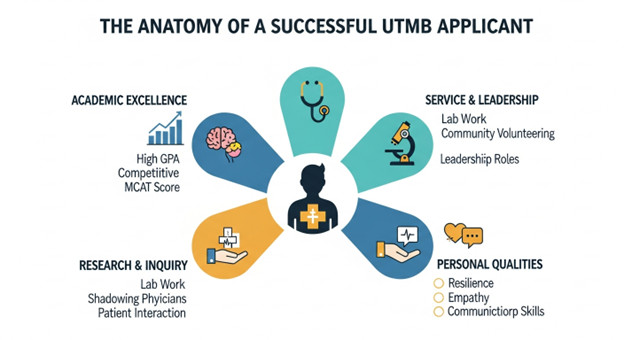
Beyond academics, UTMB Galveston seeks applicants who have a proven commitment to medicine and a demonstrated understanding of the healthcare profession through meaningful experiences. These experiences serve as evidence of an applicant’s maturity, empathy, and dedication. Key areas include:
- Clinical Experience: Shadowing physicians from various specialties and direct patient care roles (e.g., volunteering or working as an EMT, CNA, or medical scribe) are crucial. These experiences provide firsthand insight into the day-to-day realities of medical practice and patient interaction.
- Research Experience: Involvement in research, whether in a laboratory setting or through clinical research projects, demonstrates scientific curiosity, analytical skills, and an understanding of evidence-based medicine. UTMB, with its strong research focus, values applicants who have engaged in meaningful research endeavors.
- Volunteering and Community Service: Demonstrating a commitment to serving others, particularly underserved populations, is highly valued. Experiences that showcase empathy, compassion, and an understanding of societal health needs are particularly impactful.
- Leadership Roles: Holding leadership positions in student organizations, community initiatives, or professional settings can highlight an applicant’s ability to motivate others, manage responsibilities, and contribute to group success.
The quality and depth of these experiences are often considered more important than the sheer quantity. Applicants should be able to reflect thoughtfully on what they learned from each experience and how it shaped their desire to pursue medicine and attend UTMB.
Navigating the Application Journey: TMDSAS & Beyond
The Texas Medical & Dental Application Service (TMDSAS): Your Primary Portal
For applicants to medical schools in Texas, including UTMB Galveston, the Texas Medical & Dental Application Service (TMDSAS) serves as the centralized application portal. TMDSAS processes applications for all Texas public medical, dental, and veterinary schools. Applicants must create an account and complete the TMDSAS application thoroughly and accurately. This comprehensive application requires detailed information about academic history, extracurricular activities, work experience, volunteer work, research, awards, and personal essays. Submitting a complete and polished TMDSAS application on time is the foundational step in the admissions process. The application fee for TMDSAS is $70 and covers the initial processing of your application.
Letters of Recommendation: Building Your Support System
Letters of recommendation (LORs) provide admissions committees with external perspectives on an applicant’s character, academic abilities, and potential for success in medical school. UTMB Galveston requires a minimum number of letters, typically including a committee letter from your undergraduate institution if available, or a specified number of individual letters from faculty members and supervisors who know you well.
When selecting recommenders, choose individuals who can speak specifically about your strengths, such as your intellectual curiosity, work ethic, interpersonal skills, resilience, and commitment to medicine. Avoid asking individuals who know you only superficially. Provide your recommenders with ample time (at least 4-6 weeks) and all necessary materials, including your CV, personal statement, and information about UTMB’s mission and values. This will help them write a more personalized and compelling letter on your behalf.
The CASPer Test and Altus Suite: Assessing Non-Cognitive Skills
In addition to traditional application components, UTMB Galveston requires all applicants to complete the CASPer test and the Duet assessment, both administered through the Altus Suite. These assessments are designed to evaluate non-cognitive skills and personal characteristics that are crucial for success in medical school and as a physician. The CASPer test (Computer-based Assessment for Sampling Personalities) is a situational judgment test that presents hypothetical scenarios and asks applicants how they would respond. The Duet assessment focuses on assessing values and personality traits.
These tests evaluate competencies such as professionalism, empathy, resilience, ethical reasoning, and communication skills. They aim to provide a more holistic view of an applicant beyond academic metrics. Preparation for CASPer and Duet involves understanding the types of scenarios presented and reflecting on your own values and responses. Practicing with sample questions can help familiarize you with the format and types of questions asked, enabling you to articulate your thoughts clearly and thoughtfully.
Secondary Applications: Showcasing Your Specific Fit for UTMB
Once your primary TMDSAS application is reviewed and meets UTMB’s initial screening criteria, you will likely be invited to complete a secondary application. This is a critical opportunity to further elaborate on your qualifications and, most importantly, to demonstrate your specific interest in and fit with UTMB Galveston. The secondary application typically includes several essay prompts designed to assess your motivations, experiences, and understanding of UTMB.
These essays often delve into why you are interested in medicine, why you are choosing UTMB specifically, how your experiences align with the school’s mission and values, and how you would contribute to the UTMB community. This is where you can articulate your unique narrative, connect your past experiences to your future aspirations, and show that you have thoroughly researched UTMB and understand what makes it the right place for your medical education. Crafting thoughtful, authentic, and well-written responses is paramount.
Crafting a Compelling Application: Beyond the Numbers
Articulating Your “Why Medicine” and “Why UTMB” Narrative
The essays within your secondary application are your primary platform for conveying your personal story and motivations. Articulating a genuine and compelling “Why Medicine” is fundamental. This involves reflecting on the experiences that ignited your passion for healthcare and outlining how you envision yourself contributing to the profession. It’s not just about liking science; it’s about a deep-seated desire to serve others, to alleviate suffering, and to make a tangible difference in people’s lives.
Equally important is articulating a clear and specific “Why UTMB.” Generic statements will not suffice. Demonstrate that you have researched UTMB’s unique programs, its mission, its community engagement, and its research strengths. Connect these aspects to your own experiences, aspirations, and values. For instance, if UTMB emphasizes serving rural Texas communities and you have experience working with underserved populations, explain that connection. If UTMB’s research in infectious diseases resonates with your background, articulate that. A well-articulated narrative shows you are not just applying to any medical school, but specifically to UTMB because of a genuine alignment.
Demonstrating Alignment with UTMB’s Mission and Values
As previously noted, UTMB Galveston places significant emphasis on aligning with its core mission and values. This alignment should permeate your entire application, not just your essays. When describing your extracurricular activities, volunteer work, and clinical experiences, highlight aspects that directly reflect UTMB’s priorities. For example, if UTMB is committed to community health, showcase experiences where you have actively contributed to community well-being. If research is a key pillar, detail your research endeavors and their significance.
Use your essays to explicitly connect your actions and insights to UTMB’s stated mission. Discuss how your experiences have prepared you to contribute to their educational and research environment, and how you will embody their values of compassion, integrity, and service in your future practice. This demonstrates a deep understanding of what UTMB represents and a genuine desire to be a part of its community.
Showcasing Your Interpersonal Skills and Teamwork Abilities
Medicine is a collaborative profession. Admissions committees look for applicants who can work effectively with diverse teams and communicate compassionately with patients. Your application should provide evidence of strong interpersonal skills and teamwork. This can be demonstrated through:
- Group Projects: Highlight roles in academic group projects where you collaborated with peers, managed disagreements, and contributed to collective success.
- Team-Based Activities: Participation in team sports, clubs, or community organizations can showcase your ability to work cohesively with others towards a common goal.
- Leadership Roles: Demonstrating leadership often involves inspiring and guiding a team, requiring strong communication and interpersonal skills.
- Patient Interaction: Clinical and volunteer experiences where you interacted directly with patients are invaluable for showcasing empathy, active listening, and compassionate communication.
In your essays and interviews, be prepared to provide specific examples of situations where you utilized these skills, illustrating how you contribute positively to group dynamics.
Addressing Challenges and Growth in Your Application
No applicant’s journey is without its challenges. Admissions committees understand that setbacks are a part of life and offer opportunities for growth. Instead of avoiding or downplaying difficulties, present them as learning experiences. If you faced academic struggles, explain the circumstances and, more importantly, what you learned from the experience and how you improved. Did you have to overcome personal adversity? Detail the resilience and maturity you gained.
The AAMC notes that 709 students were over the age of 30 in the 2023-24 entering medical school class, indicating that successful applicants come from diverse life stages and may bring a wealth of varied experiences. Your application should reflect not just your accomplishments, but also your capacity for self-awareness, perseverance, and growth. Frame challenges as opportunities that have strengthened your resolve and deepened your understanding of yourself and your commitment to medicine.
Considerations for Out-of-State Applicants: Understanding UTMB’s Acceptance Rates
UTMB Galveston, like most Texas medical schools, prioritizes applicants who are Texas residents. While out-of-state applicants are considered, the number of available positions is significantly smaller, leading to lower acceptance rates for non-residents. UTMB has stated that international applicants who do not have permanent U.S. residency are not considered. Therefore, U.S. citizens who are out-of-state residents should be aware of this higher competitive hurdle.
For out-of-state applicants, it is even more crucial to present an exceptionally strong application that clearly demonstrates a unique fit with UTMB’s mission and values, and why UTMB is the absolute best place for their medical education. Highlighting extensive research collaborations, unique clinical experiences not available elsewhere, or a profound personal connection to UTMB’s specific mission can help an out-of-state applicant stand out. Understanding these dynamics is key to setting realistic expectations and tailoring your application strategy accordingly. The overall average acceptance rate for applicants to MD (allopathic) medical schools in 2024 was 44.58%, but this varies significantly by institution and residency status.
Mastering the UTMB Interview: Your Final Hurdle
Understanding the UTMB Medical School Interview Format
The interview is a pivotal stage in the UTMB Galveston admissions process. It provides the admissions committee with an opportunity to assess your interpersonal skills, critical thinking abilities, motivation, and suitability for the program beyond what is conveyed in your written application. While the exact format can evolve, interviews at UTMB typically involve interactions with faculty members, current medical students, or other members of the admissions committee.
Interviews may take various forms, including traditional one-on-one conversations or Multiple Mini Interviews (MMI). MMIs involve a series of short, independent stations where applicants encounter unique scenarios (e.g., ethical dilemmas, communication tasks, problem-solving exercises) and are assessed on their approach and response. Regardless of the format, the goal is to evaluate your composure, communication style, ethical reasoning, and your ability to think on your feet. Be prepared for questions that probe your motivations, experiences, understanding of medical ethics, and knowledge of UTMB.
Preparing for Common Interview Themes and Questions
Thorough preparation is essential for success in your UTMB interview. Common themes include:
- Motivation for Medicine: Why do you want to become a physician? What experiences have solidified this decision?
- Why UTMB? Why are you specifically interested in the John Sealy School of Medicine? What aspects of its mission, curriculum, or research align with your goals?
- Ethical Dilemmas: How would you handle a situation involving a conflict of interest, patient confidentiality, or end-of-life care?
- Teamwork and Collaboration: Describe a time you worked effectively in a team, or a time you faced challenges collaborating with others.
- Dealing with Stress and Adversity: How do you cope with pressure or failure? Provide an example.
- Understanding of Current Healthcare Issues: Be prepared to discuss relevant topics in medicine and healthcare.
- Personal Strengths and Weaknesses: What are your greatest assets, and what areas do you seek to improve?
Practice answering these types of questions aloud, either by yourself or with a study partner. Focus on providing thoughtful, specific, and honest responses, drawing from your experiences.
Tips for a Successful Interview Performance
To excel in your UTMB interview, consider the following tips:
- Research UTMB Thoroughly: Familiarize yourself with the school’s mission, values, curriculum, research strengths, and recent achievements. This will allow you to tailor your responses and demonstrate genuine interest.
- Practice Active Listening: Pay close attention to the interviewer’s questions and respond directly. Ask clarifying questions if needed.
- Be Authentic and Honest: Let your personality shine through. Admissions committees are looking for the real you.
- Provide Specific Examples: Instead of general statements, use the STAR method (Situation, Task, Action, Result) to illustrate your experiences and skills with concrete examples.
- Maintain Professionalism: Dress professionally, arrive on time (or log in early for virtual interviews), and exhibit positive body language.
- Articulate Clearly: Speak clearly and concisely, avoiding jargon unless appropriate.
- Ask Thoughtful Questions: Prepare a few insightful questions to ask the interviewer. This shows your engagement and interest.
- Follow Up: Send a brief, personalized thank-you note or email to your interviewer(s) within 24 hours.
After the Interview: What to Expect & Next Steps
Understanding UTMB’s Acceptance Notification Process
Following your interview, the admissions committee will deliberate and make decisions on your application. The notification process can vary, but typically, applicants will be informed of the admissions committee’s decision via email or through the TMDSAS portal. Decisions can include an acceptance, a waitlist status, or a rejection.
It is important to understand that acceptance to medical school is a competitive process, and the wait can be challenging. UTMB, like other institutions, may have rolling admissions, meaning decisions are made and offers extended throughout the application cycle. Be patient and await official communication.
Financial Considerations for Medical School
The financial commitment to medical school is substantial. The median education debt for medical school graduates from the Class of 2023 was $200,000. UTMB Galveston, like all institutions, offers financial aid packages, scholarships, and loan opportunities to help students manage these costs. Prospective students are encouraged to explore the financial aid section of UTMB’s website early in the application process. Understanding the financial implications and available resources is a crucial part of the decision-making process for accepted students.
Background Checks and Health Requirements
As part of the matriculation process, all accepted students are required to undergo a comprehensive background check. This is standard practice for medical schools, ensuring the safety and integrity of the learning environment and the patient population. UTMB utilizes services like CastleBranch for these checks, which may include criminal history verification. Additionally, students must meet specific health requirements, including immunizations and medical evaluations, to ensure they are fit for clinical duties. Adherence to these requirements is mandatory for enrollment.
Conclusion
The journey to admission at UTMB Galveston’s John Sealy School of Medicine is a demanding yet incredibly rewarding path. It requires a strategic approach that balances academic excellence with a deep understanding of the institution’s mission and values. By meticulously preparing for each stage – from building a strong academic foundation with excellent GPA and MCAT scores, to crafting a compelling application through TMDSAS, articulating your unique narrative in secondary essays, and demonstrating your suitability in the interview – you can significantly enhance your prospects. Remember that UTMB seeks individuals who are not only intelligent and capable but also compassionate, resilient, and driven by a genuine desire to serve. While the process is competitive, with approximately 54,699 people applying to U.S. medical schools in 2025, a 5.3% increase from 2024, a well-prepared and authentic applicant stands the best chance of achieving their goal. Embrace the challenge, highlight your unique contributions, and demonstrate your unwavering commitment to becoming a physician who embodies the esteemed legacy of UTMB.
Frequently Asked Questions About UTMB Galveston Medical School
1. What GPA do you need to get into University of Texas Medical Branch at Galveston?
Matriculants at the John Sealy School of Medicine at UTMB average a GPA of 3.87. Texas medical schools are highly competitive, and applicants below a 3.7 will face an uphill battle. Because UTMB draws almost entirely from the Texas applicant pool via TMDSAS, your GPA will be benchmarked against other high-achieving Texas residents. Both science (BCPM) and cumulative GPA matter, so sustained academic excellence is essential.
2. What MCAT score do you need for University of Texas Medical Branch at Galveston?
The average MCAT score for matriculants at UTMB is 513, which falls around the 83rd percentile nationally. Most successful applicants score in the 510–517 range. A score below 510 is a significant red flag given the competition from the Texas applicant pool, so aim for at least 511 before applying.
3. What is the acceptance rate at University of Texas Medical Branch at Galveston?
UTMB’s acceptance rate is approximately 4.22% for the 2025–2026 cycle, making it one of the more selective public medical schools in Texas. Out of roughly 5,450 applicants, about 230 students ultimately matriculate. While that number sounds daunting, UTMB does extend a comparatively large number of interview invitations relative to its class size, so a competitive application can realistically land you an invite.
4. How many people apply to University of Texas Medical Branch at Galveston each year?
Approximately 5,450 applicants apply to UTMB each admissions cycle through TMDSAS (Texas Medical and Dental Schools Application Service). Of those, 230 matriculate into the entering class — a ratio that underscores how important a strong primary application is for earning a secondary invitation. Because nearly all applications funnel through TMDSAS, UTMB competes with the other Texas public medical schools for the same qualified applicant pool.
5. Does University of Texas Medical Branch at Galveston accept out-of-state applicants?
UTMB does accept a small number of out-of-state applicants, but the vast majority of the class — approximately 90% — are Texas residents. Only about 10% of matriculants come from outside Texas. Non-residents should expect a significantly harder path to acceptance and should apply with MCAT and GPA credentials well above the school’s averages. Out-of-state tuition runs approximately $42,014 per year compared to $27,000 for Texas residents.
6. What is the interview format at University of Texas Medical Branch at Galveston?
UTMB uses a traditional interview format with one-on-one sessions conducted from August through December. As part of the supplemental application, all applicants must complete asynchronous video responses to two questions submitted via the Spark Hire platform — this serves as an early screening step before an in-person interview is offered. CASPer scores are also reviewed during the admissions process. The combination of Spark Hire video, CASPer, and traditional interviews gives the committee multiple data points on each candidate’s professionalism and communication skills.
7. What are the secondary essay prompts at University of Texas Medical Branch at Galveston?
UTMB’s supplemental application asks applicants to respond to two of six essay prompts. Topics include: describing a time you learned in a team and how it prepares you for medical school; describing a mistake you made; discussing a scientific inquiry experience; identifying qualities you look for in a physician and which you need to develop; reflecting on work experience and skills relevant to medicine; and explaining what specifically draws you to UTMB’s history, location, and mission on the Gulf Coast. The supplemental application deadline is November 6, 2026 at 8:00 AM CST, and it also includes the Spark Hire asynchronous video component.
8. How much does University of Texas Medical Branch at Galveston cost?
For the 2025–2026 academic year, tuition and fees at UTMB are approximately $27,000 per year for Texas residents and $42,014 per year for non-residents. Over the full four years of the MD program, total costs are estimated at $102,350 for in-state students and $161,190 for out-of-state students — these figures account for tuition, fees, and standard living expenses in Galveston. As a Texas public medical school, UTMB offers one of the more affordable paths to an MD degree in the country for Texas residents.
9. Is CASPer required to apply to University of Texas Medical Branch at Galveston?
Yes, CASPer is required for all applicants to the John Sealy School of Medicine at UTMB. CASPer is a situational judgment test administered through the Altus Suite platform that assesses professionalism, empathy, and ethical reasoning. For the 2027 entry year, the last accepted test date is October 20, 2026, so plan to sit for the exam well before the deadline. Admissions reviewers incorporate CASPer scores alongside your MCAT, GPA, and Spark Hire video responses when making decisions.
10. What makes the University of Texas Medical Branch at Galveston unique among medical schools?
Founded in 1891, UTMB is the oldest medical school in Texas and one of the oldest in the American Southwest, giving it more than 130 years of clinical and research heritage. Its island campus in Galveston has shaped a distinctive focus on disaster medicine, coastal and Gulf Coast health, and underserved community care — experience that became nationally visible after UTMB’s response to Hurricane Ike. The campus houses four on-site hospitals, including an affiliated Shriners Hospital for Children, providing students with unusually broad and high-acuity clinical exposure from day one.
11. What research opportunities are available at University of Texas Medical Branch at Galveston?
UTMB is home to the Galveston National Laboratory (GNL), one of only two non-military BSL-4 (Biosafety Level 4) research facilities in the United States, funded with a $150 million federal investment. The GNL allows researchers — including medical students — to study the world’s most dangerous pathogens in a secure environment, making UTMB a global leader in infectious disease and biodefense research. In 2026, UTMB also launched the Galveston Heart Study, a landmark long-term cardiovascular and brain health initiative tracking thousands of county residents, and entered a $9.5 million Blue Zones partnership to study longevity. Students interested in translational research, population health, or infectious disease will find exceptional mentored opportunities here.