
Your Path to Becoming a Physician at LKSOM
Embarking on the journey to become a physician is a significant undertaking, and for many aspiring medical professionals, the Lewis Katz School of Medicine (LKSOM) at Temple University represents a beacon of opportunity. Nestled in the vibrant heart of Philadelphia, LKSOM offers a rigorous academic environment, unparalleled clinical experiences, and a profound commitment to serving diverse urban communities. For those drawn to its distinctive mission and dedication to producing compassionate, skilled physicians, understanding the intricacies of the LKSOM admissions process is paramount. This comprehensive guide is meticulously crafted to demystify every aspect of applying to LKSOM, from understanding its core values and academic prerequisites to navigating the application gauntlet and excelling in the interview. We will delve into what makes LKSOM unique, what the admissions committee seeks in its future classes, and provide actionable strategies to help you present your strongest self. Whether you are just beginning to explore medical school options or are refining your application strategy, this guide will serve as your essential roadmap to gaining admission to the Lewis Katz School of Medicine.
This blog will cover:
- Your Path to Becoming a Physician at LKSOM
- Unpacking the LKSOM “Fit”: What Lewis Katz Seeks in Future Physicians
- Laying the Groundwork: Academic and Experiential Prerequisites for Success
- The Application Gauntlet: AMCAS, Secondary, and CASPer Deep Dive
- The Interview Stage: Showcasing Your Best Self to LKSOM
- Beyond the MD Program: Exploring LKSOM’s Diverse Pathways and Campus Locations
- Financial Planning for Your Medical Education
- Conclusion
Welcome to the Lewis Katz School of Medicine
The Lewis Katz School of Medicine at Temple University stands as a testament to innovation, community engagement, and academic excellence in medical education. Located in Philadelphia, LKSOM is dedicated to fostering physicians who are not only scientifically adept but also deeply committed to patient advocacy, public health, and addressing the health disparities prevalent in urban environments. The school’s rich history is interwoven with the fabric of its city, providing students with a unique educational experience that extends far beyond the traditional lecture hall. Through its robust research initiatives, cutting-edge clinical training, and emphasis on holistic patient care, LKSOM prepares its graduates to lead and innovate in the ever-evolving landscape of medicine. The Lewis Katz School of Medicine is more than an institution; it is a community dedicated to advancing health equity and delivering exceptional medical care.
What You’ll Find in This Guide
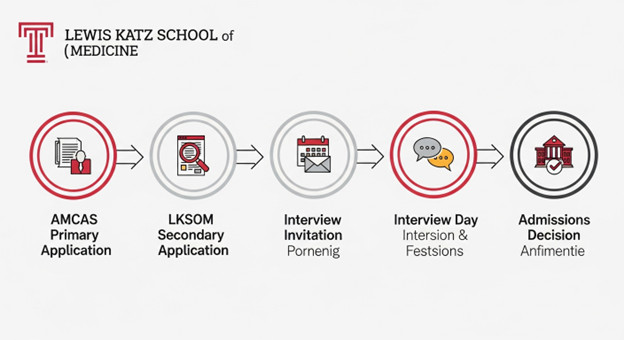
This guide is designed to be your definitive resource for navigating the LKSOM admissions process. We will systematically break down each critical component, offering clarity and strategic advice. You will find an in-depth exploration of LKSOM’s philosophy and the qualities it seeks in its applicants, ensuring you understand the crucial concept of “fit.” We will then outline the essential academic and experiential foundations necessary for a competitive application, including prerequisite coursework and the importance of the MCAT. A significant portion of this guide is dedicated to the application itself: the AMCAS primary application, the LKSOM-specific secondary application, the indispensable role of Letters of Recommendation, and the unique CASPer test. Furthermore, we will provide comprehensive strategies for preparing for and excelling in the interview stage. To offer a complete picture, we will also touch upon LKSOM’s diverse educational pathways beyond the traditional MD program and essential financial considerations. Finally, we will highlight important dates and resources to help you stay on track throughout your application journey.
Unpacking the LKSOM “Fit”: What Lewis Katz Seeks in Future Physicians
Securing a place in medical school, particularly at a distinguished institution like the Lewis Katz School of Medicine, requires more than just strong academic credentials. LKSOM actively seeks applicants who not only demonstrate intellectual prowess but also possess a deep-seated commitment to service, resilience, and a genuine passion for improving the lives of others, especially within underserved communities. Understanding what LKSOM defines as “fit” is foundational to crafting a compelling application. This involves aligning your personal experiences, values, and aspirations with the school’s mission and ethos. The admissions committee meticulously evaluates each applicant not merely as a collection of scores and experiences, but as a potential future physician who will embody LKSOM’s ideals and contribute meaningfully to the medical profession and society at large.
The Philosophy of Holistic Review in Action
At the heart of LKSOM’s admissions philosophy lies a commitment to holistic review. This means that the admissions committee goes beyond quantitative measures like GPA and MCAT scores to evaluate the entirety of an applicant’s background, experiences, and potential. The focus is on identifying individuals who demonstrate not only academic competence but also essential personal attributes and competencies crucial for success in medical school and as a practicing physician. This approach recognizes that medicine is a humanistic profession, requiring empathy, critical thinking, ethical judgment, and a dedication to lifelong learning. LKSOM’s holistic review ensures that its incoming classes are diverse, representing a wide range of backgrounds, perspectives, and life experiences, all united by a shared commitment to patient care and community well-being.
LKSOM’s Core Values and What They Mean for Applicants
The Lewis Katz School of Medicine is guided by a set of core values that shape its educational environment and define its expectations for its students and graduates. These values include excellence, compassion, innovation, integrity, diversity, and community impact. Applicants are encouraged to reflect on these values and consider how their own experiences and aspirations align with them. For instance, a demonstrated commitment to community service, particularly within urban or underserved populations, directly reflects LKSOM’s emphasis on community impact and compassion. Intellectual curiosity and a drive for innovation are crucial for those interested in LKSOM’s robust research opportunities. Integrity is paramount, expected in every aspect of an applicant’s academic and personal history. Diversity is celebrated, and applicants are encouraged to share how their unique backgrounds contribute to a richer learning environment. By understanding and articulating how your journey embodies these core values, you can powerfully demonstrate your fit with LKSOM.
Laying the Groundwork: Academic and Experiential Prerequisites for Success
A strong application to the Lewis Katz School of Medicine is built upon a solid foundation of academic achievement and meaningful experiential engagement. LKSOM seeks applicants who have not only excelled in their pre-medical studies but have also proactively sought out experiences that have shaped their understanding of medicine, patient care, and the healthcare system. This section details the crucial academic requirements and the types of experiences that will strengthen your application and prepare you for the rigors of medical school.
Essential Prerequisite Coursework
To ensure that all applicants possess the fundamental scientific knowledge required for medical school, LKSOM outlines specific prerequisite coursework. These typically include courses in biology, general chemistry, organic chemistry, physics, and mathematics (calculus and statistics). Specific requirements can vary, and it is imperative for applicants to consult the official LKSOM admissions website for the most current and detailed list of prerequisite courses. Beyond merely completing these courses, LKSOM looks for strong performance, indicated by competitive GPAs. Your academic transcripts serve as a critical document, reflecting your ability to handle the demanding scientific curriculum of medical school. Maintaining a high GPA throughout your undergraduate career is crucial, and demonstrating an upward trend can also be viewed favorably by the admissions committee.
The MCAT Exam: A Critical Standardized Assessment
The Medical College Admission Test (MCAT) is a cornerstone of the medical school application process, serving as a standardized measure of your knowledge and skills in areas vital to medical education. For the 2023 entering class, the average MCAT score for matriculants at LKSOM was 511, and the average GPA was 3.72. While these figures provide context, it’s important to remember that LKSOM employs holistic review. This means your MCAT score is evaluated alongside all other components of your application. Dedicated preparation is essential for the MCAT. Many applicants find success by utilizing comprehensive study guides, practice tests, and sometimes formal prep courses. The MCAT assesses critical thinking, problem-solving, and knowledge of scientific concepts and their application. A strong MCAT score demonstrates your readiness for the academic challenges ahead, but your preparation and approach to the exam also reflect your diligence and commitment.
Gaining Meaningful Clinical and Service Experiences
Beyond coursework and standardized tests, LKSOM places significant value on the depth and breadth of your clinical and service experiences. These experiences offer invaluable insights into the realities of patient care and the healthcare profession. Meaningful clinical experiences can include shadowing physicians across various specialties, volunteering in hospital settings, or engaging in direct patient care roles. The key is not merely to accumulate hours, but to seek out opportunities that allow for genuine interaction, observation, and reflection. Service experiences, especially those involving underserved communities or addressing health disparities, are particularly important given LKSOM’s mission. Such experiences demonstrate your commitment to altruism, empathy, and your understanding of the social determinants of health. Reflecting on these experiences, understanding what you learned, and how they influenced your decision to pursue medicine is crucial for your personal statement and interview responses.
Considering a Gap Year or Postbaccalaureate Program
For many applicants, pursuing a gap year or enrolling in a postbaccalaureate program can significantly enhance their application and preparation for medical school. A gap year offers a valuable opportunity to gain further clinical experience, engage in research, volunteer extensively, or explore other interests that may have been limited during undergraduate studies. This period can solidify your commitment to medicine and provide rich material for your application essays and interviews. Alternatively, a postbaccalaureate program can be beneficial for applicants who need to strengthen their academic record in prerequisite science courses or improve their GPA and MCAT scores. LKSOM itself offers the LKSOM ACMS Postbaccalaureate Program, designed to support individuals who wish to enhance their qualifications for medical school admission, particularly those from underrepresented backgrounds or those who have been out of school for some time. These pathways demonstrate foresight and a proactive approach to building a competitive application.
The Application Gauntlet: AMCAS, Secondary, and CASPer Deep Dive
Navigating the application process for the Lewis Katz School of Medicine involves several distinct stages, each requiring careful attention and strategic planning. The primary application submitted through AMCAS, followed by LKSOM’s supplemental application, and the CASPer test all serve as vital tools for the admissions committee to assess your qualifications and suitability for their MD program. Understanding the nuances of each of these components is essential for presenting a cohesive and compelling case for your admission.
The AMCAS® Application: Your Primary Submission
The American Medical College Application Service (AMCAS) is the centralized system for applying to most U.S. medical schools, including LKSOM. Your AMCAS application serves as the comprehensive foundation of your medical school application. It includes detailed sections on your biographic and demographic information, academic history, coursework, extensive work and activities (including volunteer work, research, and clinical experience), letters of recommendation, and a personal statement. Accuracy, completeness, and attention to detail are paramount. Ensure your coursework is accurately entered, your experiences are described with impact and reflection, and your personal statement is carefully crafted. This is the first impression the admissions committee will have of your application, and it’s crucial to present a polished and well-organized narrative. Your official transcripts will be verified against the coursework you list in AMCAS.
Crafting a Compelling Personal Statement
Your personal statement is your opportunity to tell your unique story and articulate your motivations for pursuing a career in medicine, and specifically, for applying to the Lewis Katz School of Medicine. This essay should go beyond a simple recitation of your experiences. It should weave a narrative that demonstrates your journey, your insights, and your passion for medicine. Reflect on the experiences that have shaped your decision to become a physician, highlighting moments of personal growth, challenges overcome, and profound learning. When tailoring your statement for LKSOM, consider how to connect your experiences and aspirations to the school’s mission, its commitment to Philadelphia, and its values. What drives you? What experiences have most profoundly impacted your desire to serve? Your personal statement is a critical component in showcasing your personality, resilience, and the unique perspective you will bring to LKSOM.
The Lewis Katz Supplemental Application (Secondary Application)
Once your AMCAS application is reviewed and deemed to meet LKSOM’s preliminary criteria, you will likely receive an invitation to complete the Lewis Katz School of Medicine’s supplemental application, often referred to as the secondary application. This is a critical stage where you can further demonstrate your specific interest in LKSOM and showcase how your background and goals align with the school’s unique mission and values. Secondary applications typically include specific essay prompts designed to elicit more detailed responses about your experiences, your understanding of LKSOM, and your perspectives on relevant healthcare issues, such as community health in urban settings. It is imperative to answer these prompts thoughtfully and thoroughly, tailoring each response specifically to LKSOM. Generic answers will not suffice. This is your chance to highlight your connection to Philadelphia, your commitment to serving diverse patient populations, and your understanding of the school’s specific programs and research opportunities.
Letters of Recommendation: Securing Impactful Endorsements
Letters of Recommendation (Letters of Recommendation) play a significant role in the holistic review process, offering the admissions committee insights into your character, abilities, and potential from individuals who know you well. LKSOM typically requires a certain number of Letters of Recommendation, often including at least one from a science professor and one from a non-science professor or a supervisor from a significant extracurricular or work experience. It is crucial to choose recommenders who can speak specifically and enthusiastically about your strengths, academic performance, work ethic, interpersonal skills, and potential for medical school. Provide your recommenders with ample time to write their letters and supply them with helpful materials such as your CV, personal statement, and specific information about LKSOM’s mission and values. This will enable them to write a more personalized and impactful endorsement that resonates with the admissions committee.
Mastering the CASPer Test: Demonstrating Your Situational Judgment
The CASPer test is an online, situational judgment test used by LKSOM and other medical schools to assess crucial non-cognitive skills and interpersonal characteristics important for success in medicine. These include qualities such as empathy, ethical reasoning, professionalism, communication skills, and self-awareness. The test involves a series of video-based scenarios, after which you are prompted to answer open-ended questions about how you would respond in those situations. CASPer is designed to complement traditional metrics like grades and MCAT scores by providing a window into your interpersonal judgment and decision-making abilities. To prepare, familiarize yourself with the test format, practice articulating your thoughts clearly and concisely under timed conditions, and be prepared to reflect on ethical dilemmas and interpersonal challenges. Authenticity is key; answer based on your genuine beliefs and values, demonstrating your readiness to navigate complex human interactions in a healthcare setting.
The Interview Stage: Showcasing Your Best Self to LKSOM
Receiving an invitation for an interview is a significant milestone in the LKSOM admissions process, indicating that the admissions committee sees strong potential in your application. This stage is your opportunity to directly engage with the school, articulate your motivations, and further demonstrate why you are an excellent fit for the Lewis Katz School of Medicine. Preparation and a genuine presentation of yourself are paramount to success during this critical phase.
Receiving an Interview Invitation: What Happens Next
Following the thorough review of your AMCAS application, secondary essays, and other submitted materials, selected applicants are invited for an interview. These invitations are typically extended via email and will provide details about the interview format (which may be virtual or in-person), the date and time, and any specific instructions. LKSOM interviews are designed to be a two-way street, allowing both the applicant and the school to assess mutual fit. You will have the chance to learn more about the program from faculty, current students, and potentially, even community members. It is essential to respond promptly to interview invitations and confirm your attendance.
Thorough Preparation for Success
Effective preparation is key to performing confidently and authentically during your LKSOM interview. Begin by thoroughly reviewing your own application – your personal statement, secondary essays, and descriptions of your experiences. Be ready to discuss any aspect in detail, providing further insights or elaborations. Research LKSOM extensively: understand its current initiatives, faculty research, curriculum structure, and its deep connection to the Philadelphia community. Prepare thoughtful questions to ask your interviewers; this demonstrates your engagement and genuine interest. Practice answering common interview questions, focusing on structuring your responses to be clear, concise, and reflective. Common themes include “Why medicine?”, “Why LKSOM?”, discussing your strengths and weaknesses, and elaborating on specific experiences that have shaped your journey.
Effectively Demonstrating Your “Fit” During the Interview
The interview is your prime opportunity to showcase the qualities that make you an ideal candidate for LKSOM. Beyond simply answering questions, focus on demonstrating your personality, your communication skills, and your alignment with the school’s values. Be prepared to discuss your commitment to service, particularly how you understand and can contribute to the health of Philadelphia’s diverse communities. LKSOM interviews often include interactions with community members, which is a unique aspect designed to assess your ability to connect with and understand the perspectives of those you will serve. Be genuine, enthusiastic, and thoughtful in your responses. Show that you are not only academically capable but also empathetic, resilient, and deeply motivated to become a physician who embodies the spirit of the Lewis Katz School of Medicine.
Beyond the MD Program: Exploring LKSOM’s Diverse Pathways and Campus Locations
The Lewis Katz School of Medicine at Temple University offers a variety of pathways to medical education, catering to diverse interests and career aspirations. While the traditional MD program is the primary focus, LKSOM provides specialized tracks and programs that allow students to tailor their educational experience and prepare for specific medical careers. Understanding these diverse opportunities can help prospective applicants identify the best fit for their goals.
Combined Degree Programs: MD/PhD
For applicants with a strong inclination towards medical research and a desire to contribute to scientific discovery, LKSOM offers a competitive MD/PhD program. This rigorous, dual-degree pathway is designed to train physician-scientists who will lead groundbreaking research initiatives and translate scientific findings into improved patient care. The program integrates comprehensive medical training with intensive doctoral research, preparing graduates for careers at the forefront of biomedical innovation. Applicants to the MD/PhD program typically demonstrate exceptional research experience and a clear passion for scientific inquiry alongside their commitment to medicine.
Early Assurance and Accelerated Pathways
LKSOM recognizes talented students with a demonstrated commitment to medicine and provides opportunities for early assurance and accelerated pathways. These programs are designed for highly qualified undergraduate students who have shown exceptional promise and dedication throughout their academic careers. Early assurance programs allow students to secure a conditional acceptance to medical school during their undergraduate studies, providing them with peace of mind and enabling them to focus on their continued academic and personal development. Accelerated pathways may offer streamlined routes for certain high-achieving individuals, enabling them to complete their medical education in a more concentrated timeframe.
LKSOM ACMS Postbaccalaureate Program
As mentioned previously, the LKSOM ACMS Postbaccalaureate Program is an invaluable resource for individuals seeking to enhance their qualifications for medical school admission. This program is particularly beneficial for those who may have had an indirect path to medicine, need to strengthen their science background, or wish to improve their academic record. It provides a supportive environment with access to LKSOM faculty, academic advising, and clinical exposure opportunities. This program underscores LKSOM’s commitment to fostering diversity within the medical profession and providing opportunities for a broader range of talented applicants to achieve their dreams of becoming physicians.
Exploring LKSOM’s Clinical Education Campuses
The clinical education at the Lewis Katz School of Medicine is primarily centered around its affiliated hospitals and clinics, most notably Temple University Hospital. Located in the heart of Philadelphia, these sites offer students unparalleled exposure to a wide spectrum of patient populations and medical conditions, reflecting the diverse urban environment the school serves. Rotations at Temple University Hospital and its associated facilities provide hands-on experience in a high-volume, academically-oriented healthcare system. This immersion in real-world clinical settings, under the guidance of experienced faculty and physicians, is fundamental to developing the practical skills and clinical judgment necessary for competent and compassionate medical practice. The unique challenges and rewards of practicing medicine in a major metropolitan area like Philadelphia are integral to the LKSOM experience.
Financial Planning for Your Medical Education
The pursuit of a medical degree is a significant financial investment. Understanding the costs involved and exploring available financial aid opportunities is a crucial step for all prospective medical students applying to LKSOM. Planning early and thoroughly can alleviate financial stress and ensure that your focus remains on your academic and professional development.
Understanding Tuition and Fees
The tuition and fees at the Lewis Katz School of Medicine are competitive, reflecting the high quality of education and the extensive resources provided. Prospective applicants are strongly encouraged to visit the official LKSOM Admissions website for the most up-to-date information on tuition, mandatory fees, estimated living expenses, and health insurance costs. These figures typically vary between in-state and out-of-state students and are subject to change annually. Beyond tuition, there are often additional costs associated with medical education, such as books, supplies, technology fees, and equipment required for clinical rotations. A clear understanding of these expenses is essential for creating a realistic financial plan.
Scholarships and Financial Aid Opportunities
LKSOM is committed to making medical education accessible and offers a range of scholarships and financial aid opportunities to help students manage the costs of their degree. These opportunities can include merit-based scholarships, need-based financial aid, and specific scholarships designated for students demonstrating particular talents or commitment to certain areas of medicine, such as primary care or service to underserved communities. Federal student loan programs are also a primary source of funding for many medical students. The Office of Financial Aid at LKSOM is a valuable resource for guidance on the application process for scholarships, federal aid, and understanding loan repayment options. Applicants are encouraged to complete the FAFSA (Free Application for Federal Student Aid) and any other required financial aid forms promptly to be considered for all available assistance.
Conclusion
Your journey to becoming a physician at the Lewis Katz School of Medicine is a challenging yet profoundly rewarding endeavor. This guide has aimed to provide a comprehensive overview of the LKSOM admissions process, demystifying its core values, academic prerequisites, and application components. By understanding what Lewis Katz seeks in its future physicians—a blend of academic excellence, unwavering compassion, innovative spirit, and deep commitment to community—you can strategically align your application with the school’s mission. From mastering the AMCAS and secondary applications to preparing effectively for the CASPer test and the crucial interview stage, each step is an opportunity to showcase your unique strengths and suitability for this esteemed institution. Remember that LKSOM values a holistic approach, seeking individuals who will not only excel academically but also contribute meaningfully to the diverse fabric of medicine and the Philadelphia community. We encourage you to use this guide as a starting point, delve deeper into LKSOM’s official resources, and approach your application with authenticity, dedication, and a clear vision for your future in medicine. Your path to LKSOM begins with careful planning, persistent effort, and a genuine demonstration of your passion for healing and service.
Frequently Asked Questions About Temple Lewis Katz School of Medicine
1. What GPA do you need to get into Temple University Lewis Katz School of Medicine?
The average GPA of matriculants at Lewis Katz School of Medicine is 3.79. While there is no published minimum, competitive applicants typically present a cumulative GPA of 3.6 or higher. Both science GPA and cumulative GPA are reviewed, so strong performance in prerequisite science courses is especially important. Applicants with a GPA below the median can still be competitive if supported by a high MCAT score and compelling clinical or research experience.
2. What MCAT score do you need for Lewis Katz School of Medicine at Temple University?
The average MCAT score for enrolled students at Lewis Katz is 512, which falls in approximately the 83rd percentile. There is no published minimum score, but most successful applicants score at or above 510. A strong MCAT paired with a mission-aligned application can improve your chances even if your score is slightly below the average. CASPer is also required and evaluates non-cognitive skills alongside the MCAT.
3. What is the acceptance rate at Lewis Katz School of Medicine?
The acceptance rate at Lewis Katz School of Medicine is approximately 1.59% for the 2025–2026 academic year. Out of roughly 14,278 applicants, 227 students ultimately matriculated. This makes Lewis Katz highly selective, though its holistic review process means that mission fit, community service, and personal background are weighed alongside academic metrics. Applicants who demonstrate a genuine commitment to urban health and underserved communities tend to stand out.
4. How many people apply to Lewis Katz School of Medicine each year?
Approximately 14,278 applicants applied to Lewis Katz School of Medicine for the 2025–2026 entering class. Of those, 227 students matriculated, reflecting an extremely competitive applicant pool. The school reviews applications holistically, meaning a large volume of applicants does not reduce your chances if your profile aligns with the school’s mission. Early submission of your AMCAS application and completing the secondary promptly are both strongly advised.
5. Does Lewis Katz School of Medicine accept out-of-state applicants?
Yes, Lewis Katz actively accepts out-of-state applicants. In the 2025–2026 matriculating class, 58.6% of students were from outside Pennsylvania, compared to 41.4% Pennsylvania residents. This means the majority of the entering class actually comes from out of state, making Lewis Katz a genuinely national program. Out-of-state applicants should note that tuition is slightly higher at $62,868 per year compared to $59,292 for Pennsylvania residents.
6. What is the interview format at Lewis Katz School of Medicine?
Lewis Katz uses a three-interview format conducted during interview days held September through April. All candidates complete a primary interview with a physician or PhD faculty member on the Admissions Committee, a secondary blind interview with a faculty or student committee member who has not reviewed the application materials, and a Community interview with a community representative. The interview day begins with an overview of the curriculum, clinical opportunities, and service learning programs. Both the North Philadelphia and St. Luke’s campuses host interview days.
7. What are the secondary essay prompts for Lewis Katz School of Medicine?
The Lewis Katz secondary application includes several prompts, each with a 2,000-character limit. Key prompts ask applicants to describe their specific interest in Lewis Katz School of Medicine, explain what makes them unique or how they will contribute to the Katz community, and describe their activities for the current gap year (June 2025 to June 2026). There is also a prompt about any participation in pathway or pipeline programs such as SHPEP, Diversity Scholars, or STEP-UP. The secondary application fee is $100, with FAP waivers available, and the deadline is January 15, 2026.
8. How much does it cost to attend Lewis Katz School of Medicine at Temple University?
Tuition for the MD program at Lewis Katz School of Medicine is $59,292 per year for Pennsylvania residents and $62,868 per year for out-of-state students for the 2025–2026 academic year. When living expenses, fees, and health insurance are factored in, total annual cost of attendance is typically higher. The school’s secondary application fee is $100, though AAMC Fee Assistance Program (FAP) waivers are accepted. Prospective students should explore Temple’s financial aid office and available scholarships early in the application process.
9. What is the urban health mission of Lewis Katz School of Medicine?
Founded in 1901, Lewis Katz School of Medicine has a deep-rooted commitment to serving the underserved communities of North Philadelphia, one of the most economically challenged urban areas in the United States. The school’s strategic plan, “Inspiring Excellence,” centers on aligning with communities, advancing health equity, and creating lasting social change through medical education and research. MD students engage in service learning alongside their clinical training, putting community-driven medicine at the heart of the curriculum. Applicants who demonstrate a genuine interest in primary care, health equity, or working in underserved urban settings are strongly aligned with the school’s mission.
10. What research opportunities are available at Lewis Katz School of Medicine?
Lewis Katz School of Medicine maintains a robust research enterprise focused on translating discoveries made in Philadelphia’s neighborhoods into real-world clinical solutions. Faculty investigators study complex diseases including cardiac disease, cancer, pulmonary conditions, neurodegeneration, and addiction, with a strong emphasis on community health-driven research. The school operates across three campuses in Pennsylvania and partners with Temple Health, providing students access to a large academic health system for clinical and research training. Students interested in a physician-scientist pathway can pursue dual-degree options and formal research tracks embedded within the MD curriculum.