
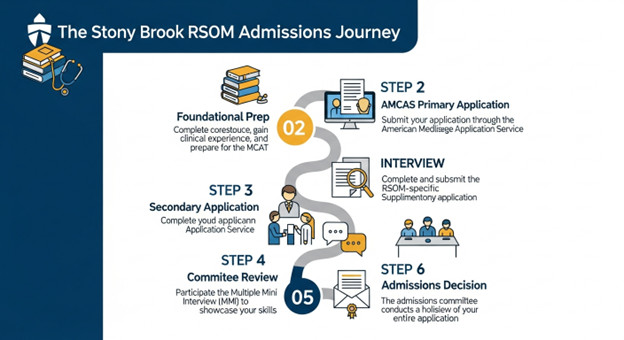
Embarking on the journey to become a physician is a profound commitment, and for many, the Stony Brook Renaissance School of Medicine (RSOM) represents a pinnacle aspiration. This esteemed institution, a vital component of Stony Brook University, offers a unique educational experience designed to cultivate not just competent doctors, but multifaceted, innovative thinkers ready to lead the future of healthcare. Navigating the intricate path to admission requires a strategic approach, a deep understanding of RSOM’s ethos, and meticulous preparation across every application stage. This guide serves as your comprehensive roadmap, demystifying the admissions process and illuminating the steps necessary to present your strongest candidacy for admission to this distinguished medical school. From foundational academic preparation to the nuances of the interview, we will explore each critical phase, empowering you with the knowledge to confidently pursue your dream of becoming a physician at the Renaissance School of Medicine.
This blog will cover:
- What Defines the “Renaissance” Ethos? Mission, Values, and Vision
- Why Stony Brook? Identifying Your Fit with RSOM’s Unique Approach
- Step 1: Building Your Foundational Profile (Pre-Application Preparation)
- Step 2: Navigating the Primary AMCAS Application
- Step 3: Mastering the Stony Brook Renaissance Secondary Application
- Step 4: Excelling in the Interview Process
- Step 5: Understanding RSOM’s Distinctive Curriculum and Clinical Training
- Step 6: Financial Planning and Post-Acceptance Steps
- Conclusion
Welcome to the Stony Brook Renaissance School of Medicine
Stony Brook University’s Renaissance School of Medicine (RSOM) stands as a beacon of excellence in medical education and research. Situated within the vibrant academic ecosystem of Stony Brook University, RSOM is renowned for its commitment to innovation, interdisciplinary collaboration, and the development of physicians who are not only scientifically adept but also deeply attuned to the humanistic aspects of medicine. The university‘s affiliation with the advanced facilities of Stony Brook University Hospital provides students with unparalleled opportunities for clinical exposure and hands-on training. RSOM’s mission extends beyond traditional medical training, aiming to foster physicians who can adapt to the evolving landscape of healthcare, embrace new knowledge, and contribute meaningfully to patient care and scientific advancement.
What Defines the “Renaissance” Ethos? Mission, Values, and Vision
The term “Renaissance” in RSOM’s name is more than a descriptor; it encapsulates a philosophy that drives the school’s approach to medical education. This ethos champions intellectual curiosity, a broad understanding across disciplines, and the integration of scientific inquiry with compassionate patient care. RSOM’s mission is to educate and train physicians and biomedical scientists to lead the advancement of health through excellence in education, research, and patient care. Its values emphasize diversity, equity, inclusion, lifelong learning, collaboration, and a commitment to serving the community. The vision is to be a premier medical school recognized for its innovative educational programs, cutting-edge research, and its graduates’ transformative impact on health and well-being. This philosophy aims to cultivate physicians who possess not only medical expertise but also the critical thinking, creativity, and adaptability characteristic of Renaissance thinkers, prepared to tackle complex challenges in medicine.
Why Stony Brook? Identifying Your Fit with RSOM’s Unique Approach
Choosing the right medical school is a deeply personal decision, and understanding RSOM’s unique offerings is paramount to assessing your fit. Stony Brook distinguishes itself through its integrated curriculum, robust research opportunities, and its strong connection to Stony Brook University Hospital, a major academic medical center. The institution fosters an environment where students are encouraged to explore diverse interests, engage in innovative research, and develop a holistic understanding of health and disease. If you are an applicant who thrives in a dynamic, intellectually stimulating environment, values interdisciplinary learning, and is motivated to contribute to advancements in medical education and patient care, Stony Brook’s Renaissance School of Medicine could be an exceptional choice. Prospective students are encouraged to delve into RSOM’s specific programs, faculty research, and community outreach initiatives to ascertain if its mission and values resonate with their personal and professional aspirations.
Step 1: Building Your Foundational Profile (Pre-Application Preparation)
The journey to medical school begins long before submitting an application. It starts with building a robust foundation that demonstrates your readiness for the rigorous demands of medical education and your unwavering motivation to become a physician. This preparatory phase involves excelling academically, mastering standardized tests, cultivating meaningful experiences, and clearly defining your personal narrative. It’s about showcasing a well-rounded profile that highlights not only your intellectual capabilities but also your character, resilience, and commitment to service.
Academic Excellence: Core Prerequisites and GPA Expectations
A strong academic record is fundamental for admission to any medical school. RSOM, like other institutions, expects applicants to have completed a rigorous undergraduate curriculum that provides a solid grounding in the sciences. Key prerequisite courses typically include general Biology, general Chemistry, organic Chemistry, and physics. Many programs also strongly recommend or require biochemistry, statistics, and advanced mathematics. Beyond completing these courses, maintaining a high Grade Point Average (GPA) is crucial. While RSOM does not publish specific GPA cutoffs, successful applicants generally possess GPAs that reflect a strong academic aptitude. In 2023-2024, medical school matriculants in the U.S. had a median undergraduate GPA of 3.85 AAMC, October 2023. Demonstrating excellence across your entire academic transcript, with a particular emphasis on your science GPA (sGPA), signals your ability to handle the demanding coursework at RSOM.
Mastering the Medical College Admissions Test (MCAT)
The MCAT is a standardized, multiple-choice examination that assesses your knowledge of scientific concepts and principles, as well as your critical reasoning and problem-solving abilities. It is a cornerstone of the admission process for medical school, and the AAMC (Association of American Medical Colleges) administers this vital test. Achieving a competitive MCAT score is essential. For the 2023-2024 application cycle, the mean MCAT score for matriculants to U.S. MD-granting medical schools was 511.7 AAMC, October 2023. Prospective applicants should aim to score within or above the average range for matriculants to ensure their score supports their application. Effective preparation involves creating a comprehensive study plan, utilizing practice tests, and focusing on all sections of the exam, including Chemical and Physical Foundations of Biological Systems, Critical Analysis and Reasoning Skills (CARS), Biological and Biochemical Foundations of Living Systems, and Psychological, Social, and Sociological Foundations of Behavior.
Cultivating Meaningful Extracurricular Experiences
Beyond academics and standardized tests, RSOM seeks individuals with diverse experiences that demonstrate commitment, leadership, and a genuine passion for healthcare. Extracurricular activities provide crucial insights into your character, your ability to work with others, and your understanding of the physician‘s role. These experiences should be meaningful and demonstrate sustained involvement rather than superficial participation. Key areas include:
- Clinical Experience: Direct patient interaction, shadowing physicians, volunteering in healthcare settings (e.g., hospitals, clinics, hospices). This shows your exposure to patient care and your understanding of clinical environments.
- Research Experience: Engaging in scientific research, whether laboratory-based or clinical, showcases your analytical skills, scientific curiosity, and potential to contribute to medical advancements.
- Volunteer Work: Community service and volunteer activities highlight your commitment to helping others and your understanding of societal needs.
- Leadership Roles: Taking on leadership positions in student organizations, clubs, or community initiatives demonstrates your ability to motivate others and manage responsibilities.
- Shadowing: Observing physicians in their daily practice provides invaluable insight into the realities of the profession and helps solidify your motivation.
The goal is to accumulate experiences that you can speak about with depth and reflection, illustrating lessons learned and personal growth.
Crafting Your Personal Narrative: Identifying Your “Why Medicine”
Your personal narrative, particularly your motivation for pursuing medicine, is a critical component that sets you apart. This involves introspection to understand precisely why you want to become a physician and how your life experiences have shaped this aspiration. RSOM, like all medical schools, looks for applicants who possess a deep-seated passion for healing, a commitment to service, and a clear understanding of the challenges and rewards of the medical profession. Reflect on pivotal moments, influential figures, or significant experiences that ignited your interest in medicine. Articulating this “why medicine” authentically will form the bedrock of your personal statement and subsequent application essays, providing a cohesive and compelling story of your journey.
Step 2: Navigating the Primary AMCAS Application
The primary AMCAS (American Medical College Application Service) application is the central portal through which most U.S. MD-granting medical schools receive their initial applicant information. Submitting a well-crafted and thorough AMCAS application is a critical step that requires meticulous attention to detail and a strategic approach to presenting your qualifications and experiences. This comprehensive document is your first formal introduction to the admissions committees, and it must effectively communicate your academic achievements, extracurricular involvement, and your core motivation for pursuing medical education.
Understanding the American Medical College Application Service (AMCAS)
The AMCAS system is managed by the AAMC and serves as the centralized processing service for applications to participating medical schools. It requires applicants to provide detailed information about their academic history, including transcripts from all undergraduate and graduate institutions attended, standardized test scores (MCAT), and extensive details about their extracurricular activities and achievements. The AMCAS application also includes a personal statement and requires the submission of letters of recommendation. Applicants must carefully review the AMCAS instructions and deadlines, as the timely and accurate submission of all required application materials is paramount. The admissions process relies heavily on the information provided through this platform.
Writing a Compelling Personal Statement
Your personal statement is arguably the most crucial essay within the AMCAS application. It’s your opportunity to tell your story, articulate your motivation for medicine, and connect your experiences to your aspirations of becoming a physician. Admissions committees at institutions like the Renaissance School of Medicine seek authenticity, introspection, and a clear demonstration of qualities such as empathy, resilience, leadership, and a commitment to service. Instead of simply listing your accomplishments, use this space to reflect on significant experiences and how they shaped your perspective and solidified your desire for a career in medicine. Focus on showing, not just telling, your qualities through narrative. A well-written personal statement can powerfully convey your unique journey and why you are a strong candidate for their medical school.
Securing Strong Letters of Recommendation
Letters of recommendation provide external validation of your skills, character, and potential. RSOM, like other medical schools, requires letters from individuals who can speak authoritatively about your academic abilities, work ethic, and personal attributes. Typically, you will need letters from science faculty who can attest to your performance in prerequisite courses (e.g., Chemistry, Biology) and potentially a pre-health advisor. You may also consider letters from supervisors of your extracurricular activities, such as research mentors, volunteer coordinators, or employers, who can speak to your character and contributions. It is crucial to provide your recommenders with ample time to write their letters, along with your CV, personal statement draft, and any specific guidelines from RSOM or AMCAS. Clear communication and thoughtful selection of recommenders are vital for obtaining supportive and insightful letters that strengthen your application materials.
Documenting Your Extracurricular Activities and Achievements
The AMCAS application provides a dedicated section for detailing your extracurricular activities, including clinical experience, research, volunteer work, leadership roles, and other significant involvements. This section requires concise yet impactful descriptions of your roles, responsibilities, the time commitment involved, and the impact or achievements realized. Each entry should highlight what you learned, how you grew, and how the experience contributed to your motivation for medicine and your understanding of the physician role. Be strategic in how you present these experiences, focusing on quality and depth over mere quantity. Admissions committees use this section to gauge your breadth of interests, your commitment to service, and your ability to apply your knowledge and skills in real-world settings, all of which are considered critical for admission to a medical school like Stony Brook.
Step 3: Mastering the Stony Brook Renaissance Secondary Application
Once your primary AMCAS application has been submitted and has passed initial screening, Renaissance School of Medicine at Stony Brook University may extend an invitation to complete their secondary application. This supplemental application serves as a crucial opportunity for RSOM to gain a deeper understanding of your specific fit with their institution’s mission, values, and unique “Renaissance” ethos. It allows you to tailor your responses directly to Stony Brook, demonstrating that you have thoughtfully considered why this particular medical school is the right place for your medical education.
The Purpose of the Supplemental Renaissance School of Medicine Application
The secondary application is not merely a formality; it is a vital component of the admissions process at RSOM. While the primary AMCAS application provides a broad overview of your qualifications, the supplemental essays and questions are designed to elicit more specific information about your background, experiences, interests, and your alignment with RSOM’s core principles. It’s where you can articulate your understanding of what it means to be a “Renaissance Physician” and demonstrate how your experiences and aspirations connect with Stony Brook’s commitment to innovation, interdisciplinary learning, and community service. Your responses here can significantly differentiate you from other applicants with similar primary application profiles, making it essential to approach it with as much care and strategic thinking as your personal statement.
Addressing Insightful Essay Questions with Depth and Authenticity
The essay questions on the supplemental RSOM application are carefully crafted to probe deeper into your thinking and character. They often touch upon your motivation for medicine, your understanding of societal health issues, your experiences with diversity, and your reasons for choosing Stony Brook specifically. When answering these prompts, it is imperative to be authentic, reflective, and specific. Connect your personal experiences and insights directly to the question asked, and whenever possible, link your responses back to the “Renaissance” ethos or RSOM’s mission. For example, if asked about a challenge you overcame, describe not only the challenge and your solution but also what you learned about yourself and how that learning prepares you for the rigors of medical education and the responsibilities of a physician. Thoroughly researching RSOM’s curriculum, faculty, and ongoing initiatives will enable you to provide more targeted and compelling answers that showcase your genuine interest and fit with the university.
The CASPer Examination: What It Is and How to Prepare
Some medical schools, including potentially RSOM (though it’s crucial to verify the most current requirements on their official admissions website), utilize the CASPer (Computer-Assisted Scrambling Performance) examination. CASPer is an online, standardized, situational judgment test designed to assess a variety of non-cognitive skills and attributes, such as ethics, empathy, professionalism, and resilience, which are crucial for success in medical education and as a physician. It typically involves responding to video-based scenarios and typing out answers to open-ended questions within a limited timeframe. Preparation for CASPer involves understanding its format, practicing answering situational questions thoughtfully, and focusing on articulating your reasoning process clearly and ethically. Familiarizing yourself with the competencies CASPer aims to evaluate and engaging in mock scenario responses can help you feel more prepared and confident on test day. Please note: For the 2024-2025 application cycle, RSOM has indicated that CASPer is NOT required. Applicants should always confirm the most up-to-date testing requirements directly with the Renaissance School of Medicine admissions office.
Step 4: Excelling in the Interview Process
The interview represents a pivotal stage in the admissions process for the Renaissance School of Medicine. It is your opportunity to move beyond the written application materials and demonstrate your personality, communication skills, critical thinking, and suitability for RSOM’s unique approach to medical education. Admissions committees use the interview to gain a more personal impression of you, assessing your motivation, your ability to think on your feet, and how well you would integrate into their community of aspiring physicians. Approaching the interview with thorough preparation and a confident, authentic demeanor is essential for success.
Understanding the Stony Brook Renaissance School of Medicine Interview Format
The specific format of the interview at RSOM can vary from year to year, but it is designed to provide a comprehensive assessment of each candidate. Historically, many medical schools have employed traditional one-on-one interviews or Multiple Mini Interviews (MMI). The MMI format, common in medical school admissions, presents candidates with a series of independent stations, each with a unique scenario that requires a verbal response or a role-playing interaction. These scenarios often assess critical thinking, problem-solving, communication skills, ethical reasoning, and self-awareness. Regardless of the specific format, the overarching goal is to evaluate your readiness for the demands of medical school and the profession of a physician. It’s important to check the RSOM admissions website for the most current details regarding their interview structure.
Comprehensive Interview Preparation
Thorough preparation is key to performing well in your interview. Begin by revisiting your own AMCAS application and secondary essays to refresh your memory on the experiences and insights you’ve presented. Deeply understand RSOM’s mission, values, and curriculum—particularly the “Renaissance” ethos and the LEARN model. Be prepared to articulate why you are specifically interested in Stony Brook and how your goals align with their program. Practice answering common interview questions, such as “Why medicine?”, “Why RSOM?”, and behavioral questions (e.g., “Tell me about a time you faced a challenge”). Utilize the STAR method (Situation, Task, Action, Result) to structure your responses to behavioral questions effectively. Engage in mock interviews with peers, mentors, or pre-health advisors to refine your delivery, time management, and confidence.
Presenting Yourself Professionally
Your presentation during the interview is as important as the content of your answers. Maintain a professional demeanor, which includes appropriate attire, good posture, and attentive listening. Speak clearly and concisely, making eye contact with your interviewer(s). While authenticity is paramount, demonstrating enthusiasm and genuine interest in the Renaissance School of Medicine and the university is crucial. Be respectful, polite, and engage thoughtfully with any questions posed. Remember that the interview is a two-way street; it’s also your opportunity to assess if RSOM is the right fit for you. Prepare insightful questions to ask the interviewer about the medical school, its programs, or student life.
Post-Interview Etiquette and Follow-Up
Following your interview, sending a timely and personalized thank-you note is a professional courtesy that can leave a positive lasting impression. This can be an email sent within 24 hours of your interview. Reiterate your continued interest in the Renaissance School of Medicine and briefly mention something specific you discussed or learned that reinforced your desire to attend. Avoid lengthy reiterations of your application. Focus on expressing gratitude for the interviewer’s time and the opportunity to learn more about RSOM. Maintain professionalism throughout this process, as all interactions contribute to the admissions committee’s overall assessment of your candidacy for admission to medical school.
Step 5: Understanding RSOM’s Distinctive Curriculum and Clinical Training
A critical aspect of evaluating your fit with the Renaissance School of Medicine involves understanding its innovative curriculum and extensive clinical training opportunities. RSOM is committed to providing a medical education that is not only comprehensive in its scientific foundation but also forward-thinking in its pedagogical approach. This includes integrated learning experiences, robust research opportunities, and hands-on training at prominent healthcare facilities, most notably Stony Brook University Hospital.
The LEARN Curriculum: A Modern Approach to Medical Education
The Renaissance School of Medicine employs the LEARN (Learning Environment for Academic Research and Discovery) curriculum, a modern, integrated approach to medical education. This model is designed to move beyond traditional discipline-based learning, fostering a deeper understanding of complex biological systems and disease processes. The curriculum emphasizes active learning, problem-based learning, and the early integration of clinical concepts and patient encounters. By emphasizing scientific discovery and research from the outset, the LEARN curriculum aligns with the “Renaissance” ethos, preparing students to be lifelong learners and innovators. This approach is designed to equip future physicians with the critical thinking and problem-solving skills necessary to navigate the evolving landscape of modern medicine.
Extensive Clinical Training Sites and Strategic Partnerships
Stony Brook’s affiliation with Stony Brook University Hospital, a Level 1 Trauma Center and one of the nation’s leading academic medical centers, provides RSOM students with invaluable clinical training. This large, tertiary care facility serves a diverse patient population, exposing students to a wide spectrum of medical conditions and healthcare challenges. Beyond the main hospital, RSOM leverages partnerships with various clinics and healthcare facilities across Long Island, offering students broad exposure to different healthcare settings and patient demographics. This comprehensive clinical training ensures that graduates are well-prepared to provide compassionate and effective care in a variety of environments, fulfilling the mission to train capable physicians.
Research Opportunities and Advanced Medical Education
Stony Brook University is a powerhouse in research, and RSOM actively integrates research into its medical education. Students are encouraged to participate in research projects under the guidance of leading faculty, contributing to scientific advancements in areas ranging from basic sciences to clinical and translational research. This emphasis on research fosters a spirit of inquiry and critical thinking, essential qualities for a “Renaissance Physician.” Opportunities abound for students to present their findings at conferences and even publish their work, offering a significant advantage for those interested in academic medicine or specialized fields. This commitment to advanced medical education extends beyond the classroom, preparing graduates for competitive residency programs and impactful careers.
Technical Standards for Admission and Progression
To ensure that all graduates of the Renaissance School of Medicine can meet the demands of the medical profession, RSOM maintains specific technical standards for admission and progression. These standards outline the essential abilities and qualities required of students to successfully complete the curriculum and become competent physicians. They generally encompass abilities in observation, communication, motor function, intellectual-conceptualization, integrated reasoning, and behavior/social judgment. Prospective applicants should review these technical standards carefully on the RSOM website to confirm they can meet these essential requirements, ensuring they are well-suited for the rigorous demands of medical school.
Step 6: Financial Planning and Post-Acceptance Steps
The culmination of a successful application to medical school is an offer of admission. However, this exciting milestone also brings practical considerations, particularly regarding financial planning and the steps required before matriculation. Understanding the costs associated with medical education at Stony Brook University and exploring available financial aid options is a crucial part of preparing for this significant investment in your future as a physician.
The cost of attending medical school can be substantial, encompassing tuition, fees, living expenses, books, and equipment. For the 2023-2024 academic year, published tuition and fees for in-state MD students at Stony Brook University’s Renaissance School of Medicine were approximately $42,200, with out-of-state tuition significantly higher at around $62,200, excluding living expenses and other costs. These figures highlight the importance of proactive financial planning.
Prospective students should thoroughly explore all avenues of financial assistance. This includes applying for federal student aid (FAFSA), researching institutional scholarships offered by RSOM and Stony Brook University, and investigating external scholarships from various organizations. While a significant number of medical students receive financial aid, understanding the nuances of loans, grants, and scholarships is paramount. For instance, in 2024-25, a substantial portion of medical school matriculants received financial aid [Stony Brook University data is not explicitly provided here, but general trends indicate high reliance on aid]. Navigating this landscape requires careful research and timely applications.
Upon receiving an offer of admission, candidates will typically have a defined period to accept or decline. This period often involves submitting a deposit to secure your place. You may also have the option to defer your admission, though this is usually granted under specific circumstances. RSOM will provide a checklist of post-acceptance requirements, which often include background checks, immunizations, health insurance verification, and any necessary pre-matriculation coursework or orientation activities. Successfully completing these steps ensures a smooth transition into your medical education at Stony Brook. Preparing for medical school involves not only academic readiness but also a solid financial footing and understanding of the administrative requirements that follow acceptance.
Conclusion
The path to admission at the Stony Brook Renaissance School of Medicine is a structured yet deeply personal journey, demanding dedication, strategic preparation, and a clear articulation of your motivation to become a physician. From meticulously building your foundational profile with strong academic performance in Chemistry and Biology and excelling on the MCAT administered by the AAMC, to thoughtfully navigating the AMCAS application, crafting compelling secondary essays, and mastering the interview, each step plays a crucial role. Understanding the unique “Renaissance” ethos, the innovative LEARN curriculum, and the extensive clinical training opportunities at Stony Brook University Hospital is vital for demonstrating your genuine fit. While the competitive landscape for medical school admission continues to evolve, with metrics like the mean MCAT score around 511.7 for matriculants AAMC, October 2023 and a median GPA of 3.85 AAMC, October 2023, success hinges on presenting a holistic profile that showcases not only your intellectual prowess but also your character, resilience, and unwavering commitment to medical education and patient care. The U.S. faces a projected physician shortage of up to 86,000 by 2036 AAMC, March 2024, underscoring the critical need for dedicated individuals like you to enter the field. By approaching each stage with foresight and authenticity, you can effectively present yourself as a strong candidate ready to contribute to the esteemed community at Stony Brook University.
Frequently Asked Questions About Stony Brook Renaissance School of Medicine
1. What GPA do you need to get into Stony Brook University Renaissance School of Medicine?
The average GPA for matriculants at the Renaissance School of Medicine at Stony Brook University is 3.93. This is above the national average for accepted medical students and above the average for New York medical schools. Both science (BCPM) and cumulative GPA are evaluated, so a strong upward trend or high science GPA can support your application. Competitive applicants typically have a GPA of 3.8 or higher.
2. What MCAT score do you need for Stony Brook University Renaissance School of Medicine?
The average MCAT score for matriculants at Stony Brook Renaissance School of Medicine is 516, which falls in approximately the 92nd percentile. This score reflects the school’s highly selective admissions process and its research-intensive academic environment. Applicants scoring below 514 should consider whether Stony Brook is a realistic target, while those at or above 516 are competitive. Strong section balance is preferred alongside a high total score.
3. What is the acceptance rate at Stony Brook University Renaissance School of Medicine?
The acceptance rate at Stony Brook University Renaissance School of Medicine is approximately 2.5%, making it one of the more selective public medical schools in the country. In a recent admissions cycle, roughly 141 students matriculated from a pool of approximately 5,689 applicants. The school’s strong preference for New York State residents further narrows the effective acceptance rate for out-of-state applicants. Early and complete applications improve your odds in this competitive pool.
4. How many people apply to Stony Brook University Renaissance School of Medicine each year?
Approximately 5,689 applicants submit primary applications to the Renaissance School of Medicine at Stony Brook University each admissions cycle. The school receives a high volume of applications relative to its class size, which is typical for well-regarded public medical schools in the Northeast. Of these thousands of applicants, only a small fraction receive secondary application invitations and advance to the interview stage. Starting your AMCAS application early in June is strongly recommended to remain competitive.
5. Does Stony Brook University Renaissance School of Medicine accept out-of-state applicants?
Stony Brook Renaissance School of Medicine does accept out-of-state applicants, but as a New York State public medical school it gives significant preference to New York residents. The majority of each entering class is composed of in-state students, and out-of-state applicants face considerably lower acceptance rates. Out-of-state tuition is $73,608 per year compared to $50,958 for New York residents (2025–2026 figures). Out-of-state applicants with exceptionally strong stats and compelling ties to New York or the school’s mission are most competitive.
6. What is the interview format at Stony Brook University Renaissance School of Medicine?
Stony Brook Renaissance School of Medicine uses a traditional interview format rather than Multiple Mini Interviews (MMI). Interviews are conducted with faculty and/or current students and are generally described by applicants as low-stress and conversational. The interview day includes tours of the campus and Stony Brook University Hospital, providing a strong impression of the school’s facilities and clinical environment. Applicants invited to interview should prepare to discuss their motivation for medicine, experiences, and alignment with the school’s research-oriented mission.
7. What are the secondary essay prompts at Stony Brook University Renaissance School of Medicine?
Stony Brook’s secondary application includes three 500-word essays. The first asks whether your education will be continuous from college to medical school — if yes, describe your proudest accomplishment; if no, explain your gap year plans. The second prompt asks how your past experiences and/or challenges have defined you. The third prompt offers a choice between two questions: your career goals and how you plan to achieve them, or a description of a time you faced an ethical or professional dilemma. Each essay carries significant weight, so well-crafted, specific responses are essential.
8. How much does Stony Brook University Renaissance School of Medicine cost?
For the 2025–2026 academic year, tuition and fees at the Renaissance School of Medicine are $50,958 per year for New York State residents and $73,608 per year for non-residents. When factoring in living expenses, health insurance, and other fees, total cost of attendance is substantially higher — typically exceeding $80,000–$100,000 annually. As a public university, Stony Brook offers more affordable tuition for NY residents compared to private medical schools. Financial aid, scholarships, and federal loans are available through the university’s financial aid office.
9. Is CASPer required to apply to Stony Brook University Renaissance School of Medicine?
Yes, CASPer (Computer-Based Assessment for Sampling Personal Characteristics) is required for all applicants to the Renaissance School of Medicine at Stony Brook University. Successful completion of CASPer is mandatory in order to maintain admission eligibility — incomplete results will disqualify your application. CASPer is a situational judgment test that assesses professionalism, empathy, and ethical reasoning through written and video-response scenarios. Applicants should register for CASPer early in the cycle through Altus Suite and allow processing time for scores to be distributed to the school.
10. What research opportunities are available at Stony Brook University Renaissance School of Medicine?
Stony Brook Renaissance School of Medicine is a research powerhouse, generating over $250 million in funded research during the 2022–2023 academic year alone. Research programs span neurological diseases, cancer, cardiovascular disorders, biomedical imaging, regenerative medicine, and infectious diseases. The school also offers a combined MD-PhD program (MSTP) for students committed to physician-scientist careers, with full funding including stipend and tuition. The school’s affiliation with Stony Brook University — a flagship research institution and member of the Association of American Universities (AAU) — provides students with access to cutting-edge labs and faculty across disciplines.